
This problem requires calculating the time taken for sound waves to travel a certain distance, given their speed. We will use the fundamental formula relating speed, distance, and time, and ensure all units are consistent before calculation.
Identify the given values:
Convert units to be consistent: The speed is given in meters per second (m/s), so the distance should also be in meters. Convert kilometers to meters:
\[ 1 \text{ km} = 1000 \text{ m} \]\[ d = 7 \text{ km} = 7 \times 1000 \text{ m} = 7000 \text{ m} \]Recall the formula for speed, distance, and time:
\[ \text{Speed} = \frac{\text{Distance}}{\text{Time}} \]Rearrange the formula to solve for Time:
\[ \text{Time} = \frac{\text{Distance}}{\text{Speed}} \]Substitute the values and calculate the time:
\[ \text{Time} = \frac{7000 \text{ m}}{700 \text{ m/s}} \]\[ \text{Time} = 10 \text{ s} \]Correct Option: D) 10 s
The problem involves calculating the total age of students based on their average age before and after some students leave. We will use the formula for average, which is the sum of quantities divided by the number of quantities, to find the total age at different stages.
Calculate the initial total age of all students:
Given that there are 10 students and their average age is 16 years.
Determine the number of remaining students:
Two students left the class.
Calculate the total age of the remaining students:
The average age of the remaining 8 students is 16.25 years.
Identify the required value:
The question asks for the total age of the students left (meaning the remaining students).
From step 3, we found this to be 130 years.
C) 30 years — The question asks for the total age of the students who left, not the remaining students. Let's re-evaluate the question carefully. The question asks: "What is the total age of the students left?" This can be interpreted in two ways: (1) the students who remained, or (2) the students who departed. Given the options, it seems the question is asking for the total age of the students who departed.
Total age of students who left = Initial Total Age - Total Age of Remaining Students
\[ \text{Total Age of Students Who Left} = 160 - 130 = 30 \text{ years} \]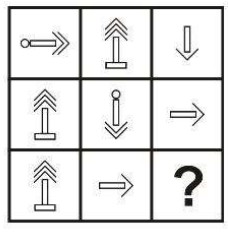
Choose the correct picture that replaces the symbol (?) above from the options given below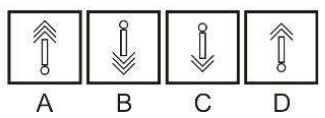
The question involves identifying the pattern in a 3x3 grid and selecting the correct option to replace the question mark.
Correct Option: D) The arrow points up, completing the pattern.
To identify a co-prime pair, we need to understand the definition of co-prime numbers. Two numbers are co-prime (or relatively prime) if their greatest common divisor (GCD) is 1. This means they share no common prime factors.
Correct Option: A) (16, 25) is the co-prime pair because their greatest common divisor is 1.
We need to determine the relationship between Y and X. We are given that X is Y's brother and Z is the mother of Y. The gender of Y is unknown. We will analyze each statement individually and then in combination to see if it helps determine Y's gender, which is crucial for answering the question.
Analyze the initial information:
Analyze Statement 1: Z has only 1 son and 1 daughter.
Analyze Statement 2: X is the only son of V who has 2 children.
Since both Statement 1 alone and Statement 2 alone are sufficient to determine the relationship between Y and X, the answer is that either statement alone is sufficient.
Correct Option: D) Either 1 or 2 alone is sufficient
Find the odd man out: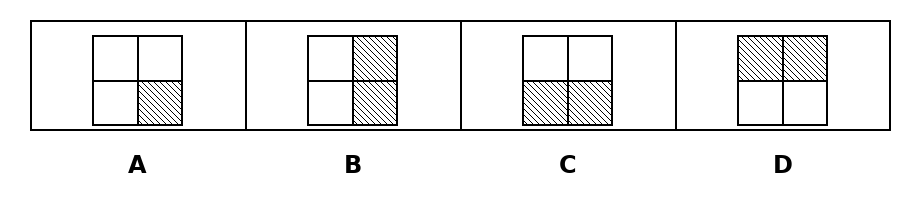
The task is to identify the pattern among the given diagrams and find the one that does not fit with the others. Each option consists of a square divided into four smaller squares, with some squares shaded.
Thus, option D is the odd one out because its shading pattern is different from the consistent pattern seen in options A, B, and C.
Correct Option: D) The shading pattern is different.
Find the rate of discount when the marked price is Rs 1,880 and selling price is Rs 1,598.
To find the rate of discount, we first need to calculate the discount amount, which is the difference between the marked price and the selling price. Then, the discount rate is calculated as a percentage of the marked price.
The discount is the reduction from the marked price to arrive at the selling price.
\[ \text{Discount} = \text{MP} - \text{SP} \]\[ \text{Discount} = 1880 - 1598 \]\[ \text{Discount} = 282 \]The rate of discount is expressed as a percentage of the marked price.
\[ \text{Rate of Discount} = \left( \frac{\text{Discount}}{\text{MP}} \right) \times 100\% \]\[ \text{Rate of Discount} = \left( \frac{282}{1880} \right) \times 100\% \]\[ \text{Rate of Discount} = 0.15 \times 100\% \]\[ \text{Rate of Discount} = 15\% \]D) 15% is the correct rate of discount calculated from the given marked price and selling price.
Pipes A and B can fill a water tank in 30 and 45 minutes respectively while pipe C can take out all the water in 60 minutes. If the three pipes are opened simultaneously, how long will it take to fill the empty tank?
(25 + \( \frac{5}{7} \)) min
60 min
(34 + \( \frac{1}{2} \)) min
(18 + \( \frac{5}{7} \)) min
To solve this problem, we need to determine the combined rate of work of the three pipes. Pipes A and B fill the tank, so their rates are positive. Pipe C empties the tank, so its rate is negative. We will calculate the fraction of the tank filled or emptied by each pipe in one minute and then sum these rates to find the net rate. Finally, we will find the reciprocal of the net rate to get the total time required to fill the tank.
Correct Option: A) \((25 + \frac{5}{7})\) min
A bullet, of mass 20 g, is horizontally fired with a velocity 150 m/s from a pistol of mass 2.5 kg. What is the recoil velocity of the pistol?
This problem can be solved using the principle of conservation of linear momentum. In an isolated system, the total momentum before an event is equal to the total momentum after the event. Here, the system consists of the pistol and the bullet. Initially, both are at rest, so the total momentum is zero. After firing, the bullet moves forward, and the pistol recoils backward. By applying the conservation of momentum, we can find the recoil velocity of the pistol.
Identify the given values:
Apply the principle of conservation of linear momentum:
The total momentum before firing is equal to the total momentum after firing.
\[ m_b u_b + m_p u_p = m_b v_b + m_p v_p \]Where \(v_p\) is the recoil velocity of the pistol.
Substitute the initial conditions:
Since both the bullet and the pistol are initially at rest, their initial velocities are zero.
\[ (0.020 \text{ kg})(0 \text{ m/s}) + (2.5 \text{ kg})(0 \text{ m/s}) = (0.020 \text{ kg})(150 \text{ m/s}) + (2.5 \text{ kg}) v_p \] \[ 0 = (0.020 \text{ kg})(150 \text{ m/s}) + (2.5 \text{ kg}) v_p \]Calculate the momentum of the bullet after firing:
\[ (0.020 \text{ kg})(150 \text{ m/s}) = 3 \text{ kg m/s} \]Solve for the recoil velocity of the pistol (\(v_p\)):
\[ 0 = 3 \text{ kg m/s} + (2.5 \text{ kg}) v_p \] \[ (2.5 \text{ kg}) v_p = -3 \text{ kg m/s} \] \[ v_p = \frac{-3 \text{ kg m/s}}{2.5 \text{ kg}} \] \[ v_p = -1.2 \text{ m/s} \]The negative sign indicates that the recoil velocity of the pistol is in the opposite direction to the bullet's velocity.
Correct Option: C) –1.2 m s -1
The question asks for the physical quantity for which 'Coulomb' is the SI unit. We need to recall the SI units for the given options.
Based on these definitions, Coulomb is the SI unit of electric charge.
Correct Option: B) Electric charge. The Coulomb (C) is the SI unit for electric charge.