
The problem requires us to find the correct sequence of mathematical operators (\(+\), \(-\), \(\times\), \(\div\)) to replace the blanks in the given equation so that the Left Hand Side (LHS) equals the Right Hand Side (RHS). We will test each option by substituting the given operators into the equation and performing the calculations according to the order of operations (BODMAS/PEMDAS).
The given equation is \(4\_9\_3\_4 = 16\).
Substitute the operators into the equation:
\[ 4 \div 9 + 3 \times 4 \]Perform division first:
\[ \frac{4}{9} + 3 \times 4 \]Perform multiplication:
\[ \frac{4}{9} + 12 \]Add the terms:
\[ \frac{4 + 108}{9} = \frac{112}{9} \]Since \(\frac{112}{9} \neq 16\), Option A is incorrect.
Substitute the operators into the equation:
\[ 4 \times 9 + 3 \div 4 \]Perform multiplication:
\[ 36 + 3 \div 4 \]Perform division:
\[ 36 + \frac{3}{4} \]Add the terms:
\[ \frac{144 + 3}{4} = \frac{147}{4} \]Since \(\frac{147}{4} \neq 16\), Option B is incorrect.
Substitute the operators into the equation:
\[ 4 \times 9 \div 3 + 4 \]Perform multiplication and division from left to right. First, multiplication:
\[ 36 \div 3 + 4 \]Then, division:
\[ 12 + 4 \]Perform addition:
\[ 16 \]Since \(16 = 16\), the LHS equals the RHS. Option C is correct.
Substitute the operators into the equation:
\[ 4 \div 9 \times 3 + 4 \]Perform division first:
\[ \frac{4}{9} \times 3 + 4 \]Perform multiplication:
\[ \frac{12}{9} + 4 = \frac{4}{3} + 4 \]Add the terms:
\[ \frac{4 + 12}{3} = \frac{16}{3} \]Since \(\frac{16}{3} \neq 16\), Option D is incorrect.
C) \(\times, \div, +\)
The given series consists of terms that combine a number and a letter. We need to identify the pattern for both the numerical part and the alphabetical part separately to find the missing term.
The numbers in the series are 20, 22, 24, 26.
The numerical part is increasing by 2 in each step. So, the next number in the series will be \(26 + 2 = 28\).
The letters in the series are P, N, L, J.
Let's find their positions in the English alphabet (A=1, B=2, ..., Z=26):
The alphabetical part is decreasing by 2 positions in each step:
So, the next letter in the series will be the letter that is 2 positions before J. The 10th letter is J, so the 8th letter will be \(10 - 2 = 8\). The 8th letter in the alphabet is H.
The next number is 28 and the next letter is H. Therefore, the missing term is 28H.
Correct Option: C) 28H
Find the odd one: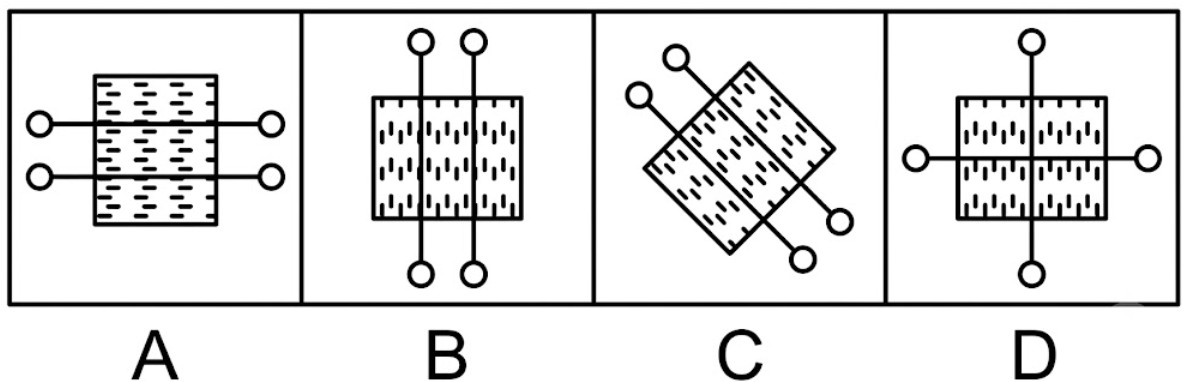
To find the odd one out, we need to analyze the patterns and orientations in the given diagrams. Each option features a square with lines and circles attached. The key is to identify the unique characteristic that sets one diagram apart from the others.
Correct Option: C) Option C is the odd one out due to its diagonal orientation and line pattern.
In a school, the number of students in class 4th, 5th and 6th were 188, 282 and 423 respectively. If each class is divided into sections and each section had the same number of students, then what was the minimum total number of sections in these three classes?
To find the minimum total number of sections, we need to maximize the number of students in each section. Since each section must have the same number of students across all three classes, this number must be a common divisor of the number of students in each class. To maximize this common number, we need to find the Highest Common Factor (HCF) of the number of students in class 4th, 5th, and 6th.
We can use the prime factorization method or the division method.
Prime Factorization:
The common prime factor among all three numbers is 47.
Therefore, the HCF is 47.
This means each section will have 47 students.
Total sections = (Sections in Class 4th) + (Sections in Class 5th) + (Sections in Class 6th)
\[ \text{Total sections} = 4 + 6 + 9 = 19 \]Correct Option: C) 19
The question asks about the winner of the Gujarat Assembly Elections held in 2017. This requires knowledge of recent Indian political history, specifically election results for major state assemblies.
Correct Option: C) Bharatiya Janata Party
The question asks to identify the relationship between the first pair of words and then apply the same relationship to the third word to find the fourth word. This is a classic analogy question where we need to find the characteristic action or movement associated with the given animal.
Correct Option: D) Flying — The relationship is that the second word describes the primary mode of movement of the animal mentioned in the first word. Snakes primarily move by crawling. Similarly, honey bees primarily move by flying.
Which of the following statement(s) is/are true/false?
A. The following reaction is an example of a reversible reaction: N2(g) + 3H2(g) ⇌ 2NH3 (g)
B. The following reaction is an example of a thermal decomposition reaction:
CaCO3(s) - heat → CaO(s) + CO2(g)
Both A and B are false.
Only B is true.
Both A and B are true
Only A is true.
We need to evaluate each statement individually to determine if it is true or false based on chemical definitions. Statement A concerns reversible reactions, and Statement B concerns thermal decomposition reactions.
Correct Option: C) Both A and B are true
The question asks for the location of the Kolar Gold Field. This is a factual question related to Indian geography and mineral resources. The approach is to recall the geographical location of this well-known mining area.
Correct Option: D) Karnataka
Kolar Gold Field (KGF) is a famous gold mining region located in the Kolar district of the Indian state of Karnataka. It was one of the major gold producers in India for over a century before its closure in 2001 due to declining gold reserves and increasing operational costs. The area is still significant historically and geographically.
The following Venn diagram shows the number of students playing Football (F), Hockey (H) and Basketball (B) in a class.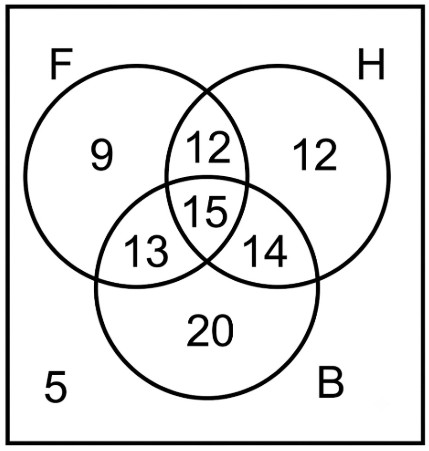
Find the total number of students playing both F and H but not playing B?
To find the number of students playing both Football (F) and Hockey (H) but not Basketball (B), we need to look at the intersection of the Football and Hockey circles in the Venn diagram, excluding any overlap with Basketball.
Correct Option: C) 12
The question asks to identify the specific project that laid the groundwork for the Digital India campaign's goal of providing high-speed broadband to 2.5 lakh Gram Panchayats (GPs) using optical fiber. This requires knowledge of major government initiatives related to digital infrastructure in India.
B) Bharat Net — BharatNet (formerly NOFN) is the world's largest rural broadband connectivity project, aiming to connect 2.5 lakh Gram Panchayats with high-speed optical fiber. It serves as the backbone for the Digital India initiative, providing the necessary infrastructure for digital inclusion in rural India.