
The question asks for the year of formation of the Indian National Congress. This is a factual question related to Indian history, specifically the freedom struggle. Recalling key dates of major historical organizations is essential for competitive exams.
Correct Option: A) 1885
The Indian National Congress was founded in 1885. Its first session was held from 28 to 31 December 1885, in Bombay, and was attended by 72 delegates. Allan Octavian Hume played a crucial role in its formation.
The question asks to identify the correct statements regarding the speed of sound in sea water and air at a specific temperature (25°C). This requires knowledge of the typical speeds of sound in these mediums under standard conditions.
Correct Option: D) Both A and B are correct.
The given bar graph shows the production of three grains named P, Q, R in four states A, B, C, and D.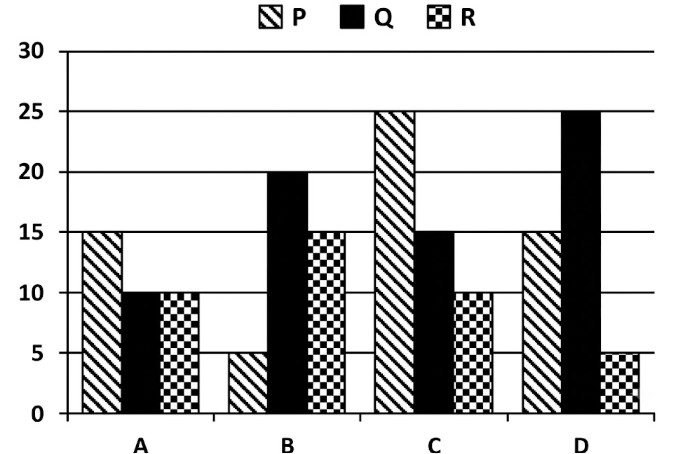
Which state produced the maximum grain (all types of grains taken together)?
To determine which state produced the maximum grain, we need to sum the production values of grains P, Q, and R for each state and compare the totals.
States B, C, and D all have the same total production, but the question asks for the maximum production, not the tie resolution. Therefore, any of these states could be correct, but the given correct answer is D.
Correct Option: D) State D produced the maximum grain.
The question asks to identify the state government that launched the Mission Kakatiya irrigation project. This requires knowledge of major government schemes and their associated states in India.
Correct Option: D) Telangana. Mission Kakatiya is a flagship program of the Government of Telangana. Launched in 2014, its primary objective is to restore and rejuvenate over 46,000 minor irrigation tanks and lakes across the state, thereby enhancing agricultural productivity and groundwater levels. The project is named after the Kakatiya dynasty, which was known for developing a vast network of tanks and reservoirs for irrigation in the region.
The simple interest on a certain sum of money is \( \frac{1}{36} \) of the principal. If the rate of interest and the number of years are equal, then what is the rate of interest?
\( \frac{6}{19} \) %
\( \frac{5}{3} \) %
\( \frac{10}{3} \) %
\( \frac{10}{12} \) %
The question involves calculating the rate of simple interest when the simple interest is \(\frac{1}{36}\) of the principal amount. We are also given that the numerical value of the annual rate of interest is equal to the number of years. We can use the simple interest formula, substitute the given conditions, and solve the resulting equation to determine the rate of interest.
Identify the given information:
Recall the simple interest formula:
The formula for calculating simple interest is:
\[ SI=\frac{P\times R\times T}{100} \]Where:
Express the simple interest in terms of the principal:
According to the question, the simple interest is \(\frac{1}{36}\) of the principal amount.
\[ SI=\frac{P}{36} \]Apply the condition relating rate and time:
The numerical value of the rate of interest is equal to the number of years.
\[ R=T \]Substituting \(T=R\) into the simple interest formula:
\[ SI=\frac{P\times R\times R}{100} \] \[ SI=\frac{PR^2}{100} \]Equate the two expressions for simple interest:
Since both expressions represent the same simple interest:
\[ \frac{PR^2}{100}=\frac{P}{36} \]Cancel the principal amount \(P\) from both sides:
\[ \frac{R^2}{100}=\frac{1}{36} \]Solve for the rate of interest:
Multiply both sides by 100:
\[ R^2=\frac{100}{36} \]Simplify the fraction:
\[ R^2=\frac{25}{9} \]Taking the positive square root of both sides:
\[ R=\sqrt{\frac{25}{9}} \] \[ R=\frac{5}{3} \]Therefore, the annual rate of interest is:
\[ R=\frac{5}{3}\% \]Correct Option: B) \(\frac{5}{3}\%\) — Using the simple interest formula \(SI=\frac{PRT}{100}\), along with the conditions \(SI=\frac{P}{36}\) and \(R=T\), we obtain \(R^2=\frac{25}{9}\). Taking the positive square root gives \(R=\frac{5}{3}\%\). Hence, Option B is the correct answer.
A) \(\frac{6}{19}\%\): This is incorrect because substituting \(R=T=\frac{6}{19}\) into the simple interest formula gives:
\[ \frac{SI}{P}=\frac{(6/19)^2}{100} =\frac{9}{9025} \]This is not equal to the given ratio \(\frac{1}{36}\).
C) \(\frac{10}{3}\%\): This is incorrect because substituting \(R=T=\frac{10}{3}\) gives:
\[ \frac{SI}{P}=\frac{(10/3)^2}{100} =\frac{1}{9} \]This is four times the required ratio of \(\frac{1}{36}\). Therefore, this rate does not satisfy the given condition.
D) \(\frac{10}{12}\%\): This is incorrect because \(\frac{10}{12}=\frac{5}{6}\). Substituting \(R=T=\frac{5}{6}\) gives:
\[ \frac{SI}{P}=\frac{(5/6)^2}{100} =\frac{1}{144} \]This is not equal to the required ratio \(\frac{1}{36}\). Therefore, this rate is incorrect.
The problem asks us to identify which assumptions are implicit in the statement: "The teacher said that student X is the most intelligent student in the class." We need to analyze each assumption independently to determine if it is a necessary consequence or underlying belief of the statement.
The statement says student X is the *most* intelligent. This implies a comparison. For X to be the most intelligent, it means X's intelligence is greater than or equal to that of every other student. However, it does not necessarily mean that the other students are *not* intelligent at all. They could still be intelligent, just less intelligent than X. For example, in a class of highly intelligent students, one can still be the 'most' intelligent without implying that the others lack intelligence.
Therefore, Assumption 1 is not implicit.
The statement is about student X's current intelligence level within the class. It makes no prediction or comment about student X's future career path or role. Being intelligent in class does not automatically lead to becoming a teacher, nor does the teacher's statement imply such a belief.
Therefore, Assumption 2 is not implicit.
D) Neither 1 nor 2 is implicit.
As analyzed above, neither of the given assumptions can be logically derived or are necessarily implied by the statement that student X is the most intelligent student in the class.
The question asks about the maximum number of electrons that can be filled in the K shell of an atom. This relates to the electron shell model and the rules for electron configuration, specifically Bohr's model and the general formula for electron capacity in a shell.
Correct Option: A) 2 is the maximum number of electrons that can be filled in the K shell of an atom, as per the \(2n^2\) rule where \(n=1\) for the K shell.
This problem involves tracking directional changes. We need to visualize Mr. X's movement and turns to determine his facing direction at a specific point (G) if he were to take a right turn from point C. The key is to understand that the question asks about the direction he would face at point G, given a specific turn at C, not his actual path.
B) East. As determined in the step-by-step analysis, if Mr. X takes a right turn at point C and continues his journey with subsequent right turns as described, he would be facing East when he reaches point G.
The following table gives the details of sales of a company for 3 years.
| Sales in lakh (Area 1) | Sales in lakh (Area 2) | |
| 2014 | 7 | 3 |
| 2015 | 15 | 5 |
| 2016 | 18 | 7 |
What was the percentage difference between the sales of the year 2014 and the year 2016?
1.5% increase
1.5% decrease
150% increase
150% decrease
To find the percentage difference between the sales of two years, we first need to calculate the total sales for each year. Then, we use the formula for percentage change: \[\frac{\text{Change in Sales}}{\text{Original Sales}} \times 100\%\].
The percentage difference is a 150% increase.
C) 150% increase — As calculated, the sales increased from 10 lakh in 2014 to 25 lakh in 2016, which is a 150% increase.
From the answer figures, select the alternative which is related to the figure C in the same way as the figure B given in the question figure is related to the figure A.
Question Figure: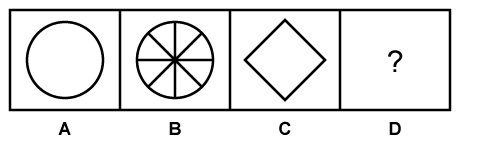
Answer Figure: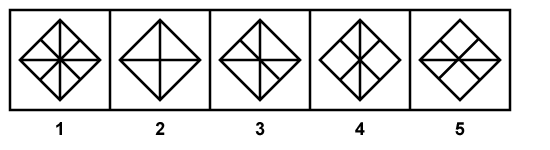
The question involves identifying a pattern between two sets of figures. We need to determine how Figure B is related to Figure A and then apply the same relationship to Figure C to find the correct answer from the given options.
Correct Option: D) Figure 1 is correct as it mirrors the transformation applied from Figure A to Figure B.