
The question asks for the term describing the division of a cell into two identical daughter cells. This is a fundamental concept in biology related to cell reproduction.
Correct Option: B) Bifurcation. While the more precise biological term for this process in prokaryotes is "binary fission" and in eukaryotes it involves mitosis followed by cytokinesis, "bifurcation" broadly describes the splitting into two, which accurately captures the essence of a cell dividing into two identical daughter cells. In the context of the given options, it is the most appropriate general term.
To solve this problem, we need to follow the order of operations, commonly remembered by the acronym PEMDAS/BODMAS. This stands for Parentheses/Brackets, Exponents/Orders, Multiplication and Division (from left to right), and Addition and Subtraction (from left to right).
First, multiplication:
\[ 2 \times 8 = 16 \]The expression is now:
\[ 16 + 28 \div 2 - 24 \]Next, division:
\[ 28 \div 2 = 14 \]The expression is now:
\[ 16 + 14 - 24 \]First, addition:
\[ 16 + 14 = 30 \]The expression is now:
\[ 30 - 24 \]Finally, subtraction:
\[ 30 - 24 = 6 \]Thus, the value of the expression is 6.
Correct Option: D) 6
To determine the day of the week for a given date, we use the concept of "odd days" or "extra days". An odd day is the remainder when the number of days is divided by 7. We calculate the total number of odd days from a reference point (e.g., 01/01/0001) up to the day before the given date, and then map this number to a day of the week.
D) Wednesday is the correct day.
This is a blood relations problem. We need to establish the relationships between the individuals mentioned and then determine the relationship between the daughter of M and V. We can use a family tree or step-by-step deductions.
Correct Option: C) Niece
The sex of a human child is determined by the specific combination of sex chromosomes inherited from the parents. Humans have two sex chromosomes: X and Y. Females have two X chromosomes (XX), while males have one X and one Y chromosome (XY). During reproduction, each parent contributes one sex chromosome to the offspring.
Correct Option: A) Father. The father contributes either an X or a Y chromosome through his sperm, which ultimately determines whether the child will be female (XX) or male (XY), respectively.
Find the odd one: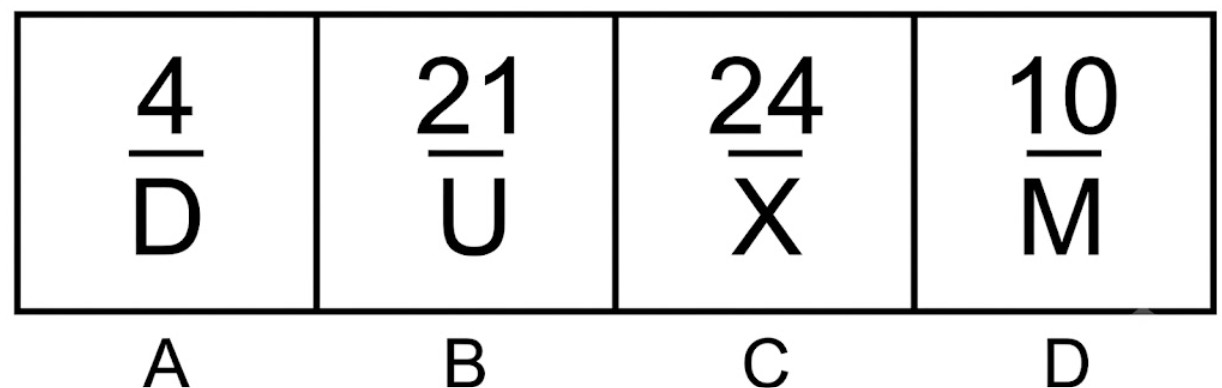
The task is to identify the option that does not follow the pattern observed in the other options. Each option consists of a number over a letter.
Correct Option: D) 10 over M does not match the pattern.
The question asks to identify which of the given metals is found in its free (native) state in nature. This relates to the reactivity series of metals. Metals that are less reactive tend to exist in their free state, as they do not readily react with other elements to form compounds.
Correct Option: D) Pt
The question asks to identify the odd one out from the given options. This requires classifying each option based on its biological context and function.
Correct Option: A) Nissl Granules
How many triangles are there in the following figure?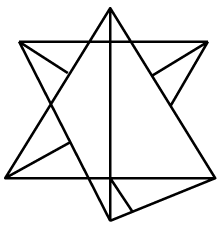
To determine the total number of triangles in the given figure, we need to systematically count all possible triangles formed by the intersections of lines within the larger triangle.
After carefully counting all possible triangles, the total comes to 23.
Correct Option: C) 23
The question asks to identify a dicot plant from the given options. Dicotyledonous (dicot) plants are one of the two major groups of flowering plants, characterized by having two cotyledons (seed leaves) in their embryo. Other distinguishing features include net-like venation in leaves, flower parts in multiples of four or five, and a taproot system.
C) Sweet potato vine is a dicot plant. It belongs to the family Convolvulaceae, which is characterized by dicotyledonous features such as two cotyledons, net-like leaf venation, and flower parts typically in fives.