
To find the Highest Common Factor (HCF) of two numbers, we can use the prime factorization method or the Euclidean algorithm. The prime factorization method involves finding the prime factors of each number and then multiplying the common prime factors.
A) 39 — As calculated, the HCF of 195 and 273 is 39.
This problem involves calculating the combined work rate of pipes filling and emptying a hose. We will determine the individual filling/emptying rates per hour for each pipe and then combine them to find the net filling rate of the hose when all pipes are open. Finally, we will use the net rate to find the total time required to fill the hose.
Calculate the filling rate of pipe x:
Pipe x fills the hose in 15 hours. So, in 1 hour, pipe x fills \(\frac{1}{15}\) of the hose.
Calculate the filling rate of pipe y:
Pipe y fills the hose in 12 hours. So, in 1 hour, pipe y fills \(\frac{1}{12}\) of the hose.
Calculate the emptying rate of pipe z:
Pipe z empties the hose in 20 hours. So, in 1 hour, pipe z empties \(\frac{1}{20}\) of the hose.
Calculate the net filling rate when all pipes are open:
When all pipes are open, the net filling rate is the sum of the filling rates minus the emptying rate.
\[ \text{Net rate} = \text{Rate of x} + \text{Rate of y} - \text{Rate of z} \] \[ \text{Net rate} = \frac{1}{15} + \frac{1}{12} - \frac{1}{20} \]To add/subtract these fractions, find the Least Common Multiple (LCM) of 15, 12, and 20. The LCM is 60.
\[ \text{Net rate} = \frac{4}{60} + \frac{5}{60} - \frac{3}{60} \] \[ \text{Net rate} = \frac{4 + 5 - 3}{60} \] \[ \text{Net rate} = \frac{9 - 3}{60} \] \[ \text{Net rate} = \frac{6}{60} \] \[ \text{Net rate} = \frac{1}{10} \text{ of the hose per hour} \]Calculate the total time to fill the hose:
If the net rate is \(\frac{1}{10}\) of the hose per hour, it means the hose will be filled in 10 hours.
\[ \text{Time} = \frac{1}{\text{Net rate}} \] \[ \text{Time} = \frac{1}{\frac{1}{10}} = 10 \text{ hours} \]Correct Option: A) 10 hours
To convert kilowatt-hour (kWh) to Joules (J), we need to understand the definitions of these units. Kilowatt-hour is a unit of energy, and Joule is the standard SI unit of energy. We will use the conversion factors for kilowatts to watts and hours to seconds.
A kilowatt-hour (kWh) is a unit of energy equal to one kilowatt of power sustained for one hour.
A Joule (J) is the SI unit of energy, defined as one watt-second (W·s).
We know that 1 kilowatt (kW) is equal to 1000 watts (W).
\[ 1 \text{ kW} = 1000 \text{ W} \]We know that 1 hour (h) is equal to 60 minutes, and 1 minute is equal to 60 seconds. Therefore, 1 hour is equal to \(60 \times 60\) seconds.
\[ 1 \text{ h} = 60 \text{ minutes} = 60 \times 60 \text{ seconds} = 3600 \text{ seconds} \]Now, substitute these values into the definition of 1 kWh:
\[ 1 \text{ kWh} = 1 \text{ kW} \times 1 \text{ h} \]\[ 1 \text{ kWh} = (1000 \text{ W}) \times (3600 \text{ s}) \]\[ 1 \text{ kWh} = 3600000 \text{ W} \cdot \text{s} \]Since 1 Joule (J) is equal to 1 Watt-second (W·s):
\[ 1 \text{ kWh} = 3600000 \text{ J} \]Correct Option: D) 3600000
The question asks about a specific collaboration between ISRO and a state government to establish a telemedicine center for Amarnath pilgrims. To answer this, one needs to recall or identify the geographical location of the Amarnath shrine and recent news or initiatives related to healthcare and technology in that region.
C) Jammu and Kashmir is the correct answer. ISRO, in collaboration with the Jammu and Kashmir government, established a telemedicine center at an altitude of 12,700 feet to provide medical assistance to pilgrims undertaking the annual Amarnath Yatra. This initiative aims to utilize satellite communication for remote healthcare services in the challenging terrain leading to the shrine.
How to express 20 g of CO2 in moles? (Atomic mass C = 12, O = 16)
To express a given mass of a substance in moles, we need to calculate its molar mass first. The molar mass is the sum of the atomic masses of all atoms in the chemical formula. Once the molar mass is known, the number of moles can be calculated by dividing the given mass by the molar mass.
Correct Option: D) 0.45 moles
This is an analogy question based on letter coding. We need to identify the pattern or rule applied to transform "ROAD" into "URDG" and then apply the same rule to "LANE" to find the missing term.
Let's look at the position of each letter in the English alphabet.
The pattern is that each letter in the first word is shifted forward by 3 positions in the alphabet to get the corresponding letter in the second word.
Now, we apply the "\(+3\)" rule to each letter of "LANE":
So, LANE becomes ODQH.
Correct Option: B) ODQH
The question asks to identify the city in Uttar Pradesh famous for glass bangles. This is a general knowledge question related to the industrial specializations of cities in India, particularly Uttar Pradesh.
Firozabad, located in Uttar Pradesh, is globally renowned as the "Bangle City" or "Glass City" due to its extensive glass industry, especially the production of glass bangles and other glass items.
B) Firozabad is famously known as the "Glass City" or "Suhaag Nagari" (City of Matrimony) because it is the hub of India's glass industry, particularly for glass bangles. It has been a center for glass manufacturing for centuries.
The question asks to identify the Indian state where Kalbeliya is a popular dance form. This requires knowledge of traditional Indian dance forms and their associated regions.
B) Rajasthan is the correct answer because Kalbeliya is a famous folk dance of the Kalbeliya tribe from Rajasthan.
Answer the following questions based on the diagrams given below: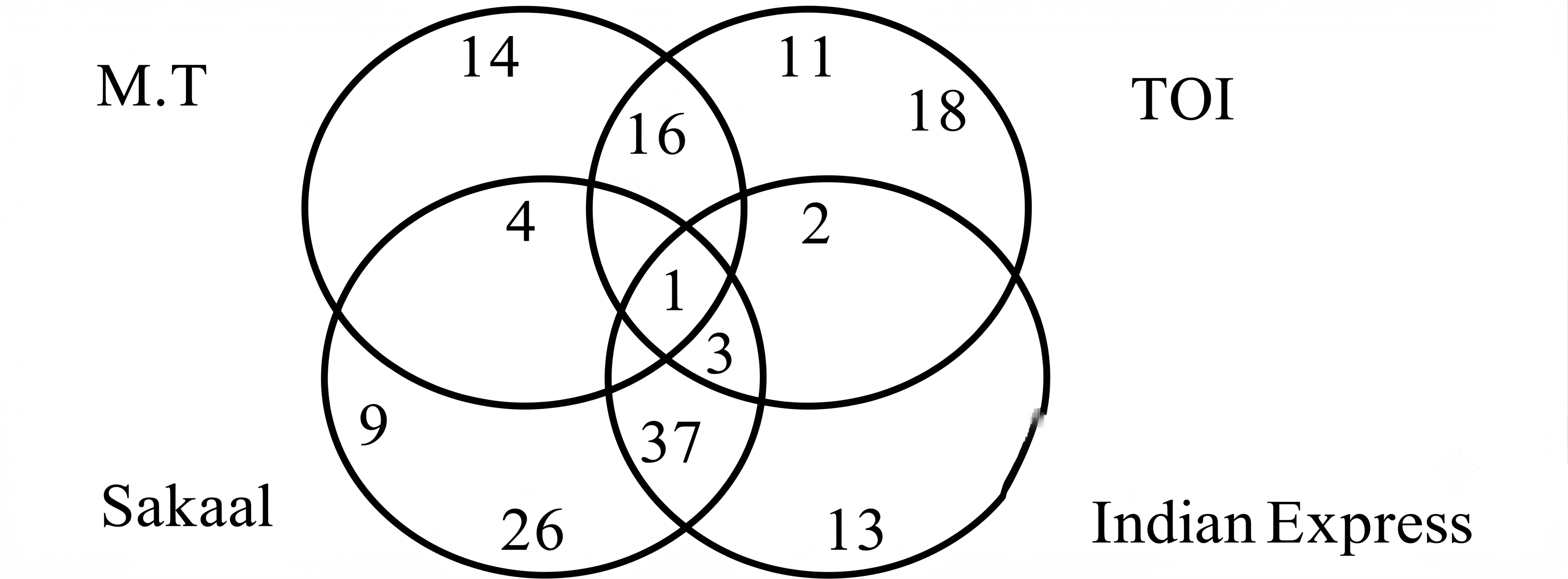
Numbers represent the number of subscribers and circles indicate a newspaper.
Question:
How many people buy only Sakal newspapers?
To find how many people buy only the Sakal newspaper, we need to identify the section of the Venn diagram that represents subscribers of only Sakal and not any other newspaper.
Correct Option: A) 35
The question asks to identify the person appointed as the Brexit Secretary by British Prime Minister Theresa May. This is a factual recall question related to significant political appointments during a specific period in UK politics.
Stephen Barclay was appointed as the Secretary of State for Exiting the European Union (Brexit Secretary) by Prime Minister Theresa May in November 2018, following the resignation of Dominic Raab. He served in this role until July 2019.
D) Stephen Barclay was appointed as the Brexit Secretary by Theresa May in November 2018.