
To find the middle decimal number when arranged in ascending order, we first need to list all the given decimals. Then, we will arrange them from the smallest to the largest. Once arranged, we can identify the number that falls exactly in the middle of the sequence.
Correct Option: B) 5.74
The problem involves decoding a pattern in a given word and then applying the same pattern to another word. We need to identify the rule by which "COCK" is transformed into "DPDL" and then apply that rule to "HEN".
D) IFO is the correct answer because applying the identified pattern (each letter shifted to the next in the alphabet) to "HEN" results in "IFO".
This is a syllogism question. We need to evaluate the conclusions based on the given statements. We can use Venn diagrams or the rules of syllogism to determine which conclusions logically follow.
Let's analyze the statements and conclusions:
Statements:
Conclusion 1: Some metals are pins.
Conclusion 2: Some pins are clips.
Based on this analysis, only Conclusion 1 follows.
Correct Option: C) Only conclusion 1 follows.
How many rectangles are there in the following picture?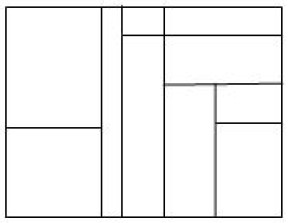
To solve this problem, we need to count all possible rectangles in the given diagram. A rectangle is formed by selecting two horizontal and two vertical lines.
Correct Option: D) 24
This problem can be solved by recognizing a common algebraic identity. The given expression resembles the expansion of \((a+b)^3\) or a related identity involving \(a^3 + b^3 + c^3 - 3abc\). By carefully assigning values to variables, the expression can be simplified.
Let the given expression be \(E\):
\[ E = (0.98)^3 + (0.02)^3 + 3 \times 0.98 \times 0.02 - 1 \]Recall the algebraic identity: If \(a+b+c = 0\), then \(a^3 + b^3 + c^3 = 3abc\). This can be rewritten as \(a^3 + b^3 + c^3 - 3abc = 0\).
Let's try to fit the given expression into this identity. Let \(a = 0.98\) and \(b = 0.02\). We need a third term \(c\).
Consider the structure \(a^3 + b^3 + c^3 - 3abc\). The given expression has \((0.98)^3 + (0.02)^3\). It also has \(+ 3 \times 0.98 \times 0.02\). This looks like \(3ab(-c)\) if \(c\) is negative, or it could be part of \((a+b)^3 = a^3 + b^3 + 3ab(a+b)\).
Let's use the identity \(a^3 + b^3 + c^3 - 3abc = (a+b+c)(a^2+b^2+c^2-ab-bc-ca)\).
Consider the terms \(0.98\), \(0.02\), and \(-1\). Let's define:
\[ a = 0.98 \]\[ b = 0.02 \]\[ c = -1 \]Now, let's calculate the sum \(a+b+c\):
\[ a+b+c = 0.98 + 0.02 + (-1) \]\[ a+b+c = 1.00 - 1 \]\[ a+b+c = 0 \]Since \(a+b+c = 0\), we can apply the identity \(a^3 + b^3 + c^3 - 3abc = 0\), which means \(a^3 + b^3 + c^3 = 3abc\).
Substitute the values of \(a\), \(b\), and \(c\) into the identity:
\[ (0.98)^3 + (0.02)^3 + (-1)^3 = 3 \times (0.98) \times (0.02) \times (-1) \]Simplify both sides:
\[ (0.98)^3 + (0.02)^3 - 1 = -3 \times 0.98 \times 0.02 \]Rearrange the terms to match the given expression:
\[ (0.98)^3 + (0.02)^3 + 3 \times 0.98 \times 0.02 - 1 = 0 \]Thus, the value of the given expression is \(0\).
Correct Option: D) 0
The question asks to identify the state that won the best tableau award at the Republic Day parade in 2018. This is a factual question related to current affairs and general knowledge, specifically about national events and awards.
Correct Option: C) Maharashtra
Maharashtra's tableau, themed "Coronation of Chhatrapati Shivaji Maharaj", won the first prize for the best tableau at the Republic Day parade in 2018. The award was presented by the then Union Defence Minister Nirmala Sitharaman.
The question asks to identify which of the given options is NOT a simple permanent tissue. To answer this, we need to understand the classification of plant tissues, specifically distinguishing between simple permanent tissues and complex permanent tissues.
C) Xylem is a complex permanent tissue. It consists of multiple types of cells (tracheids, vessels, xylem parenchyma, and xylem fibers) that work together to transport water and minerals throughout the plant. Therefore, it is not a simple permanent tissue.
sin² 60° + cos² 30° + cot² 45° + sec² 60° =?
\( \frac{15}{2} \)
\( \frac{13}{2} \)
\( \frac{7}{2} \)
\( \frac{5}{2} \)
To solve this problem, we need to recall the standard trigonometric values for common angles (30°, 45°, 60°) and then substitute these values into the given expression. Finally, we will perform the arithmetic operations to find the result.
The required trigonometric values are:
The given expression is \( \sin^2 60\degree + \cos^2 30\degree + \cot^2 45\degree + \sec^2 60\degree \).
Substitute the values:
\[ \left(\frac{\sqrt{3}}{2}\right)^2 + \left(\frac{\sqrt{3}}{2}\right)^2 + (1)^2 + (2)^2 \]Now, sum these values:
\[ \frac{3}{4} + \frac{3}{4} + 1 + 4 \]Combine the fractions and integers:
\[ \frac{3}{4} + \frac{3}{4} + 5 \]\[ \frac{6}{4} + 5 \]\[ \frac{3}{2} + 5 \]To add \( \frac{3}{2} \) and \( 5 \), find a common denominator:
\[ \frac{3}{2} + \frac{5 \times 2}{2} \]\[ \frac{3}{2} + \frac{10}{2} \]\[ \frac{3 + 10}{2} \]\[ \frac{13}{2} \]B) \( \frac{13}{2} \) is the correct result obtained after substituting the trigonometric values and performing the arithmetic operations.
The question asks to determine the value of 'x'. We need to evaluate each given equation to see if it provides a unique value for 'x'.
The first equation is a quadratic equation:
\[ x^2 - 18x + 81 = 0 \]This equation is a perfect square trinomial. It can be factored as \((x-9)^2 = 0\).
Taking the square root of both sides:
\[ \sqrt{(x-9)^2} = \sqrt{0} \]\[ x - 9 = 0 \]\[ x = 9 \]Equation 1 yields a unique value for \(x\), which is 9. Therefore, Equation 1 alone is sufficient to answer the question.
The second equation is:
\[ p + q + r = 0 \]This equation involves variables \(p\), \(q\), and \(r\). It does not contain the variable \(x\), nor does it provide any information that can be used to find the value of \(x\). Therefore, Equation 2 is not sufficient.
A) Only 1 is sufficient. This is correct because Equation 1 provides a unique value for \(x\).
The pH scale is used to measure the acidity or alkalinity of a solution. It is inversely related to the concentration of hydrogen ions (\([\text{H}^+]\)). A lower pH value indicates a higher concentration of hydrogen ions and thus a more acidic solution. Conversely, a higher pH value indicates a lower concentration of hydrogen ions and a more alkaline (basic) solution.
C) 2.4 — This is the lowest pH value among the given options, indicating the highest concentration of hydrogen ions and thus the most acidic solution.