The task is to identify which of the given assumptions are implicit in the statement about sustainability. An implicit assumption is something that is not directly stated but must be true for the statement to make sense or be logically valid. We need to analyze each assumption in relation to the definition of sustainability provided.
C) Only assumption I is implicit. Assumption I directly supports the premise of why natural resources need to be protected, which is central to the definition of sustainability provided in the statement. The statement's concern for not degrading natural resources implies that these resources are vital for human life and economy.
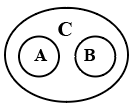
Which of the following Venn diagrams correctly represents the relationship between the given classes?
A) Table
B) Chair
C) Wood
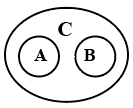
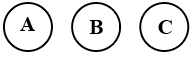
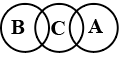
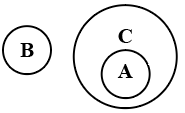
To determine the correct Venn diagram representation, we need to understand the relationship between the classes: Table, Chair, and Wood. Both tables and chairs can be made of wood, indicating that they are subsets of wood.
Correct Option: A) The diagram shows 'Table' and 'Chair' as subsets within 'Wood', which accurately represents the relationship.
This question involves understanding directional changes based on a given transformation. We need to determine the new direction for 'North' if 'South' is re-designated as 'South-East'. This implies a specific rotation of the compass.
D) North-West — As determined in the step-by-step analysis, an anti-clockwise rotation of \(45^\circ\) transforms South into South-East, and applying the same rotation to North results in North-West.
To find the total money spent on milk, we first need to determine the total quantity of milk required to produce 20 kg of paneer. We are given the amount of paneer produced from one litre of milk and the cost of one litre of milk. We will use these values to calculate the total milk needed and then the total cost.
Lata makes 20 kg of paneer. Since 1 kg = 1000 g, we convert 20 kg to grams.
\[ \text{Total paneer} = 20 \text{ kg} \times 1000 \frac{\text{g}}{\text{kg}} = 20000 \text{ g} \]From 1 litre of milk, 200 g of paneer is made. To find out how many litres of milk are needed for 20000 g of paneer, we divide the total paneer by the paneer produced per litre of milk.
\[ \text{Milk needed} = \frac{\text{Total paneer}}{\text{Paneer per litre of milk}} = \frac{20000 \text{ g}}{200 \frac{\text{g}}{\text{litre}}} = 100 \text{ litres} \]The cost of 1 litre of milk is ₹ 40. To find the total cost, we multiply the total litres of milk needed by the cost per litre.
\[ \text{Total cost} = \text{Milk needed} \times \text{Cost per litre} = 100 \text{ litres} \times \text{₹ } 40 \frac{\text{}}{\text{litre}} = \text{₹ } 4000 \]Therefore, Lata spends ₹ 4000 in procuring milk every day.
Correct Option: B) 4,000
If α and β are roots of the equation x² – x – 1 = 0, then the equation where roots are \( \frac{\alpha}{\beta} \) and \( \frac{\beta}{\alpha} \) is:
x² + 3x – 1 = 0
x² + x – 1 = 0
x² – x + 1 = 0
x² + 3x + 1 = 0
We are given a quadratic equation and its roots. We need to find a new quadratic equation whose roots are functions of the original roots. We will use Vieta's formulas to find the sum and product of the roots of the original equation. Then, we will calculate the sum and product of the new roots and form the new quadratic equation.
Identify the given equation and its roots:
The given quadratic equation is \(x^2 - x - 1 = 0\). Let its roots be \(\alpha\) and \(\beta\).
Apply Vieta's formulas to the given equation:
For a quadratic equation \(ax^2 + bx + c = 0\), the sum of the roots is \(-\frac{b}{a}\) and the product of the roots is \(\frac{c}{a}\).
Here, \(a=1\), \(b=-1\), \(c=-1\).
Define the new roots:
The new roots are \(r_1 = \frac{\alpha}{\beta}\) and \(r_2 = \frac{\beta}{\alpha}\).
Calculate the sum of the new roots:
\[ r_1 + r_2 = \frac{\alpha}{\beta} + \frac{\beta}{\alpha} \]\[ = \frac{\alpha^2 + \beta^2}{\alpha \beta} \]We know that \(\alpha^2 + \beta^2 = (\alpha + \beta)^2 - 2\alpha\beta\).Substitute the values of \(\alpha + \beta\) and \(\alpha \beta\):
\[ \alpha^2 + \beta^2 = (1)^2 - 2(-1) = 1 + 2 = 3 \]So, the sum of the new roots is:\[ r_1 + r_2 = \frac{3}{-1} = -3 \]Calculate the product of the new roots:
\[ r_1 \cdot r_2 = \left(\frac{\alpha}{\beta}\right) \cdot \left(\frac{\beta}{\alpha}\right) \]\[ = 1 \]Form the new quadratic equation:
A quadratic equation with roots \(r_1\) and \(r_2\) is given by \(x^2 - (r_1 + r_2)x + r_1 r_2 = 0\).
Substitute the sum and product of the new roots:
\[ x^2 - (-3)x + (1) = 0 \]\[ x^2 + 3x + 1 = 0 \]D) \(x^2 + 3x + 1 = 0\) is the correct equation based on our calculations.
If a + b + c = 2s, then
[(s - a)2+(s - b)2+(s - c)2 +s2] =?
(s2–a2–b2–c2)
(s2+a2+b2+c2)
(a2+b2+c2)
(4s2–a2–b2–c2)
The problem asks us to simplify the given algebraic expression \([(s - a)^2 + (s - b)^2 + (s - c)^2 + s^2]\) given the condition \(a + b + c = 2s\). We will expand each squared term and then substitute the given condition to simplify the expression.
Given the expression to simplify:
\[ (s - a)^2 + (s - b)^2 + (s - c)^2 + s^2 \]Expand each squared term using the formula \((x - y)^2 = x^2 - 2xy + y^2\):
\((s - a)^2 = s^2 - 2sa + a^2\)
\((s - b)^2 = s^2 - 2sb + b^2\)
\((s - c)^2 = s^2 - 2sc + c^2\)
Substitute these expanded forms back into the original expression:
\[ (s^2 - 2sa + a^2) + (s^2 - 2sb + b^2) + (s^2 - 2sc + c^2) + s^2 \]Group the terms:
\[ (s^2 + s^2 + s^2 + s^2) + (a^2 + b^2 + c^2) - (2sa + 2sb + 2sc) \] \[ 4s^2 + (a^2 + b^2 + c^2) - 2s(a + b + c) \]We are given the condition \(a + b + c = 2s\). Substitute this into the expression:
\[ 4s^2 + (a^2 + b^2 + c^2) - 2s(2s) \]Simplify the expression:
\[ 4s^2 + (a^2 + b^2 + c^2) - 4s^2 \]The \(4s^2\) terms cancel out:
\[ a^2 + b^2 + c^2 \]Correct Option: C) \((a^2 + b^2 + c^2)\)
Find the odd one out.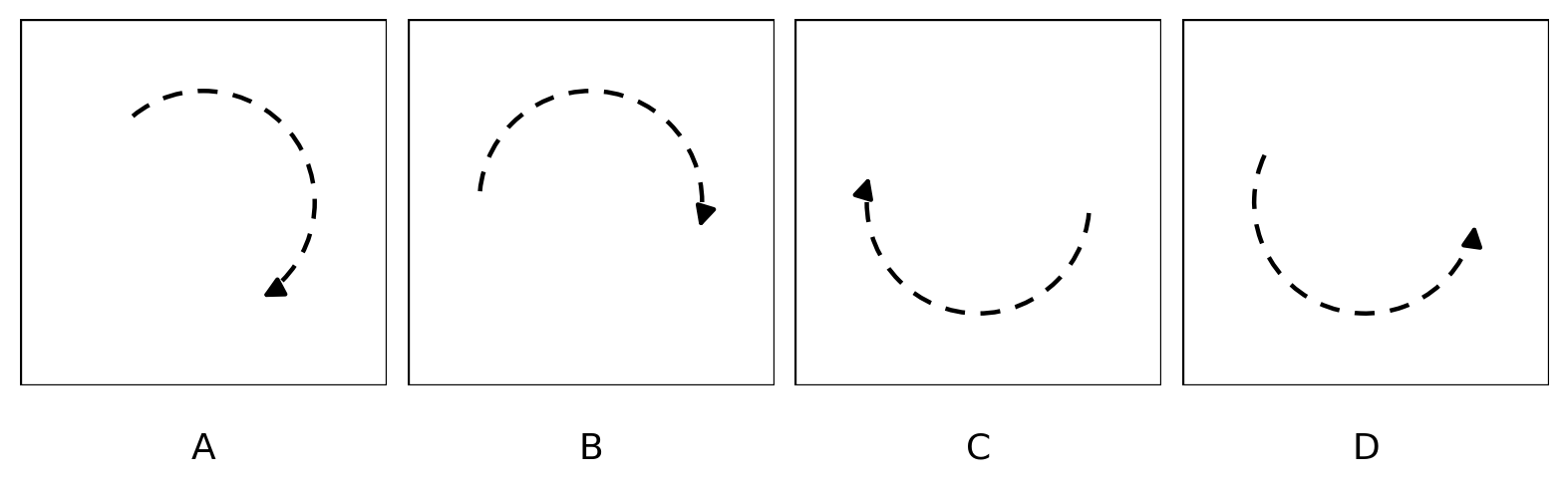
The task is to identify the diagram that does not follow the same pattern or direction as the others. Observing the direction of the arrows and the curvature of the dashed lines will help in determining the odd one out.
Correct Option: C) The arrow and curvature in option C are counter-clockwise, making it the odd one out.
This is a syllogism problem that can be solved using Venn diagrams to visualize the relationships between the categories mentioned in the statements. We will draw diagrams for the given statements and then check which conclusions logically follow from these diagrams.
Combining these, we can visualize it as: A circle representing 'Paddles' is inside a larger circle representing 'Brakes'. A third circle representing 'Glass' is completely separate from the 'Paddles' circle.
From our diagram, we see that 'Paddles' are a subset of 'Brakes'. This means there can be 'Brakes' that are not 'Paddles'. Therefore, this conclusion does not necessarily follow.
Since all paddles are brakes, it logically follows that at least some part of the 'Brakes' set consists of 'Paddles'. This conclusion is definitely true.
We know 'No glass is a paddle'. We also know 'All paddles are brakes'. However, the 'Brakes' set is larger than the 'Paddles' set. It is possible for some 'Brakes' (those that are not 'Paddles') to be 'Glass'. The statements do not provide enough information to conclude that 'No brake is glass'. For example, a brake that is not a paddle could be a glass. Thus, this conclusion does not necessarily follow.
B) Only conclusion 2 follows. As established in the step-by-step analysis, only the conclusion "Some brakes are paddles" is logically derived from the given statements.
The question asks to identify an organism that reproduces through regeneration and can regenerate its lost parts. We need to recall the reproductive strategies and regenerative capabilities of the given options.
Correct Option: D) Hydra is famous for its ability to regenerate lost body parts and can even form a complete organism from a small fragment, which is a form of asexual reproduction through regeneration.
This is a direction-based reasoning question. We need to determine the rotational shift described by the first condition and then apply the same shift to the second direction.
Let's re-evaluate the shift. If North-East becomes North, it means a 45-degree counter-clockwise rotation has occurred. North-East is 45 degrees clockwise from North. If North-East is now considered North, then the entire compass has effectively rotated 45 degrees counter-clockwise.
Let's visualize this:
Another way to think about it: The direction that was 45 degrees clockwise from North (i.e., North-East) is now labeled North. This means the new 'North' is actually the old 'North-East'. So, the entire system has rotated 45 degrees counter-clockwise.
If the entire system rotates 45 degrees counter-clockwise:
Therefore, if North-East becomes North, then East will become North-East.
B) North-East — As explained above, a 45-degree counter-clockwise rotation of the entire compass makes East become North-East.