
A car covers a distance of 44 km using 2\( \frac{3}{4} \) litres of petrol. What distance can the car cover using 1 litre of petrol?
This problem involves calculating the distance a car can cover per unit of fuel. We are given the total distance covered and the total fuel consumed. We need to find the distance covered per litre of petrol, which is a direct application of the unitary method.
The amount of petrol used is \(2 \frac{3}{4}\) litres.
\[ 2 \frac{3}{4} = \frac{(2 \times 4) + 3}{4} = \frac{8 + 3}{4} = \frac{11}{4} \text{ litres} \]The car covers 44 km using \( \frac{11}{4} \) litres of petrol. To find the distance covered using 1 litre, we divide the total distance by the total petrol consumed.
\[ \text{Distance per litre} = \frac{\text{Total Distance}}{\text{Total Petrol Consumed}} \]\[ \text{Distance per litre} = \frac{44 \text{ km}}{\frac{11}{4} \text{ litres}} \]Dividing by a fraction is equivalent to multiplying by its reciprocal.
\[ \text{Distance per litre} = 44 \times \frac{4}{11} \text{ km/litre} \]\[ \text{Distance per litre} = \frac{44 \times 4}{11} \text{ km/litre} \]\[ \text{Distance per litre} = \frac{176}{11} \text{ km/litre} \]\[ \text{Distance per litre} = 16 \text{ km/litre} \]B) The car can cover 16 km using 1 litre of petrol.
Find the odd one out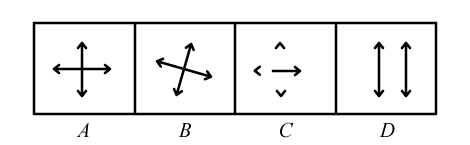
This question requires identifying the pattern or characteristic that makes one option different from the others. By examining the arrows in each diagram, we can determine which one is the odd one out.
Correct Option: A) Option A is the odd one out because it uniquely forms a complete cross with arrows pointing in all four cardinal directions.
The question asks to identify the hormone secreted by the testes in males. This requires knowledge of the endocrine system, specifically the hormones produced by various glands in the human body.
Correct Option: C) Testosterone is the primary male sex hormone, an androgen, produced mainly by the Leydig cells in the testes. It plays a crucial role in the development of male reproductive tissues such as the testes and prostate, as well as promoting secondary sexual characteristics like increased muscle and bone mass, and the growth of body hair. It is also essential for spermatogenesis (sperm production).
Which of the following states emerged as overall champions of the first (inaugural) edition of Khelo India School Games (KISG) held from 31st January to 8th February 2018 at Indira Gandhi Indoor Stadium?
The question asks to identify the state that won the overall championship of the inaugural Khelo India School Games (KISG) in 2018. This requires knowledge of the results of this specific sporting event.
A) Haryana
Haryana topped the medal tally in the first edition of the Khelo India School Games (KISG) in 2018, making it the overall champion. They secured a total of 102 medals, including 38 gold, 26 silver, and 38 bronze medals.
The question asks to identify the Indian princely state from which Velu Thampi Dalawa hailed. This requires knowledge of Indian history, specifically the princely states and their prominent figures who resisted British rule.
Correct Option: D) Travancore. Velu Thampi Dalawa was the Dalawa (Prime Minister) of the princely state of Travancore (present-day Kerala). He is renowned for his rebellion against the British East India Company in 1809, which is a significant event in the history of resistance against colonial rule in India.
The question asks us to find a word that relates to "Wood" in the same way "Transparent" relates to "Glass". This is an analogy question where we need to identify the relationship between the first pair of words and apply the same relationship to the second pair.
Correct Option: D) Opaque is the correct answer because "Opaque" describes the property of wood regarding light transmission, which is the opposite of "Transparent" for glass. Glass is transparent, and wood is opaque.
This problem involves comparing the momentum and speed of two objects with different masses but the same kinetic energy. We will use the formulas for kinetic energy and momentum to establish a relationship between them and determine how mass affects speed and momentum when kinetic energy is constant.
Correct Option: C) greater momentum
Revisiting the options, both C and D are factually correct deductions. However, in many physics contexts, when comparing objects with the same kinetic energy, the relationship \(p = \sqrt{2mKE}\) is a key takeaway. If a heavier mass has lower speed, it implies that its momentum could be higher, lower, or the same depending on the exact values. But the direct relationship \(p = \sqrt{2mKE}\) clearly shows that if \(m\) increases and \(KE\) is constant, then \(p\) must increase. So, "greater momentum" is a direct and unambiguous consequence. "Lower speed" is also true, but the question might be looking for the most significant difference or a property that uniquely identifies it in this context. Given the options, "greater momentum" is a strong and direct conclusion from the relationship between kinetic energy and momentum.
This problem can be solved using the concept of work and wages, where the amount of money earned is directly proportional to the number of workers and the number of days they work. We can find the earning rate per boy per day and then use it to calculate the total earnings for the new scenario.
The total "work units" can be considered as the product of the number of boys and the number of days.
\[ \text{Work units}_1 = \text{Number of boys}_1 \times \text{Number of days}_1 \]\[ \text{Work units}_1 = 15 \text{ boys} \times 5 \text{ days} = 75 \text{ boy-days} \]The total money earned is Rs 750 for 75 boy-days.
\[ \text{Earning per boy-day} = \frac{\text{Total money earned}_1}{\text{Work units}_1} \]\[ \text{Earning per boy-day} = \frac{750 \text{ Rs}}{75 \text{ boy-days}} = 10 \text{ Rs/boy-day} \]Now, we need to find the work units for 25 boys working for 6 days.
\[ \text{Work units}_2 = \text{Number of boys}_2 \times \text{Number of days}_2 \]\[ \text{Work units}_2 = 25 \text{ boys} \times 6 \text{ days} = 150 \text{ boy-days} \]Multiply the total work units in the second scenario by the earning per boy-day.
\[ \text{Total money earned}_2 = \text{Work units}_2 \times \text{Earning per boy-day} \]\[ \text{Total money earned}_2 = 150 \text{ boy-days} \times 10 \text{ Rs/boy-day} = 1500 \text{ Rs} \]B) 1500
The question asks to identify which of the given compounds does NOT contain water of crystallization. Water of crystallization refers to water molecules that are an integral part of the crystal structure of certain compounds. We need to recall the chemical formulas of each option to determine if they contain hydrated water molecules.
D) Baking soda — Baking soda (sodium bicarbonate, \( \text{NaHCO}_3 \)) is an anhydrous compound, meaning its crystal structure does not incorporate water molecules. Therefore, it does not possess water of crystallization.
When analyzing the motion of a vertically thrown ball, it's crucial to establish a consistent sign convention for displacement, velocity, and acceleration. A common convention is to consider the upward direction as positive and the downward direction as negative. The acceleration due to gravity always acts downwards.
D) Upwards positive — When a ball is thrown vertically upwards, its velocity is directed upwards. If we adopt the standard convention of taking the upward direction as positive, then the velocity of the ball during its upward flight will be positive. Although the magnitude of this positive velocity decreases due to gravity, its direction remains upwards, hence it remains positive until it momentarily becomes zero at the peak.