
The question asks to identify the item that does NOT belong to the group. This is a classification question where we need to find a common characteristic among most items and then identify the outlier.
Correct Option: A) C is the correct option because a hamster is a mammal, while an ant, caterpillar, and locust are all insects.
The question asks to identify the founder of Paytm who was included in TIME magazine's Most Influential People list in 2017, alongside Prime Minister Narendra Modi. This requires knowledge of prominent Indian business figures and their recognition on international platforms.
B) Vijay Shekhar Sharma is the founder of Paytm, one of India's largest mobile payment and financial services companies. He was recognized for his pioneering work in digital payments and was included in TIME magazine's 2017 list of '100 Most Influential People' in the world. This aligns perfectly with the details provided in the question.
{17+(24+3)}÷9=?
To solve this problem, we need to follow the order of operations, often remembered by the acronym PEMDAS/BODMAS. This stands for Parentheses/Brackets, Exponents/Orders, Multiplication and Division (from left to right), Addition and Subtraction (from left to right).
C) 4 is the correct answer, as derived by following the order of operations.
How many right angle triangles are there in the following figure: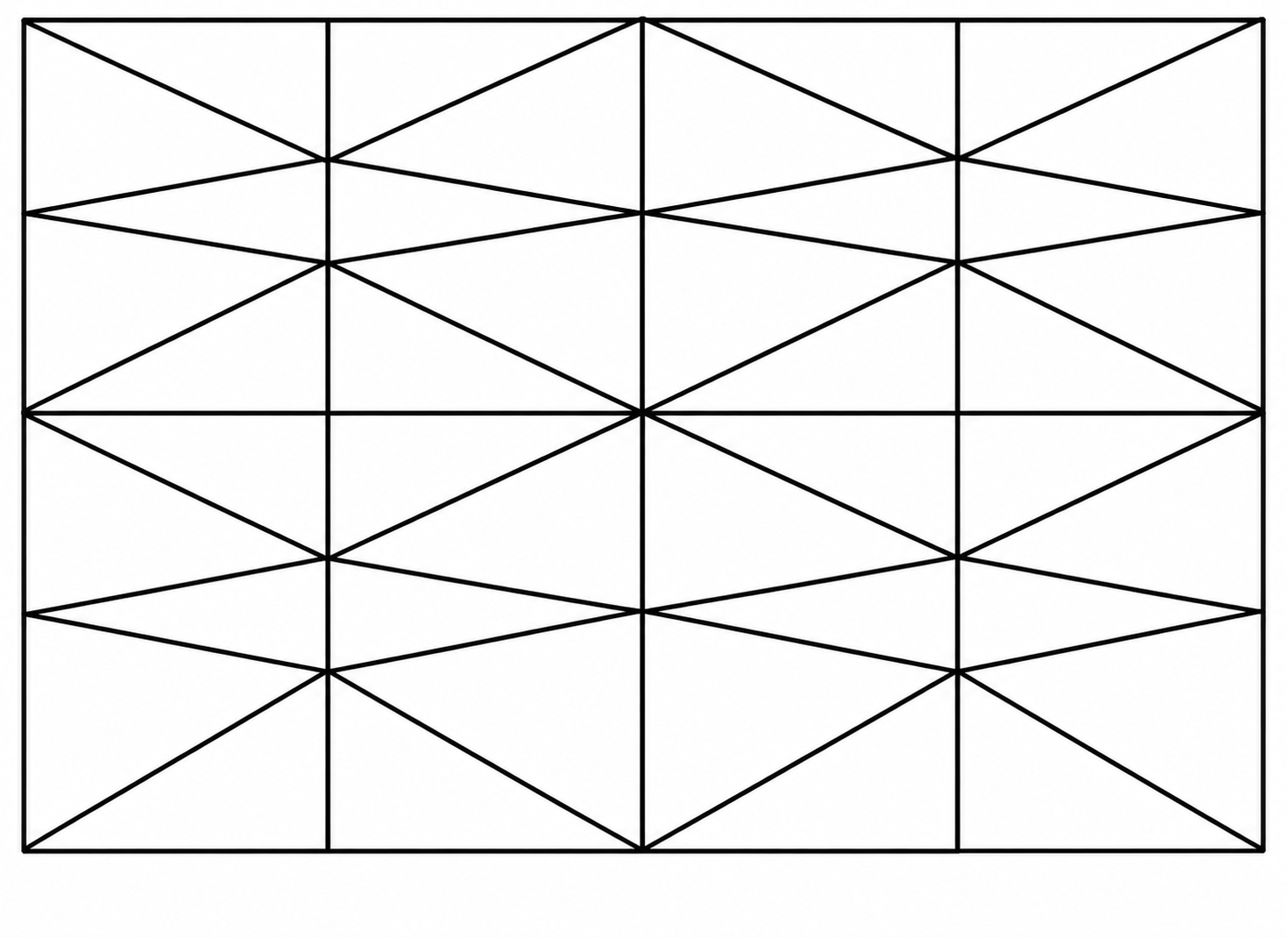
To determine the number of right-angled triangles in the given figure, we need to carefully analyze the structure and identify all possible right-angled triangles formed by the intersecting lines.
Correct Option: A) 16
The task is to identify which assumptions are implicit in the given statement. An implicit assumption is something that is not stated directly but is taken for granted or implied by the statement. We need to analyze each assumption in relation to the statement: "Global warming, species extinction and deforestation are posing a threat to the environment."
B) Both assumptions I and II are implicit. Both assumptions provide the underlying reasoning for why the environmental issues mentioned in the statement (global warming, species extinction, and deforestation) are considered a "threat.\
By walking at \( \frac{4}{5} \) of his usual speed, Soham is 6 minutes late to office. How much time does he usually take to get to office?
This problem involves the relationship between speed, time, and distance. When the distance is constant, speed is inversely proportional to time. We can set up equations based on the given information about the change in speed and the resulting delay.
Let \(S\) be Soham's usual speed and \(T\) be his usual time to reach the office. Let \(D\) be the distance to the office.
The relationship is given by:
\[ D = S \times T \quad \text{(Equation 1)} \]When Soham walks at \( \frac{4}{5} \) of his usual speed, his new speed \(S'\) is:
\[ S' = \frac{4}{5} S \]He is 6 minutes late, so his new time \(T'\) is \(T + 6\) minutes.
\[ T' = T + 6 \quad \text{(Equation 2)} \]Since the distance to the office remains the same, we can write:
\[ D = S' \times T' \]Substitute the expressions for \(S'\) and \(T'\) into this equation:
\[ D = \left(\frac{4}{5} S\right) \times (T + 6) \quad \text{(Equation 3)} \]Now, we equate Equation 1 and Equation 3, as both represent the same distance \(D\):
\[ S \times T = \frac{4}{5} S \times (T + 6) \]We can cancel \(S\) from both sides (assuming \(S \neq 0\)):
\[ T = \frac{4}{5} (T + 6) \]Now, solve for \(T\):
\[ 5T = 4(T + 6) \] \[ 5T = 4T + 24 \] \[ 5T - 4T = 24 \] \[ T = 24 \text{ minutes} \]Thus, Soham usually takes 24 minutes to get to the office.
Correct Option: C) 24 minutes
The problem asks for the maximum possible gap between two successive leap years. To solve this, we need to understand the rules for determining leap years according to the Gregorian calendar.
C) 8
The maximum gap occurs when a century year that is not divisible by 400 falls between two leap years. For example, 1896 was a leap year. 1900 was not a leap year (divisible by 100 but not by 400). The next leap year was 1904. The gap between 1896 and 1904 is 8 years.
To determine which force still acts on a stationary object, we need to understand the definitions of the given options and Newton's laws of motion. A stationary object implies zero velocity and zero acceleration. However, gravity always acts on any object with mass.
A) Weight is the force of gravity acting on an object. Even if an object is stationary, gravity continues to pull it downwards. For the object to remain stationary, there must be an equal and opposite force (e.g., normal force from the surface) balancing its weight, resulting in a net force of zero.
The question asks to identify the part of a plant seed that functions as a food store. Understanding the basic anatomy and function of different parts of a seed is crucial to answer this question.
A) cotyledons — Cotyledons are specialized embryonic leaves within the seed that are primarily responsible for storing food reserves (such as carbohydrates, proteins, and lipids) to nourish the developing embryo during germination until the seedling can produce its own food through photosynthesis.
The square root of \( \frac{882}{1922} \) is:
\( \frac{21}{31} \)
\( \frac{20}{31} \)
\( \frac{22}{31} \)
\( \frac{19}{31} \)
To find the square root of the given fraction, we first need to simplify the fraction by dividing both the numerator and the denominator by their greatest common divisor. After simplification, we can find the square root of the simplified numerator and the simplified denominator separately.
The given fraction is \( \frac{882}{1922} \). Both the numerator (882) and the denominator (1922) are even numbers, so they are divisible by 2.
\[ \frac{882 \div 2}{1922 \div 2} = \frac{441}{961} \]We need to find \( \sqrt{441} \). We know that \( 20^2 = 400 \) and \( 21^2 = 441 \).
\[ \sqrt{441} = 21 \]We need to find \( \sqrt{961} \). We know that \( 30^2 = 900 \). Let's check numbers ending in 1. \( 31^2 = (30+1)^2 = 30^2 + 2 \times 30 \times 1 + 1^2 = 900 + 60 + 1 = 961 \).
\[ \sqrt{961} = 31 \]The square root of the fraction is the square root of the numerator divided by the square root of the denominator.
\[ \sqrt{\frac{882}{1922}} = \sqrt{\frac{441}{961}} = \frac{\sqrt{441}}{\sqrt{961}} = \frac{21}{31} \]Correct Option: A) \( \frac{21}{31} \)