
The question asks to identify the athletic event in which Manpreet Kaur won a gold medal at the first leg of the Asian Grand Prix Athletics Meet. This requires knowledge of recent achievements in Indian athletics.
Correct Option: C) Shot put
From the top of a platform 7 m high, the angle of elevation of a tower was 30°. If the tower was 47 m high, how far away from the tower was the platform positioned?
15\(\sqrt{3}\) m
40 m
45\(\sqrt{3}\) m
40\(\sqrt{3}\) m
This problem involves trigonometry, specifically the concept of the angle of elevation. We need to use the tangent function to relate the height difference, the angle of elevation, and the horizontal distance between the platform and the tower.
The angle of elevation is measured from the top of the platform to the top of the tower. So, the vertical height difference that forms the opposite side of the right-angled triangle is the height of the tower minus the height of the platform.
\[ \text{Effective height} = \text{Height of tower} - \text{Height of platform} \]\[ \text{Effective height} = 47 \text{ m} - 7 \text{ m} = 40 \text{ m} \]Let \(x\) be the horizontal distance between the platform and the tower. This distance is the adjacent side to the angle of elevation in the right-angled triangle. The effective height is the opposite side.
We use the tangent function:
\[ \tan(\theta) = \frac{\text{Opposite}}{\text{Adjacent}} \]\[ \tan(30^\circ) = \frac{40 \text{ m}}{x} \]We know that \( \tan(30^\circ) = \frac{1}{\sqrt{3}} \).
\[ \frac{1}{\sqrt{3}} = \frac{40}{x} \]\[ x = 40 \times \sqrt{3} \]\[ x = 40\sqrt{3} \text{ m} \]D) \(40\sqrt{3}\) m is the correct answer, as calculated above.
Choose the mirror image for the following figure when mirror is placed at line MN.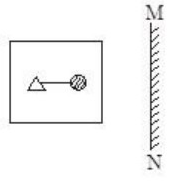
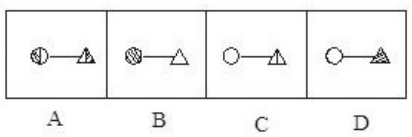
To find the mirror image of a figure, we need to reflect each element across the given mirror line. The mirror line MN is vertical, meaning the reflection will flip horizontally.
Option B correctly shows the triangle on the right and the shaded circle on the left, connected by a line.
Correct Option: B) The triangle and shaded circle are correctly swapped.
This is a logical reasoning question where we need to evaluate conclusions based on a given statement, assuming the statement is true. We must not use outside knowledge but only infer what logically follows from the statement provided.
C) Both conclusions I and II follow. Both conclusions are direct and logical inferences from the statement that waste management is a critical concern due to increasing waste.
The problem presents a series of alphanumeric terms, each consisting of a letter and a number separated by a hyphen. We need to identify the pattern in both the letter sequence and the number sequence to find the missing term.
The sequence of positions is 2, ?, 6, 8. This suggests a pattern where the difference between consecutive letters is 2. If we assume the missing letter's position is 4, then the letter would be D. This fits the pattern: \(2 \xrightarrow{+2} 4 \xrightarrow{+2} 6 \xrightarrow{+2} 8\). So, the missing letter is D.
The sequence of the bases of these squares is 5, ?, 3, 2. This is a decreasing sequence. Following the pattern, the missing base should be 4. Therefore, the missing number is \(4^2 = 16\).
D) D-16 is the correct option because it follows both the letter pattern (alphabetical position increases by 2) and the number pattern (decreasing squares of consecutive integers).
If KIN is written as PRM, then how would you write THREAD?
This is a coding-decoding question. We need to identify the pattern used to transform "KIN" into "PRM" and then apply the same pattern to "THREAD" to find the coded word.
This pattern (+5, +9, -1) seems inconsistent for a simple coding scheme. Let's try another common pattern: reverse alphabetical order (opposite letters).
This pattern perfectly matches: each letter in KIN is replaced by its opposite letter in the alphabet.
Correct Option: A) GSIVZW
To convert 1 kWh (kilowatt-hour) into Joules, we need to understand the definitions of kilowatt and hour in terms of standard SI units (watts and seconds). Energy is power multiplied by time. 1 Watt is 1 Joule per second.
Correct Option: C) 36,00,000 J is the correct conversion of 1 kWh to Joules.
To find the speed of the train, we first need to determine the total distance covered by the train to cross the bridge. When a train crosses a bridge, the total distance it travels is the sum of its own length and the length of the bridge. Once the total distance and time are known, the speed can be calculated using the formula: \(\text{Speed} = \frac{\text{Distance}}{\text{Time}}\). Finally, convert the speed from meters per second (m/s) to kilometers per hour (km/h).
When a train crosses a bridge, the total distance it travels is equal to the length of the train plus the length of the bridge.
\[ \text{Total Distance} = \text{Length of Train} + \text{Length of Bridge} \]\[ \text{Total Distance} = 161.5\ \text{m} + 758.5\ \text{m} \]\[ \text{Total Distance} = 920\ \text{m} \]The time taken to cross the bridge is given as 46 seconds.
\[ \text{Speed} = \frac{\text{Total Distance}}{\text{Time}} \]\[ \text{Speed} = \frac{920\ \text{m}}{46\ \text{s}} \]\[ \text{Speed} = 20\ \text{m/s} \]To convert speed from meters per second (m/s) to kilometers per hour (km/h), multiply by \(\frac{18}{5}\).
\[ \text{Speed in km/h} = \text{Speed in m/s} \times \frac{18}{5} \]\[ \text{Speed in km/h} = 20 \times \frac{18}{5} \]\[ \text{Speed in km/h} = 4 \times 18 \]\[ \text{Speed in km/h} = 72\ \text{km/h} \]Correct Option: B) 72 km/h
The question asks for the maximum strength of the Lok Sabha as of 2018. This requires knowledge of the provisions in the Indian Constitution regarding the composition of the Lok Sabha.
D) 552 is the maximum strength of the Lok Sabha as per the Constitution of India in 2018, comprising 530 members from states, 20 from Union Territories, and 2 nominated Anglo-Indian members.
The question asks about the substance responsible for the thickening of sclerenchyma cell walls. Sclerenchyma cells are known for their strong, rigid walls, which provide structural support to plants. We need to identify the specific chemical compound that contributes to this characteristic thickening.
B) Lignin is a complex polymer that provides significant mechanical strength and rigidity to plant cell walls, particularly in sclerenchyma cells and xylem vessels. Its deposition makes the walls thick, hard, and impermeable, enabling sclerenchyma to perform its supportive function.