A 1.5 m tall boy observes a pole. The angle of elevation of the top of the pole is 30° from the eyes of the boy. Then he approaches the pole by 7.3 m. Now the angle of elevation is 45°. Find the height of the pole from the ground. Take \(\sqrt{3}\) = 1.73.
This problem involves trigonometry, specifically the concept of angles of elevation. We need to set up two right-angled triangles based on the given information and use the tangent function to find the unknown distances and finally the height of the pole.
Let the height of the pole be \(H\). The boy's height is 1.5 m. So, the height of the pole above the boy's eye level is \(h = H - 1.5\) m.
Let the initial distance of the boy from the pole be \(x\) meters. When he approaches the pole by 7.3 m, his new distance from the pole is \((x - 7.3)\) meters.
From the first observation, the angle of elevation is 30°. In the right-angled triangle formed by the pole (above eye level), the boy's initial position, and the eye level, we have:
\[ \tan(30^\circ) = \frac{\text{Opposite}}{\text{Adjacent}} = \frac{h}{x} \]\[ \frac{1}{\sqrt{3}} = \frac{h}{x} \]\[ x = h\sqrt{3} \quad \text{(Equation 1)} \]From the second observation, the angle of elevation is 45°. In the new right-angled triangle:
\[ \tan(45^\circ) = \frac{\text{Opposite}}{\text{Adjacent}} = \frac{h}{x - 7.3} \]\[ 1 = \frac{h}{x - 7.3} \]\[ x - 7.3 = h \]\[ x = h + 7.3 \quad \text{(Equation 2)} \]Now, equate Equation 1 and Equation 2 to solve for \(h\):
\[ h\sqrt{3} = h + 7.3 \]\[ h\sqrt{3} - h = 7.3 \]\[ h(\sqrt{3} - 1) = 7.3 \]\[ h = \frac{7.3}{\sqrt{3} - 1} \]Substitute the given value of \(\sqrt{3} = 1.73\):
\[ h = \frac{7.3}{1.73 - 1} \]\[ h = \frac{7.3}{0.73} \]\[ h = 10 \text{ m} \]This is the height of the pole above the boy's eye level. To find the total height of the pole from the ground, add the boy's height:
\[ H = h + 1.5 \]\[ H = 10 + 1.5 \]\[ H = 11.5 \text{ m} \]B) 11.5 m is the correct height of the pole from the ground.
The question asks to identify the kingdom, according to Whittaker's five-kingdom classification, whose organisms lack a well-defined nucleus. This requires knowledge of the fundamental characteristics of each kingdom in Whittaker's system, specifically focusing on the presence or absence of a true nucleus.
C) Monera — Organisms in the Kingdom Monera are prokaryotes, meaning their cells lack a well-defined nucleus and other membrane-bound organelles. Their genetic material (DNA) is located in a region called the nucleoid, but it is not enclosed by a nuclear envelope.
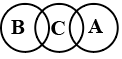
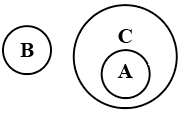
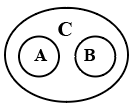
Which of the following correctly represents the relationship between
1. Car
2. Park
3. Satellite
To determine the correct relationship among "Car," "Park," and "Satellite," we need to consider their logical connections and how they might overlap or be distinct.
Correct Option: B) The diagram shows three separate circles, each representing "Car," "Park," and "Satellite," indicating no overlap or direct relationship among them.
The problem asks for the amount of charge flowing through a resistor given the current and the time duration. We can use the fundamental relationship between current, charge, and time to solve this problem.
The standard unit for time in physics is seconds. So, convert 1 minute to seconds.
\[ t = 1 \text{ minute} \times 60 \frac{\text{seconds}}{\text{minute}} = 60 \text{ seconds} \]Current is defined as the rate of flow of charge. Mathematically, this is expressed as:
\[ I = \frac{Q}{t} \]where \(I\) is the current, \(Q\) is the charge, and \(t\) is the time.A) 30 C is the correct answer. The amount of charge flowing in one minute is 30 Coulombs.
To solve this problem, we need to understand what it means for a train's tail end to cross a pole. This implies the total distance covered by the train from the moment its front end reaches the pole until its tail end leaves the pole. We will convert the speed to appropriate units (m/s) and then use the formula \(\text{Distance} = \text{Speed} \times \text{Time}\) to find the total distance covered by the front end of the train. Finally, we will subtract the length of the train to find the initial distance of the pole from the front end.
Given speed of the train, \(S = 36 \text{ km/hr}\).
To convert km/hr to m/s, multiply by \(\frac{5}{18}\):
\[ S = 36 \times \frac{5}{18} \text{ m/s} = 2 \times 5 \text{ m/s} = 10 \text{ m/s} \]The time taken for the tail end of the train to cross the pole is given as \(T = 53 \text{ seconds}\).
During this time, the front end of the train travels a total distance, let's call it \(D_{\text{total}}\).
\[ D_{\text{total}} = S \times T = 10 \text{ m/s} \times 53 \text{ s} = 530 \text{ m} \]This \(D_{\text{total}}\) is the distance the front end of the train travels from its initial position until the tail end of the train has completely crossed the pole.
Let \(L = 110 \text{ m}\) be the length of the train.
When the tail end of the train crosses the pole, the front end has traveled a distance equal to the initial distance of the pole from the front end plus the length of the train.
So, \(D_{\text{total}} = \text{Initial distance} + \text{Length of the train}\).
Let \(D_{\text{initial}}\) be the initial distance of the pole from the front end of the train.
\[ D_{\text{initial}} = D_{\text{total}} - L = 530 \text{ m} - 110 \text{ m} = 420 \text{ m} \]Correct Option: A) 420 m
Find the \( \frac{13}{16} \) worth of land whose \( \frac{9}{7} \) worth is Rs 10,116.
The problem asks us to find a fractional worth of land given another fractional worth and its corresponding value. We can solve this by first determining the full worth of the land using the given information, and then calculating the desired fractional worth.
C) 6,392.75 is the correct answer, as calculated in the step-by-step solution.
The problem involves setting up a system of two linear equations based on the given age relationships between Shaan and Uddalak at two different points in time (present and 26 years ago). We will define variables for their current ages, translate the given statements into algebraic equations, and then solve the system to find Shaan's present age.
Define variables:
Let Shaan's current age be \(S\) years.
Let Uddalak's current age be \(U\) years.
Formulate the first equation (present age relationship):
"Shaan’s current age is four years less than 1.6 times that of Uddalak’s."
\[ S = 1.6U - 4 \quad \text{(Equation 1)} \]Formulate the second equation (age relationship 26 years ago):
26 years ago, Shaan's age was \(S - 26\).
26 years ago, Uddalak's age was \(U - 26\).
"26 years ago, Uddalak’s age was one year less than half of Shaan’s age."
\[ U - 26 = \frac{1}{2}(S - 26) - 1 \]Simplify Equation 2:
\[ U - 26 = \frac{S}{2} - \frac{26}{2} - 1 \]\[ U - 26 = \frac{S}{2} - 13 - 1 \]\[ U - 26 = \frac{S}{2} - 14 \]\[ U = \frac{S}{2} - 14 + 26 \]\[ U = \frac{S}{2} + 12 \quad \text{(Equation 2 Simplified)} \]Substitute Equation 2 into Equation 1:
Now we have \(S\) in terms of \(U\) and \(U\) in terms of \(S\). Substitute the expression for \(U\) from the simplified Equation 2 into Equation 1:
\[ S = 1.6 \left( \frac{S}{2} + 12 \right) - 4 \]\[ S = 1.6 \times \frac{S}{2} + 1.6 \times 12 - 4 \]\[ S = 0.8S + 19.2 - 4 \]\[ S = 0.8S + 15.2 \]Solve for S:
\[ S - 0.8S = 15.2 \]\[ 0.2S = 15.2 \]\[ S = \frac{15.2}{0.2} \]\[ S = \frac{152}{2} \]\[ S = 76 \]Find Uddalak's current age (optional, for verification):
Using Equation 2 Simplified:
\[ U = \frac{S}{2} + 12 \]\[ U = \frac{76}{2} + 12 \]\[ U = 38 + 12 \]\[ U = 50 \]Verify with Equation 1:
\[ S = 1.6U - 4 \]\[ 76 = 1.6(50) - 4 \]\[ 76 = 80 - 4 \]\[ 76 = 76 \]The ages are consistent with both conditions.
Shaan's present age is 76 years.
Correct Option: B) 76
The question asks for the full form of NITI, an acronym commonly associated with government bodies in India. This requires knowledge of current affairs and the structure of Indian governance.
Correct Option: B) National Institution for Transforming India
NITI Aayog (National Institution for Transforming India) is a policy think tank of the Government of India, established with the aim to achieve sustainable development goals with cooperative federalism by fostering the involvement of State Governments of India in the economic policy-making process. It replaced the Planning Commission on January 1, 2015.
If “LAME” is coded as JYKC, how would “MINE” be written?
The problem is a coding-decoding type where a word is coded using a specific pattern. We need to identify this pattern by comparing the given word "LAME" with its coded form "JYKC" and then apply the same pattern to code the word "MINE".
The consistent pattern observed is that each letter in the original word is shifted back by 2 positions in the English alphabet to get its coded letter.
Correct Option: A) KGLC is the correct coding for "MINE" based on the \(-2\) shift pattern.
To find the total energy consumed, we need to calculate the energy consumed per day and then multiply it by the total number of days. The energy consumed by an appliance is given by the product of its power rating and the time it is operated. The power is given in Watts (W), and the time is given in hours. We need to convert the energy into kilowatt-hours (kWh).
Since 1 kW = 1000 W, we can convert the power:
\[ P = 1000 \text{ W} = \frac{1000}{1000} \text{ kW} = 1 \text{ kW} \]Energy consumed per day (\(E_{\text{day}}\)) is the product of power in kW and time in hours per day:
\[ E_{\text{day}} = P \times t_{\text{day}} \]\[ E_{\text{day}} = 1 \text{ kW} \times 3 \text{ hours/day} = 3 \text{ kWh/day} \]Total energy consumed (\(E_{\text{total}}\)) is the energy consumed per day multiplied by the total number of days:
\[ E_{\text{total}} = E_{\text{day}} \times N \]\[ E_{\text{total}} = 3 \text{ kWh/day} \times 30 \text{ days} = 90 \text{ kWh} \]Correct Option: C) 90 kWh