
70÷5×(10–8÷2)÷3=?
To solve this problem, we need to follow the order of operations, often remembered by the acronym PEMDAS/BODMAS:
We will evaluate the expression step-by-step, starting with the operations inside the parentheses.
The expression inside the parentheses is \( (10 - 8 \div 2) \). According to BODMAS, division comes before subtraction.
\[ 8 \div 2 = 4 \]Now, substitute the result back into the parentheses:
\[ 10 - 4 = 6 \]The original expression becomes:
\[ 70 \div 5 \times 6 \div 3 \]First, perform the division \( 70 \div 5 \):
\[ 70 \div 5 = 14 \]Now, perform the multiplication \( 14 \times 6 \):
\[ 14 \times 6 = 84 \]Perform the division \( 84 \div 3 \):
\[ 84 \div 3 = 28 \]A) The final calculated value is 28.
Frictional force acts ______.
Against the direction of the force
At any angle to the direction of the force.
In the direction of the force
Perpendicular to the direction of the force
The question asks about the direction of frictional force. Frictional force is a resistive force that opposes motion or the tendency of motion between surfaces in contact. Understanding its nature helps determine its direction relative to the applied force or motion.
Therefore, frictional force always acts against the direction of the applied force or the direction of motion.
A) Against the direction of the force — This is correct. Frictional force is inherently an opposing force, meaning it always acts in the opposite direction to the applied force or the impending motion.
Can you tell which argument is strong?
Statement: Should government take priority in linking rivers?
i) Yes, in the long run this will entirely eradicate the problem of water shortages in remote areas.
ii) No, we shouldn't contaminate the water and the rivers will naturally take its course
Both I and II are strong
Only argument II is strong
Only argument I is strong
Neither I nor II is strong
This question asks us to identify which argument is strong in response to the statement: "Should government take priority in linking rivers?" A strong argument is one that is logical, relevant, and provides a compelling reason for or against the statement. It should not be based on assumptions or extreme claims.
C) Only argument I is strong. Argument I provides a clear and significant benefit (eradicating water shortages) that directly supports making river linking a priority. While the word "entirely" is strong, the overall premise of addressing water scarcity is a powerful justification for such a project.
To identify the group to which elements with specific atomic numbers belong, we need to locate them in the periodic table. The atomic number directly tells us the position of an element in the periodic table, which in turn indicates its chemical properties and group affiliation.
Correct Option: D) halogens
Find the number of squares in the following figure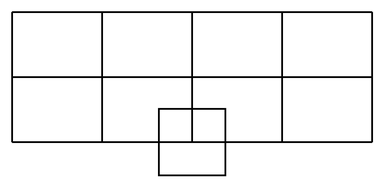
To find the total number of squares in the given figure, we need to count all possible squares of different sizes.
Correct Option: C) 17
Find the odd one out.
| A | B | C | D |
| W23 | I10 | L12 | Q17 |
To find the ratio of the areas of a circular plot and a square plot when their perimeters are equal, we need to express their areas in terms of a common variable derived from the perimeter equality. We will set up equations for the perimeter and area of both shapes, equate their perimeters, and then find the ratio of their areas.
Define variables:
Formulate perimeter equations:
Equate perimeters: Given that the perimeters are equal, \(P_c = P_s\).
\[ 2\pi r = 4a \]Express one variable in terms of the other: From the perimeter equality, we can express \(a\) in terms of \(r\):
\[ a = \frac{2\pi r}{4} = \frac{\pi r}{2} \]Formulate area equations:
Substitute to find \(A_s\) in terms of \(r\):
\[ A_s = \left(\frac{\pi r}{2}\right)^2 = \frac{\pi^2 r^2}{4} \]Calculate the ratio of their areas (\(A_c : A_s\)):
\[ \frac{A_c}{A_s} = \frac{\pi r^2}{\frac{\pi^2 r^2}{4}} \]Simplify the ratio:
\[ \frac{A_c}{A_s} = \frac{\pi r^2 \times 4}{\pi^2 r^2} = \frac{4}{\pi} \]Substitute the value of \(\pi\): Using the approximation \(\pi = \frac{22}{7}\):
\[ \frac{A_c}{A_s} = \frac{4}{\frac{22}{7}} = \frac{4 \times 7}{22} = \frac{28}{22} \]Reduce the ratio to its simplest form:
\[ \frac{A_c}{A_s} = \frac{14}{11} \]So, the ratio of their respective areas (circular plot to square plot) is \(14 : 11\).
Correct Option: D) 14 : 11
The question asks for the generation capacity of the largest wind energy plant in Kanyakumari. This is a factual question related to renewable energy infrastructure in India, specifically Tamil Nadu.
Correct Option: C) 400
The Muppandal Wind Farm in Kanyakumari, Tamil Nadu, is one of the largest onshore wind farms globally. While its total installed capacity is much higher (around 1,500 MW), a significant and often cited capacity for a major operational segment or an early large-scale project within the region is 400 MW. This figure is commonly associated with the largest wind energy generation capacity in Kanyakumari in the context of competitive examinations.
The problem asks us to find the atomic number of an isotope given its mass number and the number of neutrons in its nucleus. We need to recall the fundamental relationship between mass number, atomic number, and the number of neutrons in an atom's nucleus.
Therefore, the atomic number of the isotope is 109.
Correct Option: A) 109 is the correct atomic number calculated from the given mass number and number of neutrons.
The problem involves similar triangles formed by a line parallel to the base of a larger triangle. We will use the property of similar triangles, specifically the Basic Proportionality Theorem (Thales's Theorem) and its consequences, to find the required ratio.
Understand the given information:
Identify similar triangles due to \(DE \parallel BC\):
Since \(DE \parallel BC\), by the Basic Proportionality Theorem and its converse, \(\triangle ADE\) is similar to \(\triangle ABC\).
This implies that the ratio of corresponding sides is equal:
\[ \frac{AD}{AB} = \frac{AE}{AC} = \frac{DE}{BC} \]Calculate the ratio \(AD/AB\):
Given \(AD : DB = 4 : 3\), let \(AD = 4x\) and \(DB = 3x\).
Then \(AB = AD + DB = 4x + 3x = 7x\).
So, the ratio \(AD/AB\) is:
Determine the ratio \(DE/BC\):
From the similarity of \(\triangle ADE\) and \(\triangle ABC\), we have:
Identify another pair of similar triangles:
Consider \(\triangle DOE\) and \(\triangle COB\).
Since \(DE \parallel BC\):
Therefore, \(\triangle DOE \sim \triangle COB\) by AAA similarity criterion.
Use the similarity of \(\triangle DOE\) and \(\triangle COB\) to find \(DO/OC\):
For similar triangles, the ratio of corresponding sides is equal:
Substitute the value of \(DE/BC\):
From step 4, we know \(DE/BC = 4/7\).
So, \(DO/OC = 4/7\).
Find the ratio \(DO\) to \(DC\):
We have \(DO/OC = 4/7\). This means \(DO = 4k\) and \(OC = 7k\) for some constant \(k\).
Then \(DC = DO + OC = 4k + 7k = 11k\).
The ratio of \(DO\) to \(DC\) is:
B) 4 : 11