
This question relates to the principles of conservation of momentum and energy in a gun-bullet system. When a gun fires a bullet, both the gun and the bullet acquire momentum. According to Newton's third law and the conservation of momentum, the total momentum of the system remains zero (assuming it starts from rest). However, kinetic energy is not conserved in this process; it is generated by the chemical energy of the gunpowder. We need to compare the kinetic energy of the bullet and the gun.
Conservation of Momentum: When a bullet is fired, the gun recoils. According to the principle of conservation of momentum, the total momentum of the gun-bullet system before firing (which is zero) must be equal to the total momentum after firing.
\[ m_g v_g + m_b v_b = 0 \]Where \(m_g\) is the mass of the gun, \(v_g\) is the recoil velocity of the gun, \(m_b\) is the mass of the bullet, and \(v_b\) is the velocity of the bullet. From this, we get:
\[ m_g v_g = -m_b v_b \]The negative sign indicates that the velocities are in opposite directions. The magnitudes of the momenta are equal:
\[ |m_g v_g| = |m_b v_b| \]Comparing Masses: The mass of the gun (\(m_g\)) is significantly greater than the mass of the bullet (\(m_b\)).
\[ m_g > m_b \]Comparing Velocities: Since the magnitudes of the momenta are equal and \(m_g > m_b\), it implies that the velocity of the bullet (\(v_b\)) must be much greater than the recoil velocity of the gun (\(v_g\)).
\[ v_b > v_g \]Comparing Kinetic Energies: The kinetic energy (\(KE\)) of an object is given by the formula:
\[ KE = \frac{1}{2} m v^2 \]For the gun and the bullet, their kinetic energies are:
\[ KE_g = \frac{1}{2} m_g v_g^2 \] \[ KE_b = \frac{1}{2} m_b v_b^2 \]Deriving the Relationship: We know that \(m_g v_g = m_b v_b\). We can express \(v_g\) in terms of \(v_b\):
\[ v_g = \frac{m_b}{m_g} v_b \]Now substitute this into the kinetic energy equation for the gun:
\[ KE_g = \frac{1}{2} m_g \left(\frac{m_b}{m_g} v_b\right)^2 \] \[ KE_g = \frac{1}{2} m_g \frac{m_b^2}{m_g^2} v_b^2 \] \[ KE_g = \frac{1}{2} \frac{m_b^2}{m_g} v_b^2 \]We can rewrite this as:
\[ KE_g = \left(\frac{m_b}{m_g}\right) \left(\frac{1}{2} m_b v_b^2\right) \] \[ KE_g = \left(\frac{m_b}{m_g}\right) KE_b \]Since \(m_g > m_b\), the ratio \(\frac{m_b}{m_g}\) is less than 1. Therefore,
\[ KE_g < KE_b \]This means the kinetic energy of the bullet is greater than the kinetic energy of the gun.
C) More than the gun
As derived, the kinetic energy of the bullet is significantly greater than the kinetic energy of the gun due to its much higher velocity, even though its mass is smaller.
To find the square root of a decimal number, we can first remove the decimal point, find the square root of the resulting integer, and then place the decimal point back in the correct position. Alternatively, we can use the long division method for square roots.
C) 3.7 is the correct square root of 13.69.
The question asks to identify the actor whose autobiography is titled "Khullam Khulla". This is a factual question testing knowledge of famous personalities and their literary works, specifically autobiographies.
Correct Option: C) Rishi Kapoor
Rishi Kapoor, the veteran Bollywood actor, released his autobiography titled "Khullam Khulla: Rishi Kapoor Uncensored" in 2017. The book provides an candid account of his life, career, and experiences in the film industry.
Select the option that can replace the question mark (?) in the following series.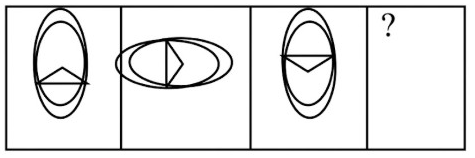
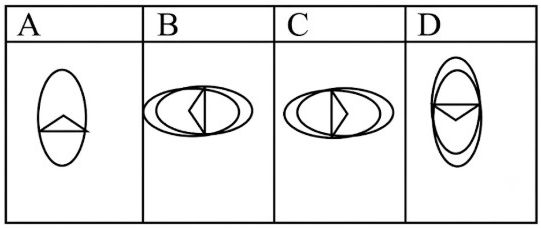
The series involves a sequence of diagrams with ellipses and triangles. The goal is to identify the pattern and select the option that logically follows the sequence.
Correct Option: D) The triangle points left, completing the rotation pattern.
A truck falls off a ledge and drops to the ground in 0.8 secs. How high is the ledge from the ground? (g = 10 m/s²)
This problem involves free fall motion under gravity. We need to find the vertical distance (height) covered by the truck given the time it takes to fall and the acceleration due to gravity. We can use the second equation of motion for uniformly accelerated motion.
For an object falling under gravity, the vertical distance \(h\) can be calculated using the second equation of motion:
\[ h = ut + \frac{1}{2}gt^2 \]Since the initial velocity \(u = 0\), the term \(ut\) becomes \(0\).
\[ h = (0)(0.8) + \frac{1}{2}(10)(0.8)^2 \]\[ h = 0 + \frac{1}{2}(10)(0.64) \]\[ h = 5 \times 0.64 \]\[ h = 3.2 \text{ m} \]The height of the ledge from the ground is \(3.2 \text{ m}\).
Correct Option: C) 3.2 m
To find the Highest Common Factor (HCF) of a set of numbers, we can use the prime factorization method. This involves finding the prime factors of each number and then multiplying the common prime factors raised to their lowest powers.
First, we find the prime factors of 54.
\[ 54 = 2 \times 27 \]\[ 54 = 2 \times 3 \times 9 \]\[ 54 = 2 \times 3 \times 3 \times 3 \]\[ 54 = 2^1 \times 3^3 \]Next, we find the prime factors of 66.
\[ 66 = 2 \times 33 \]\[ 66 = 2 \times 3 \times 11 \]\[ 66 = 2^1 \times 3^1 \times 11^1 \]Then, we find the prime factors of 90.
\[ 90 = 2 \times 45 \]\[ 90 = 2 \times 3 \times 15 \]\[ 90 = 2 \times 3 \times 3 \times 5 \]\[ 90 = 2^1 \times 3^2 \times 5^1 \]Now, we list the prime factors for all three numbers:
The common prime factors are 2 and 3.
Multiply the common prime factors raised to their lowest powers.
\[ \text{HCF} = 2^1 \times 3^1 \]\[ \text{HCF} = 2 \times 3 \]\[ \text{HCF} = 6 \]A) 6 — The HCF of 54, 66, and 90 is 6, as calculated by finding the product of their common prime factors raised to the lowest power.
Given is a statement followed by two arguments numbered I and II. Consider the statement and the arguments and decide which of the arguments is/are strong.
Statement:
Are games to be made compulsory for primary students?
Arguments:
I. Yes, games are important for physical development.
II. No, games waste the academic time of the students, thus making them weaker in academics.
Both argument I and II are strong.
Only argument II is strong.
Neither argument I nor II is strong.
Only argument I is strong.
This question asks us to evaluate the strength of two arguments regarding whether games should be compulsory for primary students. We need to determine which argument provides a valid and generally accepted reason to support or oppose the statement.
Correct Option: D) Only argument I is strong.
Argument I correctly identifies the importance of games for physical development, which is a fundamental aspect of a child's growth and well-being. This is a strong and valid reason to make games compulsory for primary students.
Who was the first female CEO of Lloyd’s of London?
Deanna M. Mulligan
Beth E. Mooney
Anna Manning
Inga Beale
The question asks to identify the first female CEO of Lloyd's of London. This requires knowledge of prominent figures in the insurance industry, specifically related to Lloyd's of London.
Correct Option: D) Inga Beale was appointed as the Chief Executive Officer of Lloyd's of London in 2014, making her the first woman to hold this position in the institution's 328-year history. She served until 2018.
Using the statement can we verify the conclusions?
Statements:
All diagrams are figures
All figures are three dimensions
Conclusions:
1. All three dimensions are diagrams
2. All figures are diagrams
All the conclusions follow
No conclusion follows.
Only conclusion 1 follows
Only conclusion 2 follows.
This problem involves syllogistic reasoning. We need to evaluate the given conclusions based on the provided statements. A good way to visualize these relationships is by using Venn diagrams.
This means that the set of 'Diagrams' is entirely contained within the set of 'Figures'. We can represent this as: \[ \text{Diagrams} \subset \text{Figures} \]
This means that the set of 'Figures' is entirely contained within the set of 'Three Dimensions'. We can represent this as: \[ \text{Figures} \subset \text{Three Dimensions} \]
From the above, we can infer a transitive relationship: if all diagrams are figures, and all figures are three dimensions, then all diagrams must also be three dimensions. \[ \text{Diagrams} \subset \text{Figures} \subset \text{Three Dimensions} \implies \text{Diagrams} \subset \text{Three Dimensions} \]
This conclusion implies that the set of 'Three Dimensions' is entirely contained within the set of 'Diagrams'. However, our combined statements only tell us that diagrams are a subset of three dimensions. There could be three-dimensional objects that are not figures, and figures that are not diagrams. Therefore, this conclusion is not necessarily true.
This conclusion implies that the set of 'Figures' is entirely contained within the set of 'Diagrams'. Our first statement clearly says "All diagrams are figures," which means diagrams are a subset of figures. This does not mean that all figures are diagrams. There could be figures that are not diagrams. Therefore, this conclusion is not necessarily true.
Correct Option: B) No conclusion follows.
The question asks to identify the process where electricity is passed through a 10% NaCl solution. This is a common industrial process for producing important chemicals.
B) Chlor-alkali process — This is the correct name for the industrial process that involves the electrolysis of an aqueous sodium chloride solution to produce chlorine, hydrogen, and sodium hydroxide.