
The question asks for the present-day Indian state where Champaran, the site of Gandhiji's first Satyagraha in India, is located. This requires knowledge of Indian history and geography.
Correct Option: D) Bihar is the correct answer because Champaran district, where Gandhiji launched his first Satyagraha in India in 1917, is located in the present-day state of Bihar.
What is the name of the compound shown in the below structure?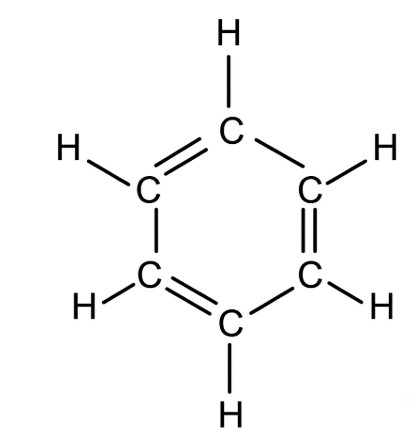
To identify the compound from the given structure, we need to recognize the arrangement of atoms and bonds in the diagram. The structure shows a hexagonal ring with alternating single and double bonds, which is characteristic of benzene.
Correct Option: B) Benzene
To find the angle between the hour hand and the minute hand at a specific time, we need to calculate the angular position of each hand relative to the 12 o'clock mark and then find the difference between these positions. The clock face is a circle, which measures 360 degrees. There are 12 hours on a clock face, so each hour mark represents \(360^\circ / 12 = 30^\circ\). There are 60 minutes, so each minute mark represents \(360^\circ / 60 = 6^\circ\).
At 6:25 p.m., the minute hand is exactly at the 25-minute mark. Since each minute mark corresponds to \(6^\circ\), the angle of the minute hand from the 12 o'clock position is:
\[ \text{Angle of minute hand} = 25 \text{ minutes} \times 6^\circ/\text{minute} = 150^\circ \]The hour hand moves \(360^\circ\) in 12 hours, which means it moves \(30^\circ\) per hour. It also moves continuously. At 6:25 p.m., the hour hand is past the 6 o'clock mark. To find its exact position, we consider the hour (6) and the minutes (25).
The angle covered by the hour hand in 6 hours is:
\[ 6 \text{ hours} \times 30^\circ/\text{hour} = 180^\circ \]Additionally, in 25 minutes, the hour hand moves a fraction of the distance between the 6 and 7 o'clock marks. The hour hand moves \(30^\circ\) in 60 minutes, so in 25 minutes it moves:
\[ \frac{25}{60} \times 30^\circ = \frac{5}{12} \times 30^\circ = 5 \times 2.5^\circ = 12.5^\circ \]So, the total angle of the hour hand from the 12 o'clock position is:
\[ \text{Angle of hour hand} = 180^\circ + 12.5^\circ = 192.5^\circ \]The angle between the two hands is the absolute difference between their individual angles:
\[ \text{Angle} = |\text{Angle of hour hand} - \text{Angle of minute hand}| \]\[ \text{Angle} = |192.5^\circ - 150^\circ| \]\[ \text{Angle} = 42.5^\circ \]The calculated angle \(42.5^\circ\) is an acute angle (less than \(180^\circ\)). If the calculated angle were greater than \(180^\circ\), we would subtract it from \(360^\circ\) to find the acute angle.
C) 42.5° is the acute angle between the hour hand and the minute hand at 6:25 p.m.
A proportion states that two ratios are equal. If four numbers \(a, b, c, d\) are in proportion, it means that the ratio of the first two terms is equal to the ratio of the last two terms. This can be written as \(a:b :: c:d\) or \[\frac{a}{b} = \frac{c}{d}\]. We are given the first three terms and need to find the fourth term.
Let the four terms of the proportion be \(a, b, c, d\).
According to the problem, the first three terms are 3, 5, and 21, respectively. So, \(a = 3\), \(b = 5\), and \(c = 21\).
Let the fourth term be \(x\). So, \(d = x\).
For these terms to be in proportion, the ratio of the first two terms must be equal to the ratio of the last two terms:
\[ \frac{a}{b} = \frac{c}{d} \]Substitute the given values into the proportion:
\[ \frac{3}{5} = \frac{21}{x} \]To solve for \(x\), we can cross-multiply:
\[ 3 \times x = 5 \times 21 \]\[ 3x = 105 \]Divide both sides by 3 to find \(x\):
\[ x = \frac{105}{3} \]\[ x = 35 \]Therefore, the fourth term of the proportion is 35.
Correct Option: C) 35
This is an analogy question. We need to identify the relationship between the first pair of words (Linen and Cloth) and then find a word that shares the same relationship with 'Gold'.
Linen is a type of fabric or material, and 'Cloth' is a general term for fabric. So, Linen is a specific kind of cloth.
We are looking for a general category to which Gold belongs, similar to how Linen belongs to the category of Cloth.
Correct Option: B) Metal
The angle of depression of the foot of a building from the top of a tower 32\(\sqrt{3}\) m high is 60°. How far away from the building is the tower?
This problem involves trigonometry, specifically the concept of angles of depression. We can visualize the situation as a right-angled triangle where the height of the tower is one leg, the distance from the tower to the building is the other leg, and the angle of depression is related to one of the acute angles in the triangle. We will use the tangent function to relate these quantities.
Thus, the tower is 32 m away from the building.
A) 32 m is the correct answer. The calculation using the tangent function correctly yields this distance.
In Δ ABC, D and E are points on AB and AC respectively such that DE is parallel to BC. If AD = 2 cm, BD = 3 cm, then \(\dfrac{\operatorname{ar}(\triangle ADE)}{\operatorname{ar}(\triangle ABC)}\) is:
\( \frac{4}{9} \)
\( \frac{16}{81} \)
\( \frac{4}{25} \)
\( \frac{2}{5} \)
The problem involves two triangles, \(\triangle ADE\) and \(\triangle ABC\), where \(DE\) is parallel to \(BC\). This condition implies that the two triangles are similar. We can use the property that the ratio of the areas of two similar triangles is equal to the square of the ratio of their corresponding sides.
Identify similar triangles: Given that \(DE \parallel BC\), we can conclude that \(\triangle ADE \sim \triangle ABC\). This is because:
By AAA similarity criterion, \(\triangle ADE \sim \triangle ABC\).
Recall the property of areas of similar triangles: For two similar triangles, the ratio of their areas is equal to the square of the ratio of their corresponding sides. That is,
\[ \frac{\operatorname{ar}(\triangle ADE)}{\operatorname{ar}(\triangle ABC)} = \left(\frac{AD}{AB}\right)^2 = \left(\frac{AE}{AC}\right)^2 = \left(\frac{DE}{BC}\right)^2 \]Calculate the length of AB: We are given \(AD = 2\text{ cm}\) and \(BD = 3\text{ cm}\). Therefore, the length of \(AB\) is:
\[ AB = AD + BD = 2\text{ cm} + 3\text{ cm} = 5\text{ cm} \]Calculate the ratio of corresponding sides: The ratio of the corresponding sides \(AD\) and \(AB\) is:
\[ \frac{AD}{AB} = \frac{2}{5} \]Calculate the ratio of the areas: Using the property from step 2:
\[ \frac{\operatorname{ar}(\triangle ADE)}{\operatorname{ar}(\triangle ABC)} = \left(\frac{AD}{AB}\right)^2 = \left(\frac{2}{5}\right)^2 = \frac{2^2}{5^2} = \frac{4}{25} \]C) \( \frac{4}{25} \) is the correct ratio of the areas of \(\triangle ADE\) to \(\triangle ABC\).
What will be the unit digit in 331?
To find the unit digit of a number raised to a power, we observe the pattern of the unit digits of the base number when raised to successive powers. This pattern is cyclic.
Therefore, the unit digit in \(3^{31}\) is \(7\).
To find the least number that must be added to 4042 to make it a perfect square, we need to find the smallest perfect square greater than 4042. We can do this by finding the square root of 4042 and then considering the next integer's square.
We know that:
\[ 60^2 = 3600 \]\[ 70^2 = 4900 \]Since 4042 is between 3600 and 4900, its square root will be between 60 and 70. Let's try squaring numbers close to the square root of 4042.
Let's try \(63^2\):
\[ 63^2 = 63 \times 63 = 3969 \]This is less than 4042. So, the next perfect square must be \(64^2\).
This is the smallest perfect square greater than 4042.
The number to be added is the difference between this perfect square and 4042:
\[ \text{Number to be added} = 4096 - 4042 = 54 \]D) 54 is the least number that must be added to 4042 to make it a perfect square (\(4042 + 54 = 4096 = 64^2\)).
This is a syllogism problem. We need to evaluate the given conclusions based on the provided statements. We can use Venn diagrams or logical deduction to determine which conclusions logically follow.
C) Only conclusion 1 follows.