The question asks to identify the only non-metal element present in Group 1 of the Modern Periodic Table. To answer this, one needs to recall the classification of elements in the periodic table, specifically focusing on Group 1 elements and their metallic/non-metallic properties.
Correct Option: D) Hydrogen is a non-metal and is placed in Group 1 of the Modern Periodic Table because it has one valence electron, similar to alkali metals, although its chemical properties are distinctly non-metallic.
To find the time taken for the body to stop, we need to first calculate the acceleration caused by the retarding force. Once the acceleration is known, we can use the first equation of motion to determine the time.
Identify the given values:
Calculate the acceleration (a) using Newton's second law:
Newton's second law states \(F = ma\). Since it's a retarding force, the acceleration will be negative (deceleration).
\[ a = \frac{F}{m} \] \[ a = \frac{-60\ \text{N}}{30\ \text{kg}} \] \[ a = -2\ \text{m/s}^2 \]The negative sign indicates that the acceleration is in the opposite direction to the initial motion, causing the body to slow down.
Use the first equation of motion to find the time (t):
The first equation of motion is \(v = u + at\).
Rearrange the equation to solve for \(t\):
\[ t = \frac{v - u}{a} \]Substitute the known values:
\[ t = \frac{0\ \text{m/s} - 20\ \text{m/s}}{-2\ \text{m/s}^2} \] \[ t = \frac{-20\ \text{m/s}}{-2\ \text{m/s}^2} \] \[ t = 10\ \text{s} \]Correct Option: B) 10 s
The body will take 10 seconds to stop.
The given series is an alternating series. We need to identify the pattern by looking at the differences or relationships between consecutive terms or alternate terms.
A) 33. The series consists of two interleaved arithmetic progressions. The odd-positioned terms (1st, 3rd, 5th, ...) form the series 3, 13, 23, ... where each term is 10 more than the previous one. The even-positioned terms (2nd, 4th, 6th, ...) form the series 2, 12, 22, ... where each term is also 10 more than the previous one. Since the last given term (22) is the 6th term (even position), the next term will be the 7th term (odd position), which is \(23 + 10 = 33\).
Select the option figure that will complete the series of question figures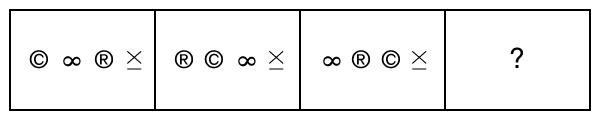
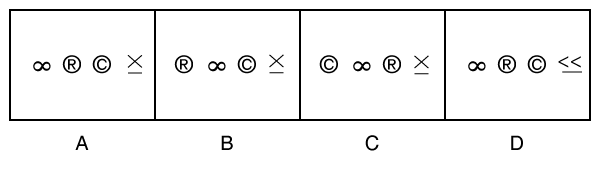
To solve this problem, we need to identify the pattern in the sequence of symbols presented in the question figures and select the option that logically completes the series.
Correct Option: C) ©, ∞, ®, ×
The question asks about the phenomenon responsible for echoes. We need to identify the basic principle of sound wave behavior that causes an echo.
Correct Option: A) Reflection of sound waves. Echoes are a direct result of sound waves bouncing off a surface and returning to the listener, which is the definition of reflection.
The question asks to identify a unisexual flower from the given options. A unisexual flower contains either male reproductive organs (stamens) or female reproductive organs (pistil/carpels), but not both. Bisexual flowers, on the other hand, contain both male and female reproductive organs.
D) Papaya is a unisexual flower. Papaya plants are dioecious, meaning male and female reproductive organs are found on separate individual plants, leading to unisexual flowers.
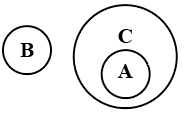
Which of the following correctly represents the relationship between:
A) Vegetation
B) Jupiter
C) Earth
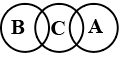
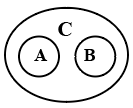
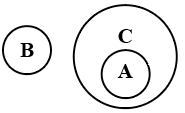
To determine the correct relationship between Vegetation, Jupiter, and Earth, consider their natural associations. Vegetation is found on Earth, and Earth is a planet within the solar system, which includes Jupiter. Jupiter, however, does not have vegetation.
Correct Option: A) Option A correctly represents Vegetation as part of Earth, with Jupiter as a separate entity.
The question asks to identify the recipient of the "Bharat Gaurav Award" 2017 in the Science and Technology category. This is a factual question requiring knowledge of awards and their recipients.
The "Bharat Gaurav Award" is presented by the Sanskriti Yuva Sanstha to individuals who have made significant contributions in various fields. In 2017, Dr. Anil K. Tripathi, a distinguished scientist, was honored with this award in the Science and Technology category for his notable contributions.
B) Anil K. Tripathi was awarded the "Bharat Gaurav Award" in 2017 for his contributions to Science and Technology. He is known for his work as a scientist and director of the CSIR-Central Institute of Medicinal and Aromatic Plants (CIMAP).
This is a syllogism problem. We can solve it by drawing Venn diagrams or by applying rules of logical deduction. We will use Venn diagrams to visualize the relationships between the categories: Pins, Sharp, and Metals.
This means there is an overlap between the set of 'Pins' and the set of 'Sharp' objects. We can draw two intersecting circles, one for 'Pins' and one for 'Sharp', with the intersection representing the pins that are sharp.
This means the entire set of 'Sharp' objects is contained within the set of 'Metals'. So, the 'Sharp' circle must be completely inside the 'Metals' circle.
Draw a large circle for 'Metals'. Inside this 'Metals' circle, draw the 'Sharp' circle. Then, draw the 'Pins' circle such that it intersects with the 'Sharp' circle (as per statement 1). This intersection part of 'Pins' will also be inside the 'Metals' circle because 'Sharp' is inside 'Metals'.
From our combined diagram, we can see that the 'Metals' circle is much larger and contains 'Sharp' entirely, and only a part of 'Pins' overlaps with 'Sharp' (and thus with 'Metals'). There are many metals that are not pins. Therefore, this conclusion does not logically follow.
Since "All Sharp are metals" (Statement 2), it directly implies that there must be some metals that are sharp (specifically, all the objects that are sharp are also metals). If all members of a smaller set are part of a larger set, then some members of the larger set must be those from the smaller set. This conclusion logically follows.
Correct Option: B) Only conclusion 2 follows.
To determine the type of bond in an oxygen molecule (\(\text{O}_2\)), we need to understand its electronic configuration and how atoms achieve stability by forming chemical bonds. We will analyze the valence electrons of oxygen and how they are shared.
A) a double covalent bond. In an oxygen molecule (\(\text{O}_2\)), each oxygen atom needs two electrons to complete its octet. They achieve this by sharing two pairs of electrons, forming a double covalent bond between the two oxygen atoms.