
To find the next term in the series, we need to identify the pattern in both the numerical part and the alphabetical part of each term. We will analyze the progression of numbers and letters separately.
Analyze the numerical sequence:
The numbers in the series are 4, 7, 12, 19.
The differences are 3, 5, 7. This is a sequence of consecutive odd numbers. The next difference should be 9.
So, the next number in the series will be \(19 + 9 = 28\).
Analyze the alphabetical sequence:
The letters in the series are A, B, D, G.
Let's find the position of each letter in the English alphabet (A=1, B=2, C=3, ...):
Now, let's look at the difference in their positions:
The differences in positions are 1, 2, 3. This is a sequence of consecutive natural numbers. The next difference should be 4.
So, the next letter will be 4 positions after G. G is the 7th letter, so \(7 + 4 = 11\). The 11th letter of the alphabet is K.
Combine the numerical and alphabetical parts:
The next number is 28 and the next letter is K.
Therefore, the next term in the series is 28K.
Correct Option: A) 28K
The problem asks us to calculate the total length of wire required to enclose a square field. We are given the area of the field, the number of wires to be placed, and that each wire's length is 5% greater than the field's perimeter. First, we need to find the side length of the square field from its area. Then, calculate the perimeter. After that, determine the length of a single wire, considering the 5% increase. Finally, multiply this single wire length by the number of wires to get the total length.
Calculate the side length of the square field:
Given the area of the square field is 31684 sq. meters.
Let \(s\) be the side length of the square field.
\[ \text{Area} = s^2 \] \[ 31684 = s^2 \] \[ s = \sqrt{31684} \]To find the square root of 31684:
We can estimate: \(100^2 = 10000\), \(200^2 = 40000\). So, the side length is between 100 and 200. The last digit is 4, so the unit digit of \(s\) must be 2 or 8.
Let's try 170: \(170^2 = 28900\). Let's try 180: \(180^2 = 32400\).
Since \(31684\) is closer to \(32400\), let's try a number ending in 2 or 8 close to 180, like 178.
\[ 178 \times 178 = 31684 \]So, the side length \(s = 178\) meters.
Calculate the perimeter of the square field:
The perimeter of a square is \(4 \times \text{side length}\).
\[ \text{Perimeter} = 4 \times s \] \[ \text{Perimeter} = 4 \times 178 \text{ m} \] \[ \text{Perimeter} = 712 \text{ m} \]Calculate the length required for each wire:
The length required for each wire is 5% greater than the perimeter of the field.
Increase percentage = 5% = 0.05
\[ \text{Length of one wire} = \text{Perimeter} + (0.05 \times \text{Perimeter}) \] \[ \text{Length of one wire} = \text{Perimeter} \times (1 + 0.05) \] \[ \text{Length of one wire} = 712 \text{ m} \times 1.05 \] \[ \text{Length of one wire} = 747.6 \text{ m} \]Calculate the total length of wire required:
The wire is placed at heights 1, 2, 3, 4 meters above the ground. This means there are 4 layers of wire.
\[ \text{Total length of wire} = \text{Length of one wire} \times \text{Number of wires} \] \[ \text{Total length of wire} = 747.6 \text{ m} \times 4 \] \[ \text{Total length of wire} = 2990.4 \text{ m} \]Correct Option: C) 2990.4 m
This question asks how kinetic energy changes when the speed of an object is doubled. We need to recall the formula for kinetic energy and analyze its dependency on speed.
where \(m\) is the mass of the object and \(v\) is its speed.
Substitute \(v_2 = 2v_1\):
\[ KE_2 = \frac{1}{2}m(2v_1)^2 \]Simplify the expression:
\[ KE_2 = \frac{1}{2}m(4v_1^2) \]Rearrange the terms:
\[ KE_2 = 4 \left( \frac{1}{2}mv_1^2 \right) \]This shows that the kinetic energy becomes 4 times its original value when the speed is doubled.
Correct Option: B) 4 times
Choose the mirror image for the following figure when the mirror is kept at the MN line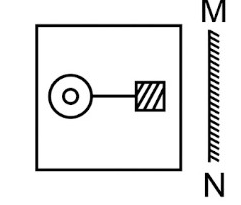
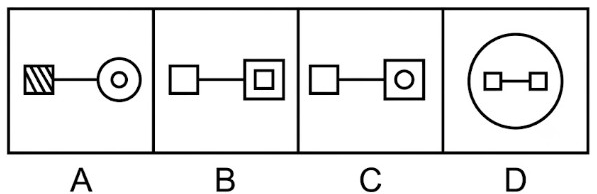
To determine the mirror image of a figure, we need to reflect the elements across the specified mirror line. In this case, the mirror is placed along the vertical line MN.
The correct reflection should have the circle on the right and the shaded square on the left, maintaining the same distance and orientation as in the original figure.
Correct Option: B) …
Avogadro number is represented by ________.
The question asks for the standard representation of Avogadro's number. This is a fundamental constant in chemistry and physics, and its symbol is universally recognized.
D) N A is the correct representation for Avogadro's number. The subscript 'A' stands for Avogadro.
The question asks to identify which of the given options is NOT an actinoid. To answer this, we need to recall the elements that belong to the actinoid series in the periodic table.
Correct Option: A) Terbium is not an actinoid. It is a lanthanoid.
The question asks to identify the Indian state to which 'Kalamkari' painting belongs. This requires knowledge of traditional Indian art forms and their geographical origins.
Correct Option: A) Andhra Pradesh is the correct answer because Kalamkari, with its two major styles (Srikalahasti and Machilipatnam), originated and is predominantly practiced in this state.
If x = \(\frac{\sqrt{3}+1}{2}\); then find the value of 4x3 + 2x2 – 8x + 7.
The problem asks us to evaluate a polynomial expression given a specific value for \(x\). Directly substituting the value of \(x\) into the polynomial would be tedious due to the presence of a square root. A more efficient approach is to manipulate the given equation for \(x\) to eliminate the square root and form a quadratic equation. Then, we can use this quadratic equation to simplify the given polynomial expression.
Given \(x = \frac{\sqrt{3}+1}{2}\).
Multiply both sides by 2:
\[ 2x = \sqrt{3} + 1 \]Subtract 1 from both sides:
\[ 2x - 1 = \sqrt{3} \]Subtract 3 from both sides:
\[ 4x^2 - 4x + 1 - 3 = 0 \]\[ 4x^2 - 4x - 2 = 0 \]Divide the entire equation by 2:
\[ 2x^2 - 2x - 1 = 0 \]We need to find the value of \(4x^3 + 2x^2 - 8x + 7\).
From step 4, we have \(4x^2 - 4x - 2 = 0\). This implies \(4x^2 = 4x + 2\).
Now, let's try to simplify the given expression using this relation. We can factor out \(x\) from the first two terms of the polynomial or perform polynomial division. Let's use polynomial division or substitution.
Consider the expression \(4x^3 + 2x^2 - 8x + 7\).
We know \(4x^2 = 4x + 2\).
Substitute \(4x^2\) in the first term:
\[ 4x^3 = x(4x^2) = x(4x + 2) = 4x^2 + 2x \]Now substitute \(4x^3 = 4x^2 + 2x\) into the polynomial:
\[ (4x^2 + 2x) + 2x^2 - 8x + 7 \]\[ = 6x^2 - 6x + 7 \]We still have \(x^2\). From \(4x^2 - 4x - 2 = 0\), we can divide by 2 to get \(2x^2 - 2x - 1 = 0\), which means \(2x^2 = 2x + 1\).
Substitute \(2x^2 = 2x + 1\) into the simplified polynomial \(6x^2 - 6x + 7\):
\[ 6x^2 - 6x + 7 = 3(2x^2) - 6x + 7 \]\[ = 3(2x + 1) - 6x + 7 \]\[ = 6x + 3 - 6x + 7 \]\[ = 3 + 7 \]\[ = 10 \]A) The value of the expression \(4x^3 + 2x^2 - 8x + 7\) is 10.
Elements show similar chemical properties if they belong to the same group in the periodic table. This is because elements in the same group have the same number of valence electrons, which dictates their chemical reactivity and bonding behavior. To determine which element will show similar properties, we need to find the electronic configuration of the given element (atomic number 20) and then compare its valence electron count with the valence electron count of the options provided.
Correct Option: A) Be(4) – Beryllium has 2 valence electrons, just like Calcium (atomic number 20). Both are alkaline earth metals and belong to Group 2 of the periodic table, hence they exhibit similar chemical properties.
The question asks to identify the company that adopted Charminar for maintenance under the Swachh Bharat Mission. This requires knowledge of specific corporate social responsibility (CSR) initiatives related to heritage site adoption in India.
Correct Option: B) NTPC
NTPC Limited, a Maharatna PSU under the Ministry of Power, adopted Charminar in Hyderabad as part of its Corporate Social Responsibility (CSR) to contribute to the Swachh Bharat Mission. This initiative focuses on the cleanliness and maintenance of the monument and its surroundings.