
The question asks to identify the winner of the 2016 Kabaddi World Cup (Men's Category). This is a factual question related to sports history, specifically Kabaddi.
Correct Option: B) India won the 2016 Kabaddi World Cup (Men's Category) by defeating Iran in the final.
The problem presents a series of terms, each consisting of a number, a letter, and another number. We need to identify the pattern in each component (first number, letter, second number) to predict the next term in the series.
Correct Option: D) 81R18
The surface area of three faces of a cuboid sharing a vertex are given as 25 m2, 32 m2 and 32 m2. What is the volume of the cuboid?
To find the volume of a cuboid when the areas of three faces sharing a common vertex are given, we can use the relationship between the dimensions of the cuboid and its volume. Let the dimensions of the cuboid be length (\(l\)), breadth (\(b\)), and height (\(h\)). The areas of the three faces sharing a vertex will be \(l \times b\), \(b \times h\), and \(l \times h\). The volume of the cuboid is \(V = l \times b \times h\).
Let the length, breadth, and height of the cuboid be \(l\), \(b\), and \(h\) respectively.
The areas of the three faces sharing a vertex are given as:
Multiply the three equations together:
\[ (l \times b) \times (b \times h) \times (l \times h) = 25 \times 32 \times 32 \] \[ l^2 \times b^2 \times h^2 = 25 \times 1024 \] \[ (l \times b \times h)^2 = 25600 \]The volume of the cuboid (\(V\)) is given by \(V = l \times b \times h\).
From the previous step, we have \((l \times b \times h)^2 = 25600\).
Take the square root of both sides to find the volume:
\[ V = \sqrt{25600} \] \[ V = 160 \, \text{m}^3 \]A) 160 m3 is the correct volume calculated from the given face areas.
The problem can be translated into a quadratic equation. We need to set up the equation based on the given statement and then solve it to find the possible values of the number.
Formulate the equation: Let the unknown number be \(x\). The problem states "Two times a number" which can be written as \(2x\). "added to the square of that number" means \(x^2\). "gives 3" means the sum equals 3.
So, the equation is:
\[ x^2 + 2x = 3 \]Rearrange into standard quadratic form: To solve a quadratic equation, we usually set it equal to zero (\(ax^2 + bx + c = 0\)).
\[ x^2 + 2x - 3 = 0 \]Solve the quadratic equation: We can solve this by factoring, using the quadratic formula, or by completing the square. Let's try factoring.
We need two numbers that multiply to \(-3\) and add up to \(2\). These numbers are \(3\) and \(-1\).
\[ (x + 3)(x - 1) = 0 \]Find the possible values for \(x\): For the product of two factors to be zero, at least one of the factors must be zero.
Thus, the possible values for the number are \(1\) or \(-3\).
Correct Option: D) 1 or -3
To find the smallest angle of a triangle when the angles are given in a ratio, we use the property that the sum of angles in any triangle is 180 degrees. We will represent the angles using a common multiple and then solve for it.
Understand the given ratio: The angles of the triangle are in the ratio 1 : 2 : 3. This means if the smallest angle is \(x\), the other two angles will be \(2x\) and \(3x\).
Apply the angle sum property of a triangle: The sum of all angles in a triangle is always 180 degrees.
Formulate the equation: Summing the angles, we get:
\[ x + 2x + 3x = 180^\circ \]Solve for \(x\): Combine the terms on the left side:
\[ 6x = 180^\circ \]Divide by 6 to find the value of \(x\):
\[ x = \frac{180^\circ}{6} \]\[ x = 30^\circ \]Identify the smallest angle: In our representation, \(x\) is the smallest angle. Therefore, the smallest angle is \(30^\circ\).
Verify the other angles (optional but good practice): The other angles would be \(2x = 2 \times 30^\circ = 60^\circ\) and \(3x = 3 \times 30^\circ = 90^\circ\). The sum is \(30^\circ + 60^\circ + 90^\circ = 180^\circ\), which confirms our calculation.
Correct Option: B) The smallest angle is \(30^\circ\).
The question asks for the location of the Rihand River Valley Project. This requires knowledge of major river valley projects and their geographical locations in India.
Correct Option: C) Uttar Pradesh
This problem involves calculating distance based on different speeds and corresponding time differences. We can use the formula \(\text{Distance} = \text{Speed} \times \text{Time}\) and set up equations based on the given conditions. The key is to express the time in a consistent unit (hours) and account for the early/late arrival times relative to a normal travel time.
Let \(D\) be the distance Chaman had to travel (in km).
Let \(T\) be the normal time Chaman should take to cover the distance \(D\) (in hours).
Convert the given speeds to km/h, which they already are: \(S_1 = 54 \text{ km/h}\) and \(S_2 = 48 \text{ km/h}\).
Convert the time differences from minutes to hours:
3 minutes early \[= \frac{3}{60} \text{ hours} = \frac{1}{20} \text{ hours}\]
1 minute late \(= \frac{1}{60} \text{ hours}\)
Formulate equations based on the given information:
When traveling at \(54 \text{ km/h}\), Chaman reaches 3 minutes early. So, the time taken is \(T - \frac{1}{20}\) hours.
Thus, \(D = 54 \times \left(T - \frac{1}{20}\right)\) (Equation 1)
When traveling at \(48 \text{ km/h}\), Chaman reaches 1 minute late. So, the time taken is \(T + \frac{1}{60}\) hours.
Thus, \(D = 48 \times \left(T + \frac{1}{60}\right)\) (Equation 2)
Since the distance \(D\) is the same in both cases, we can equate Equation 1 and Equation 2:
\[ 54 \times \left(T - \frac{1}{20}\right) = 48 \times \left(T + \frac{1}{60}\right) \]Expand both sides of the equation:
\[ 54T - \frac{54}{20} = 48T + \frac{48}{60} \]\[ 54T - \frac{27}{10} = 48T + \frac{4}{5} \]Rearrange the terms to solve for \(T\):
\[ 54T - 48T = \frac{4}{5} + \frac{27}{10} \]\[ 6T = \frac{8}{10} + \frac{27}{10} \]\[ 6T = \frac{35}{10} \]\[ 6T = \frac{7}{2} \]\[ T = \frac{7}{2 \times 6} \]\[ T = \frac{7}{12} \text{ hours} \]Now substitute the value of \(T\) back into either Equation 1 or Equation 2 to find \(D\). Using Equation 1:
\[ D = 54 \times \left(T - \frac{1}{20}\right) \]\[ D = 54 \times \left(\frac{7}{12} - \frac{1}{20}\right) \]\[ D = 54 \times \left(\frac{7 \times 5 - 1 \times 3}{60}\right) \]\[ D = 54 \times \left(\frac{35 - 3}{60}\right) \]\[ D = 54 \times \frac{32}{60} \]\[ D = \frac{54 \times 32}{60} \]\[ D = \frac{9 \times 32}{10} \]\[ D = \frac{288}{10} \]\[ D = 28.8 \text{ km} \]Alternatively, using Equation 2:
\[ D = 48 \times \left(T + \frac{1}{60}\right) \]\[ D = 48 \times \left(\frac{7}{12} + \frac{1}{60}\right) \]\[ D = 48 \times \left(\frac{7 \times 5 + 1}{60}\right) \]\[ D = 48 \times \left(\frac{35 + 1}{60}\right) \]\[ D = 48 \times \frac{36}{60} \]\[ D = \frac{48 \times 36}{60} \]\[ D = \frac{4 \times 36}{5} \]\[ D = \frac{144}{5} \]\[ D = 28.8 \text{ km} \]Both equations yield the same distance.
D) 28.8 km
A) 25.8 km — This result might occur from calculation errors, such as incorrect conversion of minutes to hours or mistakes in solving the linear equation for T or D.
B) 31.5 km — This value is likely obtained from errors in setting up the time difference (e.g., adding instead of subtracting, or vice versa, or incorrect common denominator calculations).
C) 28.0 km — This could be a result of rounding errors or minor calculation mistakes during the simplification of fractions or multiplication.
The question asks about the trend of electronegativity for halogens (fluorine, chlorine, bromine, iodine) as we move down the group in the periodic table. To answer this, we need to recall the definition of electronegativity and its general trend in the periodic table.
Thus, going from fluorine to chlorine, to bromine, and then to iodine, the electronegativity decreases.
Correct Option: D) Decreases
Which of the answer figures is formed from the shapes given the problem figure?
Problem Figure: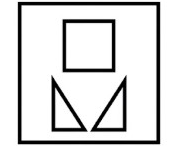
Answer Figure: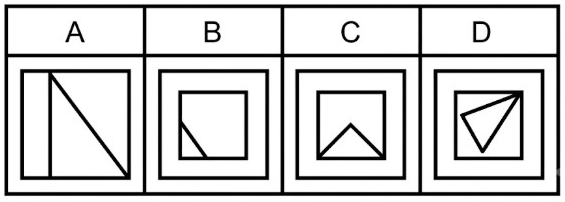
The problem figure consists of a square at the top and two triangles at the bottom within a larger square. The task is to identify which of the answer figures can be formed using these shapes.
Correct Option: B) The square and triangle arrangement in option B matches the shapes in the problem figure.
Select the option that can replace the question mark (?) in the following series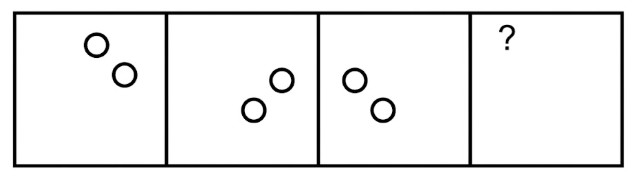
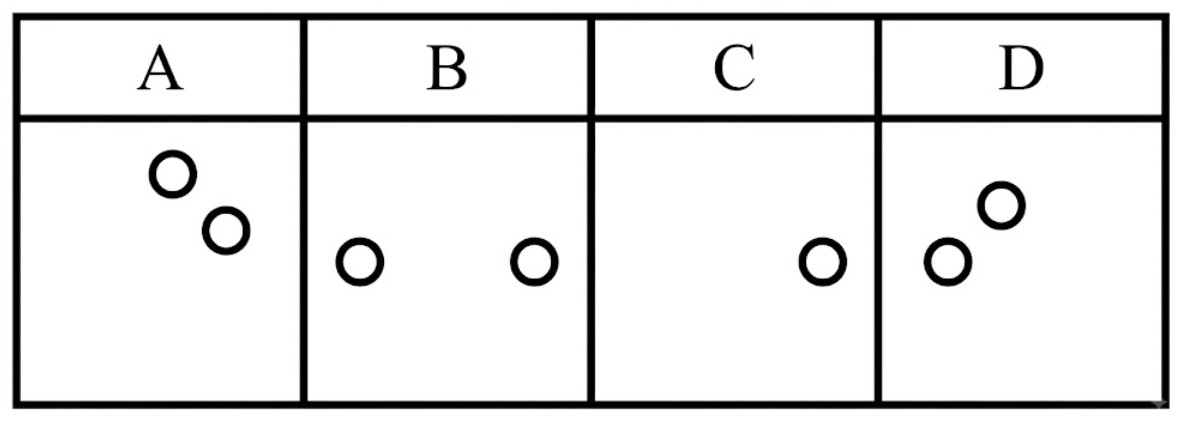
We need to identify the pattern in the series of diagrams and select the option that logically follows.
Correct Option: B) …