
The question asks to identify a pure substance from the given options. A pure substance is a form of matter that has a constant chemical composition and characteristic properties. It cannot be separated into simpler substances by physical means. Pure substances can be either elements or compounds.
Correct Option: C) Methane is a chemical compound (\( \text{CH}_4 \)) with a fixed composition and distinct properties, making it a pure substance.
The question asks about the conditions under which the Prime Minister of India cannot vote on a no-confidence motion against their own government. This requires knowledge of parliamentary procedures and the composition of the Indian Parliament.
Correct Option: A) Is a member of Rajya Sabha
If the Prime Minister is a member of the Rajya Sabha, they are not a member of the Lok Sabha. A no-confidence motion is moved and voted upon exclusively in the Lok Sabha. Therefore, a Prime Minister who is a member of the Rajya Sabha cannot vote on a no-confidence motion against their government.
The question asks to identify the Lieutenant Governor of Puducherry as of August 2018. This requires knowledge of political appointments and current affairs during that specific period.
As of August 2018, Dr. Kiran Bedi was the Lieutenant Governor of Puducherry. She served in this role from May 29, 2016, to February 16, 2021.
A) Kiran Bedi was indeed the Lieutenant Governor of Puducherry as of August 2018. She was appointed to the position in May 2016 and served until early 2021.
Select the option that can replace the question mark (?) in the following series.
Problem Figures: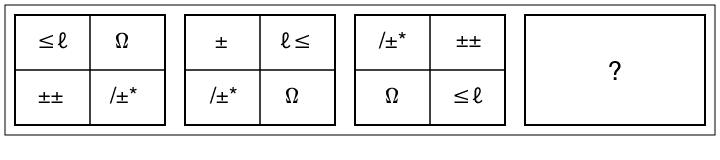
Answer Figures: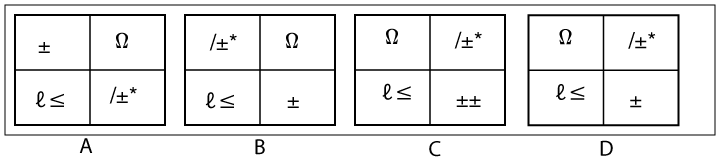
To solve this problem, we need to identify the pattern in the sequence of figures and determine which option logically follows.
Correct Option: A) The symbols follow the established pattern of rearrangement.
The question asks for the common name of ethanoic acid. This requires knowledge of chemical nomenclature, specifically the common names associated with organic acids.
D) Acetic acid — Ethanoic acid (\(\text{CH}_3\text{COOH}\)) is commonly known as acetic acid. It is the main component of vinegar, which typically contains 3-9% acetic acid by volume.
The question asks about the original language in which Babur's autobiography, Baburnama, was written. This requires knowledge of historical languages and the cultural context of the Mughal Empire's founder.
A) Turkish — Babur's native language was Chagatai Turkish, and he composed his autobiography, Baburnama, in this language.
Divya saves 45.5% of her total salary. Express the part of her savings in decimal form.
To express a percentage as a decimal, we need to divide the percentage value by 100. This is because 'percent' literally means 'per hundred'.
Correct Option: A) 0.4550
The question asks to identify the activist who actively participated in the campaign against the Narmada Valley Project. This requires knowledge of prominent social activists and their associated movements in India.
Medha Patkar is a well-known social activist who founded the Narmada Bachao Andolan (NBA) along with others. The NBA is a social movement protesting against the large-scale dam construction across the Narmada River, particularly the Sardar Sarovar Dam, due to concerns about displacement of local communities, environmental impact, and rehabilitation issues.
Correct Option: C) Medha Patkar
The question asks to identify which of the given plants bears naked seeds. This refers to the characteristic feature of Gymnosperms, where the ovules are not enclosed by an ovary wall and remain exposed both before and after fertilization, leading to naked seeds. We need to classify each option into its respective plant group to determine the correct answer.
Correct Option: B) Deodar is a conifer, which belongs to the group Gymnosperms. Gymnosperms are characterized by having ovules that are not enclosed within an ovary wall, resulting in "naked seeds" that are exposed on the surface of scales or modified leaves, often arranged in cones.
162 ÷ [51 − {29 − (9 − \(\overline{6+7}\))}] =?
To solve this problem, we need to follow the order of operations, often remembered by the acronym BODMAS/PEMDAS. This means we perform operations in the following order: Brackets (or Parentheses), Orders (or Exponents), Division and Multiplication (from left to right), and Addition and Subtraction (from left to right). The vinculum (bar over numbers) acts as a grouping symbol, similar to parentheses.
First, evaluate the expression under the vinculum (bar):
\[ 6 + 7 = 13 \]Substitute this value back into the original expression:
\[ 162 \div [51 - \{29 - (9 - 13)\}] \]Next, evaluate the innermost parentheses:
\[ 9 - 13 = -4 \]Substitute this value back:
\[ 162 \div [51 - \{29 - (-4)\}] \]Simplify the expression inside the curly braces. Remember that subtracting a negative number is equivalent to adding a positive number:
\[ 29 - (-4) = 29 + 4 = 33 \]Substitute this value back:
\[ 162 \div [51 - 33] \]Now, evaluate the expression inside the square brackets:
\[ 51 - 33 = 18 \]Finally, perform the division:
\[ 162 \div 18 = 9 \]D) 9 is the correct answer after following the order of operations.