
The question asks to identify a unicellular green algae from the given options. To answer this, one needs to recall the characteristic features and classification of the listed algal genera.
Correct Option: D) Chlamydomonas is a genus of unicellular green algae, characterized by its single-celled structure and two flagella for motility.
If 522 ÷ 29 = 18, then 5.22 ÷ 0.0018 =?
The problem provides a division fact and asks us to use it to solve another division problem involving decimals. The key is to manipulate the decimal numbers to relate them back to the given whole number division.
Understand the given information: We are given the division fact: \(522 \div 29 = 18\). This can also be written as:
\[ \frac{522}{29} = 18 \]Analyze the expression to be evaluated: We need to find the value of \(5.22 \div 0.0018\). This can be written as:
\[ \frac{5.22}{0.0018} \]Convert decimals to fractions to remove decimal points: To make the numbers easier to work with and relate them to the given whole number division, we can express the decimals as fractions:
\[ 5.22 = \frac{522}{100} \] \[ 0.0018 = \frac{18}{10000} \]Substitute these fractional forms into the expression:
\[ \frac{5.22}{0.0018} = \frac{\frac{522}{100}}{\frac{18}{10000}} \]Simplify the complex fraction: Dividing by a fraction is the same as multiplying by its reciprocal:
\[ \frac{522}{100} \times \frac{10000}{18} \]Rearrange the terms to use the given division fact:
\[ \left(\frac{522}{18}\right) \times \left(\frac{10000}{100}\right) \]Use the given information to find \(522 \div 18\): From the given \(522 \div 29 = 18\), we can also infer that \(522 \div 18 = 29\). This is because if \(a \div b = c\), then \(a \div c = b\).
\[ \frac{522}{18} = 29 \]Calculate the second part of the multiplication:
\[ \frac{10000}{100} = 100 \]Perform the final multiplication:
\[ 29 \times 100 = 2900 \]B) 2900 is the correct answer, as derived from the step-by-step calculation.
The question asks to identify a component that is present within a carpel. To answer this, it's essential to understand the structure of a flower, particularly the female reproductive part known as the carpel or pistil.
B) Ovule — The ovule is housed within the ovary, which is the basal part of the carpel. Therefore, the ovule is present in a carpel.
The question asks for the term used to describe objects that do not produce their own light. We need to differentiate between objects that emit light and those that merely reflect it or allow it to pass through.
C) Non-illuminated objects. Objects that do not produce light themselves are called non-luminous objects. Among the given choices, "non-illuminated objects" most directly conveys the idea of objects that do not generate light. While "non-luminous" is the standard scientific term, "non-illuminated" can be understood in this context as objects that are not a source of light.
To determine if a set of three lengths can form the sides of a right-angled triangle, we use the Pythagorean theorem. The Pythagorean theorem states that in a right-angled triangle, the square of the length of the hypotenuse (the side opposite the right angle, which is always the longest side) is equal to the sum of the squares of the other two sides (legs). If the given sides are \(a\), \(b\), and \(c\) (where \(c\) is the longest side), then for a right-angled triangle, the relationship \(a^2 + b^2 = c^2\) must hold true.
Let's check each option:
Option A: 84 cm, 13 cm, 85 cm
Option B: 84 cm, 63 cm, 115 cm
Option C: 15 cm, 112 cm, 111 cm
Option D: 76 cm, 100 cm, 57 cm
Correct Option: A) 84 cm, 13 cm, 85 cm
The question asks to identify the largest producer of manganese in India as of 2018. This requires knowledge of the distribution of mineral resources and their production statistics in India.
Correct Option: A) Madhya Pradesh
The question asks to identify the plant tissue that is formed by dead cells. We need to recall the characteristics of different types of plant tissues, specifically focusing on whether their cells are living or dead at maturity.
Correct Option: A) Sclerenchyma tissue is formed by the combination of dead cells. These cells have thick, lignified walls and provide mechanical strength to the plant.
A question and two statements are given. Decide which of the statement(s) is/are sufficient to answer the question.
Question:
Nitara has 20 colored pencils of four different colours. How many black pencils does she have?
Statements:
1. She has 5 red colored pencils.
2. She has 4 blue colored pencils.
3. The number of green pencils is twice that of blue pencils.
Only statement 1 is sufficient.
Only statement 3 is sufficient.
Statements 1, 2 and 3 all together are sufficient
Statements 1 and 2 together are not sufficient
The problem asks us to determine the number of black pencils Nitara has, given a total number of pencils and information about pencils of other colors. We need to evaluate if the provided statements, individually or in combination, are sufficient to find the number of black pencils.
C) Statements 1, 2 and 3 all together are sufficient. As shown in step 7, by combining all three statements, we can uniquely determine the number of black pencils.
Select the alternative figure that will complete the series of question pictures?
Question Figure: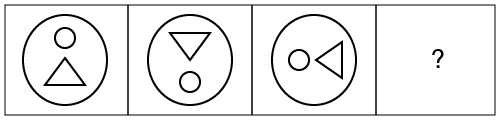
Option Figure: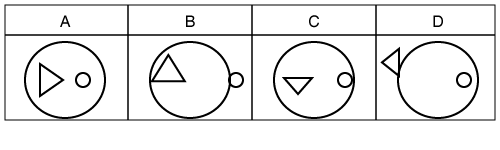
The question involves identifying the pattern in a series of figures and selecting the figure that logically completes the series. Each figure consists of a circle containing two shapes: a circle and a triangle, with the triangle rotating in each step.
Correct Option: A) The triangle points to the right, and the circle is on the left, matching the pattern.
Select the term which is related to the third term in the same way as the second term is related to the first term.
Needle : Stitch :: Knife :?
This is an analogy question where we need to find the relationship between the first pair of words and apply the same relationship to the second pair to find the missing term.
Correct Option: C) Cut. A needle is used to stitch, and a knife is used to cut.