
The question asks to identify the first wicket-keeper in One Day International (ODI) cricket history to achieve 100 stumpings. This requires knowledge of cricket records, specifically those related to wicket-keeping statistics.
M.S. Dhoni, the former captain and wicket-keeper for the Indian cricket team, holds the record for the most stumpings in One Day International cricket. He was the first wicket-keeper to reach 100 stumpings in ODIs.
Correct Option: D) M.S. Dhoni was the first wicket-keeper in the world to complete 100 stumpings in One Day International cricket. He achieved this milestone on September 3, 2017, during a match against Sri Lanka.
This problem involves work and time. We need to calculate the individual work rates of Aarti and Bharti, then determine how much work Aarti completes alone before Bharti joins, and finally how many days they work together to finish the remaining work. The total time taken to complete the work is given.
D) 6
As calculated, Aarti worked alone for 6 days before Bharti joined. Therefore, Bharti joined after 6 days.
The question asks to identify which metal reacts with steam to form a metal oxide and hydrogen gas. This involves understanding the reactivity series of metals and their reactions with water in different forms (cold water, hot water, steam).
D) Iron reacts with steam to form iron oxide (\(\text{Fe}_3\text{O}_4\)) and hydrogen gas. The reaction is: \[\text{3Fe(s)} + \text{4H}_2\text{O(g)} \rightarrow \text{Fe}_3\text{O}_4\text{(s)} + \text{4H}_2\text{(g)}\]
The question asks to identify the type of weather phenomenon that "Loo" represents. This requires knowledge of common local winds and atmospheric conditions, particularly those prevalent in the Indian subcontinent.
Correct Option: C) Heat wave
Loo is a local hot wind that is a characteristic feature of the summer season in the northern plains of India. It blows during the day, often into the late afternoon, and is known for its strong, gusty, hot, and dry nature. Exposure to Loo can be detrimental to health, causing heatstroke. Therefore, Loo is directly associated with a heat wave condition, which is a prolonged period of excessively hot weather.
How many triangles are there in the following figure?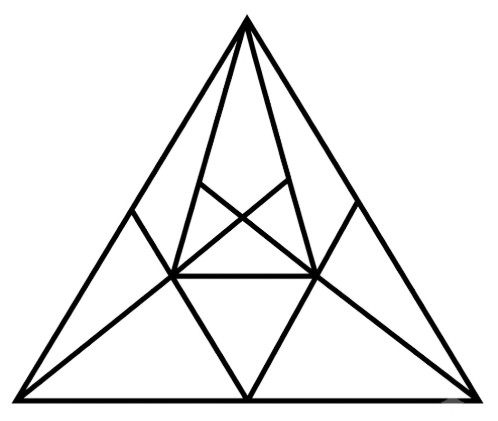
To determine the number of triangles in the given figure, we need to systematically count all possible triangles, starting from the smallest ones to the largest.
Correct Option: B) 23
The question asks to identify the theme of "Hausla 2017", an event celebrated from November 16 to November 20, 2017. This requires knowledge of significant government initiatives or events related to social welfare in India.
D) Celebration of children's rights. "Hausla 2017" was indeed a festival for children, organized by the Ministry of Women and Child Development, focusing on celebrating children's rights and providing them with a platform.
Find the difference between simple interest and compound interest on Rs. 2,000 for 2 years at 10% per annum?
To find the difference between simple interest (SI) and compound interest (CI), we will calculate both interests separately for the given principal, rate, and time, and then find their difference. Alternatively, for 2 years, there's a direct formula to calculate the difference between CI and SI.
The formula for Simple Interest is:
\[ \text{SI} = \frac{P \times R \times T}{100} \]\[ \text{SI} = \frac{2000 \times 10 \times 2}{100} \]\[ \text{SI} = \frac{40000}{100} \]\[ \text{SI} = \text{Rs. } 400 \]The formula for Amount under Compound Interest is:
\[ A = P \left(1 + \frac{R}{100}\right)^T \]\[ A = 2000 \left(1 + \frac{10}{100}\right)^2 \]\[ A = 2000 \left(1 + \frac{1}{10}\right)^2 \]\[ A = 2000 \left(\frac{11}{10}\right)^2 \]\[ A = 2000 \times \frac{121}{100} \]\[ A = 20 \times 121 \]\[ A = \text{Rs. } 2420 \]Now, calculate Compound Interest (CI):
\[ \text{CI} = A - P \]\[ \text{CI} = 2420 - 2000 \]\[ \text{CI} = \text{Rs. } 420 \]For 2 years, the difference between CI and SI is given by the formula:
\[ \text{Difference} = P \left(\frac{R}{100}\right)^2 \]\[ \text{Difference} = 2000 \left(\frac{10}{100}\right)^2 \]\[ \text{Difference} = 2000 \left(\frac{1}{10}\right)^2 \]\[ \text{Difference} = 2000 \times \frac{1}{100} \]\[ \text{Difference} = \text{Rs. } 20 \]C) Rs. 20 — The difference between the simple interest (Rs. 400) and compound interest (Rs. 420) is Rs. 20. This matches the calculation using both methods.
This question tests general knowledge about the design features of current Indian currency notes. Aspirants should be familiar with the iconic images depicted on the reverse side of various denominations.
A) Rs. 200 — The reverse side of the Indian Rs. 200 banknote features a motif of the Sanchi Stupa, depicting India's cultural heritage.
The problem is a coding-decoding question. We need to identify the pattern used to code "WAIT" as "231920" and then apply the same pattern to find the code for "RUN". The pattern usually involves the alphabetical position of letters.
The word is WAIT and the code is 231920.
When these numerical positions are concatenated, we get 231920. So, the pattern is simply writing down the alphabetical position of each letter consecutively.
Concatenating these numbers gives us 182114.
Correct Option: D) 182114
The question asks to identify the recipient of the 2018 Padma Shri award in the 'Art-Folk Music' category from Uttar Pradesh. This requires knowledge of prominent awardees in specific fields and regions for that particular year.
In 2018, Mohan Swaroop Bhatia was awarded the Padma Shri for his contributions to folk music, specifically from Uttar Pradesh.
Correct Option: C) Mohan Swaroop Bhatia