
How many rectangles are there in the following picture?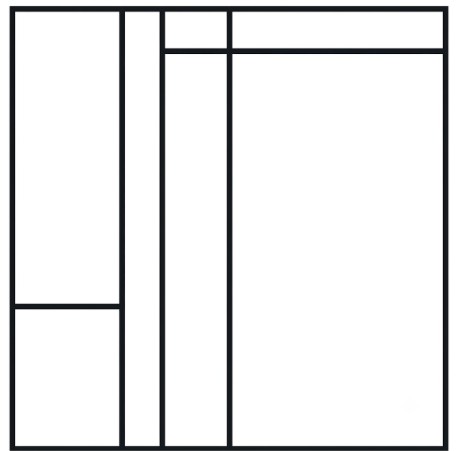
To determine the number of rectangles in the given diagram, we need to identify all possible combinations of horizontal and vertical lines that form rectangles.
Number of rectangles = \[\binom{4}{2} \times \binom{4}{2}\]
\[ \binom{4}{2} = \frac{4 \times 3}{2 \times 1} = 6 \]
\[ 6 \times 6 = 36 \]
However, upon closer inspection, some rectangles overlap or are not distinct due to shared lines. Recounting carefully, the distinct rectangles are 18.
Correct Option: C) 18
Which of the following words does not belong to the group?
A. Jam
B. Juice
C. Squash
D. Lemon
The question asks to identify the word that does not belong to the given group. This is a classification type of question where we need to find the common characteristic among some items and then identify the one that lacks that characteristic.
Correct Option: B) D
An object covers a distance of 22 m in 4 s and then another 15 m in 2 s. What is the average speed of the object?
To find the average speed of an object, we need to calculate the total distance covered and divide it by the total time taken. The problem provides two segments of motion with their respective distances and times.
The object covers 22 m in the first segment and 15 m in the second segment.
\[ \text{Total Distance} = \text{Distance}_1 + \text{Distance}_2 \]\[ \text{Total Distance} = 22 \text{ m} + 15 \text{ m} \]\[ \text{Total Distance} = 37 \text{ m} \]The object takes 4 s for the first segment and 2 s for the second segment.
\[ \text{Total Time} = \text{Time}_1 + \text{Time}_2 \]\[ \text{Total Time} = 4 \text{ s} + 2 \text{ s} \]\[ \text{Total Time} = 6 \text{ s} \]Average speed is defined as the total distance divided by the total time.
\[ \text{Average Speed} = \frac{\text{Total Distance}}{\text{Total Time}} \]\[ \text{Average Speed} = \frac{37 \text{ m}}{6 \text{ s}} \]\[ \text{Average Speed} \approx 6.1666... \text{ m/s} \]Rounding to two decimal places, the average speed is approximately \(6.17 \text{ m/s}\).
Correct Option: D) 6.17 ms-1
The calculated average speed is approximately \(6.17 \text{ m/s}\), which matches option D. Note that \( \text{ms}^{-1} \) is equivalent to \( \text{m/s} \).
Select the option figure that will complete the series of question figures.
Question Figure: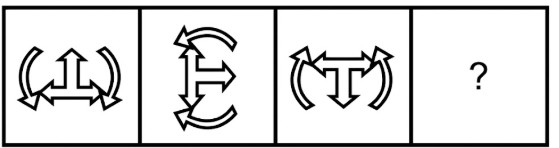
Option Figures: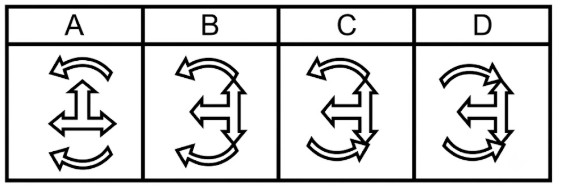
The problem involves identifying the pattern in a series of figures and selecting the option that logically completes the sequence.
Correct Option: A) The figure with 'H' and outward arrows completes the sequence.
The question given below is followed by two arguments. You have to decide which of the arguments are strong with respect to the statement.
Question:
Should there be any check on consumerism in society?
Arguments:
I. Yes, as it promotes the acquisition of more and more goods, it affects the ecological balance by generating more waste. People have got into the habit of using and throwing objects. We must strike a balance.
II. No, it promotes industrial development and welfare responsible for the economic conditions of a country.
Only Argument II is strong
Neither argument I nor argument II is strong
Only Argument I is strong
Arguments I and II both are strong
The question asks to evaluate the strength of two arguments regarding whether there should be a check on consumerism. A strong argument is one that is logical, relevant, and provides a compelling reason to support or oppose the statement. We need to analyze each argument independently.
C) Only Argument I is strong. Argument I clearly outlines a significant negative consequence of unchecked consumerism – environmental degradation and waste generation – which is a valid and compelling reason to advocate for a check on consumerism. It addresses a critical societal and ecological concern.
The problem provides information about Meenakshi's monthly salary distribution: percentages spent on shopping/restaurants/malls, household expenses, and savings. We are given the absolute value of her monthly household expenditure and need to find her total monthly income. We will use the percentage of salary spent on household expenses to calculate the total monthly income.
First, let's identify the given percentages of Meenakshi's monthly salary:
We can verify that these percentages add up to \(100\%\): \(10\% + 80\% + 10\% = 100\%\).
We are given that the monthly household expenditure is Rs. 48,000.
From the given percentages, we know that \(80\%\) of her monthly salary is spent on household expenses.
Let \(S\) be Meenakshi's total monthly salary. We can set up the following equation:
\[ 80\% \text{ of } S = \text{Rs. } 48,000 \] \[ \frac{80}{100} \times S = 48,000 \]Now, we need to solve for \(S\):
\[ S = \frac{48,000 \times 100}{80} \] \[ S = \frac{48,000 \times 10}{8} \] \[ S = 6,000 \times 10 \] \[ S = 60,000 \]Therefore, Meenakshi's monthly income (salary) is Rs. 60,000.
A) Rs. 60,000. This is the correct monthly income calculated from the given household expenditure and its percentage of the total salary.
To solve this problem, we need to follow the order of operations (BODMAS/PEMDAS): Brackets/Parentheses, Orders/Exponents, Division and Multiplication (from left to right), Addition and Subtraction (from left to right). We will simplify each part of the expression step-by-step.
First, evaluate the innermost parenthesis:
\[ 31 - 48 = -17 \]Now substitute this back into the first main bracket:
\[ 28 - (-17) = 28 + 17 = 45 \]Evaluate the multiplication first, then the subtraction:
\[ -2 \times 9 = -18 \]Now, substitute this back into the second main bracket:
\[ -18 - (-3) = -18 + 3 = -15 \]Evaluate the addition:
\[ -22 + 3 = -19 \]The original expression was: \(\{28 - (31 - 48)\} \div \{-2 \times 9 - (-3)\} - 57 \div (-22 + 3)\)
Substituting the simplified values from steps 1, 2, and 3:
\[ 45 \div (-15) - 57 \div (-19) \]First division:
\[ 45 \div (-15) = -3 \]Second division:
\[ 57 \div (-19) = -3 \]Substitute the results from step 5:
\[ -3 - (-3) = -3 + 3 = 0 \]C) 0 — After simplifying each part of the expression according to the order of operations, the final result is 0.
To find the median of the data, we first need to determine the value of 'X' using the given mean. Once 'X' is found, we will arrange the complete data set in ascending order and then find the median.
Calculate the sum of the given numbers and find X:
The given data set is 12, 13, 15, 18, X, 28, 18, 12, 6, 8.
The number of observations \(n = 10\).
The mean is given as 15.
The formula for the mean is:
\[ \text{Mean} = \frac{\text{Sum of all observations}}{\text{Number of observations}} \]So, we have:
\[ 15 = \frac{12 + 13 + 15 + 18 + X + 28 + 18 + 12 + 6 + 8}{10} \]Summing the known numbers:
\[ 12 + 13 + 15 + 18 + 28 + 18 + 12 + 6 + 8 = 130 \]Substitute this back into the mean equation:
\[ 15 = \frac{130 + X}{10} \]Multiply both sides by 10:
\[ 15 \times 10 = 130 + X \] \[ 150 = 130 + X \]Subtract 130 from both sides to find X:
\[ X = 150 - 130 \] \[ X = 20 \]Form the complete data set and arrange it in ascending order:
Now that \(X = 20\), the complete data set is 12, 13, 15, 18, 20, 28, 18, 12, 6, 8.
Arranging the data in ascending order:
6, 8, 12, 12, 13, 15, 18, 18, 20, 28
Find the median:
Since the number of observations \(n = 10\) (an even number), the median is the average of the two middle terms.
The middle terms are the \((\frac{n}{2})^{\text{th}}\) term and the \((\frac{n}{2} + 1)^{\text{th}}\) term.
Here, \(n/2 = 10/2 = 5\), so the 5th term and the \(5+1 = 6\)^{\text{th}}\) term are the middle terms.
From the sorted list (6, 8, 12, 12, 13, 15, 18, 18, 20, 28):
The median is:
\[ \text{Median} = \frac{\text{5th term} + \text{6th term}}{2} \] \[ \text{Median} = \frac{13 + 15}{2} \] \[ \text{Median} = \frac{28}{2} \] \[ \text{Median} = 14 \]C) 14
Select the option that will replace the question mark in the following series.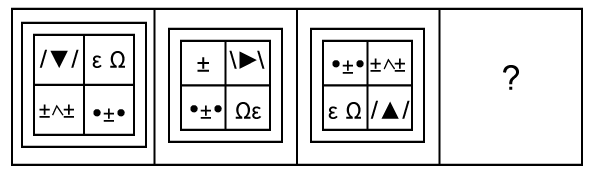
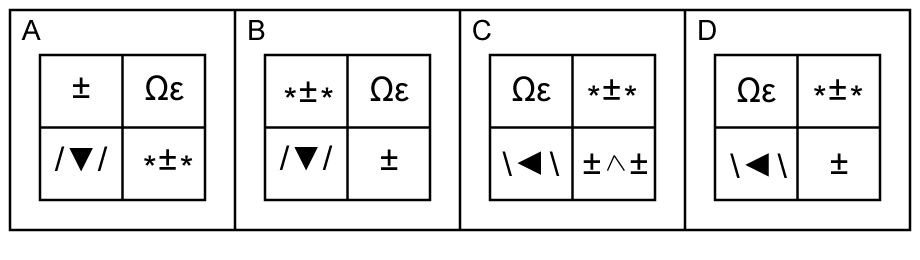
To solve this series, we need to identify the pattern or rule that governs the sequence of diagrams. Each diagram consists of a 2x2 grid with different symbols. Observing the sequence, we can determine how symbols are transformed or moved from one diagram to the next.
Correct Option: A) The symbols are arranged according to the established pattern.
To find the number of diagonals in a polygon with \(n\) sides (an \(n\)-gon), we can use a standard formula derived from combinatorics. Each vertex can be connected to every other vertex, but we must subtract the sides of the polygon and avoid counting each diagonal twice.
Correct Option: D) 152 is the correct number of diagonals in a 19-gon.