
The question asks for the temperature at which water can coexist in both liquid and solid states. This refers to the melting/freezing point of water, where a phase transition occurs.
B) \(0^\circ\text{C}\) is the temperature at which water freezes to form ice or ice melts to form water. At this specific temperature, both liquid water and solid ice can coexist in equilibrium.
The question asks to identify the Chief Minister of Sikkim as of August 2018. This requires knowledge of political officeholders during that specific period.
Correct Option: B) Pawan Kumar Chamling was indeed the Chief Minister of Sikkim in August 2018. He holds the record for the longest-serving Chief Minister in India, serving for over 24 years until May 2019.
In a triangle ABC, the value of cos\( \frac{B+C}{2} \) = ?
cos A
\(\sin\frac{A}{2}\)
\(\sin\frac{A+B}{2}\)
cot B
This problem involves applying the fundamental property of angles in a triangle and trigonometric identities. We know that the sum of angles in a triangle is 180 degrees. We will use this property to express \(B+C\) in terms of \(A\) and then substitute it into the given trigonometric expression.
In any triangle ABC, the sum of its interior angles is 180 degrees.
\[ A + B + C = 180^{\circ} \]From this, we can express \(B+C\) in terms of \(A\):
\[ B + C = 180^{\circ} - A \]Now, divide both sides by 2:
\[ \frac{B+C}{2} = \frac{180^{\circ} - A}{2} \] \[ \frac{B+C}{2} = 90^{\circ} - \frac{A}{2} \]Substitute this expression into the given trigonometric term \(\cos\left(\frac{B+C}{2}\right)\):
\[ \cos\left(\frac{B+C}{2}\right) = \cos\left(90^{\circ} - \frac{A}{2}\right) \]Using the trigonometric identity \(\cos(90^{\circ} - \theta) = \sin(\theta)\), we can simplify the expression:
\[ \cos\left(90^{\circ} - \frac{A}{2}\right) = \sin\left(\frac{A}{2}\right) \]Therefore, \[\cos\left(\frac{B+C}{2}\right) = \sin\left(\frac{A}{2}\right)\].
Correct Option: B) \(\sin\frac{A}{2}\)
Identify the odd-one among the following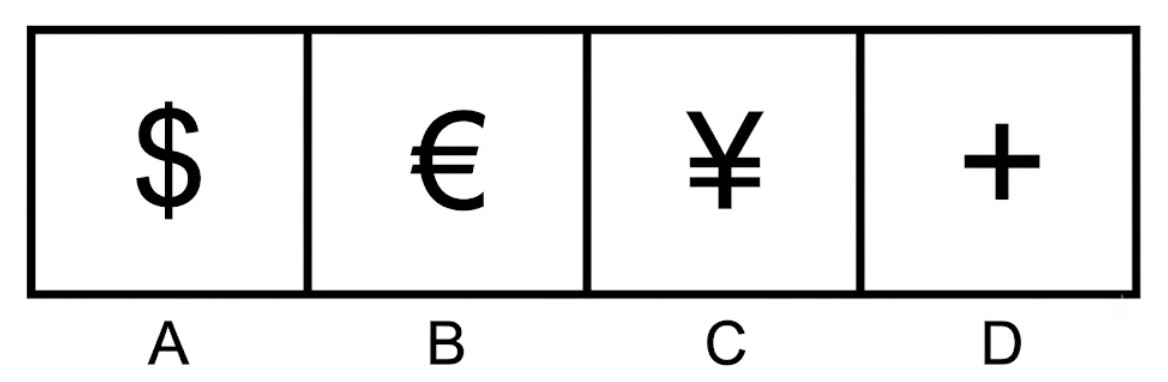
The question asks us to identify the odd-one-out among four symbols: the Dollar sign ($), Euro sign (€), Yen sign (¥), and Plus sign (+). To solve this, we need to examine the meaning and function of each symbol and identify the common characteristic shared by three of them. The symbol that does not belong to the same category is the odd-one-out.
Identify the four symbols:
Understand Figure A — Dollar sign ($):
The Dollar sign ($) is a currency symbol used to represent the dollar, which is the official currency of countries such as the United States, Canada, and Australia. It is commonly used to indicate monetary values and financial transactions.
Understand Figure B — Euro sign (€):
The Euro sign (€) represents the euro, the official currency used by many European Union member countries. It is a monetary symbol used to express prices, payments, and other financial values.
Understand Figure C — Yen sign (¥):
The Yen sign (¥) represents the Japanese yen, the official currency of Japan. The same symbol is also commonly used for the Chinese yuan. It belongs to the category of currency symbols.
Understand Figure D — Plus sign (+):
The Plus sign (+) is a mathematical symbol primarily used to represent addition or a positive value. Unlike the other three symbols, it does not represent a currency.
For example:
\[ 5+3=8 \]Here, the Plus sign indicates the mathematical operation of addition.
Compare the symbols based on their functions:
| Figure | Symbol | Category |
|---|---|---|
| A | $ | Currency symbol |
| B | € | Currency symbol |
| C | ¥ | Currency symbol |
| D | + | Mathematical symbol |
Figures A, B, and C are currency symbols, whereas Figure D is a mathematical symbol.
Identify the odd-one-out:
Since the first three symbols represent currencies and the fourth symbol represents a mathematical operation, Figure D does not belong to the same category.
Therefore, Figure D (+) is the odd-one-out.
Correct Option: C) D — Figure D contains the Plus sign (+), which is a mathematical symbol used for addition. Figures A ($), B (€), and C (¥) are currency symbols. Therefore, Figure D is the odd-one-out, corresponding to Option C.
A) C: This is incorrect because Figure C represents the Yen sign (¥), which is a currency symbol. It belongs to the same category as the Dollar sign ($) and Euro sign (€).
B) B: This is incorrect because Figure B represents the Euro sign (€), which is a currency symbol. Therefore, it shares the common characteristic of Figures A and C.
D) A: This is incorrect because Figure A represents the Dollar sign ($), which is a currency symbol. Like the Euro and Yen signs, it is used to represent monetary values and is not the odd-one-out.
A box contains 100 pens out of which 8 are defective. A pen is taken out of the box. Find the probability that it is not defective?
\( \frac{23}{25} \)
\( \frac{8}{100} \)
\( \frac{100}{8} \)
\( \frac{25}{23} \)
To find the probability that a pen taken out of the box is not defective, we first need to determine the number of non-defective pens. Then, we use the basic probability formula: Probability = (Number of favorable outcomes) / (Total number of outcomes).
Total number of pens in the box = \(100\)
Number of defective pens = \(8\)
Number of non-defective pens = Total number of pens - Number of defective pens
\[ \text{Number of non-defective pens} = 100 - 8 = 92 \]The probability of an event is given by the formula:
\[ P(\text{Event}) = \frac{\text{Number of favorable outcomes}}{\text{Total number of outcomes}} \]In this case, the favorable outcome is drawing a non-defective pen.
\[ P(\text{not defective}) = \frac{\text{Number of non-defective pens}}{\text{Total number of pens}} \] \[ P(\text{not defective}) = \frac{92}{100} \]Both the numerator and the denominator can be divided by \(4\).
\[ P(\text{not defective}) = \frac{92 \div 4}{100 \div 4} = \frac{23}{25} \]Correct Option: A) \( \frac{23}{25} \)
This question tests the understanding of the principles of free fall, specifically in a vacuum. The key concept is that in a vacuum, air resistance is absent, and therefore, all objects fall at the same rate regardless of their mass, shape, or size.
Correct Option: C) feather, coin and brick all will reach the bottom together
Find the next term of the following series
CY, DV, FR, IM,?
The problem presents a series of letter pairs. To find the next term, we need to identify the pattern in both the first and second letters of each pair. We will analyze the progression of the first letters and the second letters separately.
The first letters are C, D, F, I.
The pattern for the first letter is an incrementing addition: +1, +2, +3. Following this pattern, the next increment should be +4.
So, the next first letter will be I + 4 positions = M (J, K, L, M).
The second letters are Y, V, R, M.
The pattern for the second letter is a decrementing subtraction: -3, -4, -5. Following this pattern, the next decrement should be -6.
So, the next second letter will be M - 6 positions = G (L, K, J, I, H, G).
The next first letter is M and the next second letter is G.
Therefore, the next term in the series is MG.
A) MG is the correct option because it follows both the identified patterns for the first and second letters.
The question asks to identify the sport associated with the Begum Hazrat Mahal Cup, specifically in the context of 2018. This requires knowledge of major sports tournaments and their names in India.
The Begum Hazrat Mahal Cup is a national-level women's football championship in India. It was indeed active in 2018, serving as a significant tournament for women's football in the country.
Correct Option: C) Football
The question asks about the profession or field of fame of Shereen Bhan. This requires general knowledge about prominent Indian personalities.
Correct Option: A) Indian journalist and news anchor
Shereen Bhan is a prominent Indian journalist and news anchor. She is best known for her work with CNBC-TV18, where she has served as the Managing Editor. She hosts several popular business news shows and has interviewed numerous business and political leaders, making her a recognized figure in Indian media.
The problem presents a series of alphanumeric terms. Each term consists of a letter and a number. We need to identify the pattern in both the letters and the numbers to find the missing term.
The numbers in the series are 100, 81, ?, 49, 36.
Let's find the square root of each number:
The sequence of square roots is 10, 9, ?, 7, 6. This is a decreasing sequence of consecutive integers. Therefore, the missing square root must be 8.
So, the missing number is \(8^2 = 64\).
The letters in the series are N, K, ?, E, B.
Let's find the position of each letter in the English alphabet (A=1, B=2, ..., Z=26):
Now, let's look at the differences between the positions:
This indicates a consistent pattern where each letter is 3 positions before the previous one. Following this pattern:
So, the missing letter is H.
The missing letter is H and the missing number is 64.
Therefore, the missing term is H-64.
C) H-64 is the correct term, as it follows both the numerical and alphabetical patterns identified in the series.