
The question given below is followed by two arguments 1 and 2. Read the question and decide which of the arguments is strong with respect to the question.
Question:
Should distance education be abolished in India?
Arguments:
1. Yes, the interaction between teachers and students will improve the personality of the student.
2. No, not all students can pay the fees for regular education
Only argument 1 is strong
Neither Argument 1 nor Argument 2 is strong
Arguments 1 and 2 both are strong
Only argument 2 is strong
The question asks whether distance education should be abolished in India and presents two arguments. We need to evaluate the strength of each argument independently to determine if it provides a valid reason for or against the abolition of distance education.
Correct Option: C) Arguments 1 and 2 both are strong
Both arguments present valid and significant points regarding the pros and cons of distance education. Argument 1 emphasizes the importance of teacher-student interaction for personality development, a strong point in favor of traditional education. Argument 2 highlights the accessibility and affordability of distance education for those who cannot afford regular education, which is a strong argument against its abolition. Since both arguments hold significant weight, they are both considered strong.
To determine how metallic property changes across the modern periodic table, we need to understand the definition of metallic property and how factors like atomic size, nuclear charge, and shielding effect vary in periods and groups.
Combining these two trends, metallic property decreases from left to right in a period and increases from top to bottom in a group.
D) Metallic property decreases from left to right in a period but increases from top to bottom in a group. This statement accurately describes the trends in metallic property across periods and down groups in the modern periodic table.
The problem asks us to find the principal amount given the difference between compound interest (CI) and simple interest (SI) for a certain period and rate. We can use the standard formulas for CI and SI and their difference, or a specific formula for the difference between CI and SI for 2 years.
Simple Interest (SI) for \(T\) years at rate \(R\):
\[ \text{SI} = \frac{P \times R \times T}{100} \]Compound Interest (CI) for \(T\) years at rate \(R\):
\[ \text{CI} = P \left( \left(1 + \frac{R}{100}\right)^T - 1 \right) \]We are given that \(\text{CI} - \text{SI} = 2\).
\[ \frac{41P}{400} - \frac{P}{10} = 2 \]To subtract, find a common denominator, which is 400:
\[ \frac{41P}{400} - \frac{P \times 40}{10 \times 40} = 2 \]\[ \frac{41P - 40P}{400} = 2 \]\[ \frac{P}{400} = 2 \]Alternative Method (Direct Formula for CI - SI for 2 years):
For 2 years, the difference between CI and SI is given by the formula:
\[ \text{CI} - \text{SI} = P \left( \frac{R}{100} \right)^2 \]Substitute the given values:
\[ 2 = P \left( \frac{5}{100} \right)^2 \]\[ 2 = P \left( \frac{1}{20} \right)^2 \]\[ 2 = P \left( \frac{1}{400} \right) \]\[ P = 2 \times 400 \]\[ P = 800 \]Thus, the principal amount is Rs. 800.
C) Rs. 800
To find the perimeter of a rectangular plot, we need to sum the lengths of all its four sides. A rectangle has two pairs of equal sides: length and width. The formula for the perimeter of a rectangle is \(2 \times (\text{length} + \text{width})\).
C) 120 m is the correct perimeter calculated using the formula \(2 \times (\text{length} + \text{width})\).
The question asks to identify the main thinking part of the brain. To answer this, we need to recall the major divisions of the human brain and their primary functions.
Correct Option: B) The Forebrain is the main thinking part of the brain. It contains the cerebrum, which is responsible for complex cognitive functions like thinking, memory, language, and voluntary actions.
What is the HCF of \( \frac{3}{5} \), \( \frac{9}{10} \) and \( \frac{6}{25} \)?
\( \frac{3}{50} \)
\( \frac{3}{5} \)
18
\( \frac{18}{50} \)
To find the HCF (Highest Common Factor) of fractions, we use a specific formula: the HCF of fractions is equal to the HCF of their numerators divided by the LCM (Least Common Multiple) of their denominators.
Identify the numerators and denominators:
The given fractions are \( \frac{3}{5} \), \( \frac{9}{10} \), and \( \frac{6}{25} \).
Calculate the HCF of the numerators:
The numerators are 3, 9, 6.
The highest common factor among 3, 9, and 6 is 3.
\[ \text{HCF}(3, 9, 6) = 3 \]Calculate the LCM of the denominators:
The denominators are 5, 10, 25.
We can find the LCM using prime factorization:
To find the LCM, take the highest power of all prime factors present:
\[ \text{LCM}(5, 10, 25) = 2^1 \times 5^2 = 2 \times 25 = 50 \]Apply the formula for HCF of fractions:
\[ \text{HCF of fractions} = \frac{\text{HCF of numerators}}{\text{LCM of denominators}} \] \[ \text{HCF} \left( \frac{3}{5}, \frac{9}{10}, \frac{6}{25} \right) = \frac{\text{HCF}(3, 9, 6)}{\text{LCM}(5, 10, 25)} = \frac{3}{50} \]Correct Option: A) \( \frac{3}{50} \)
The question asks for the term that describes a medium's ability to refract light. This concept is fundamental in optics and relates to how much a medium can bend light as it passes through it.
B) Optical density — Optical density is the correct term used to describe a medium's ability to refract light. A medium with a higher optical density has a higher refractive index and causes light to bend more.
Identify the odd one from the given figures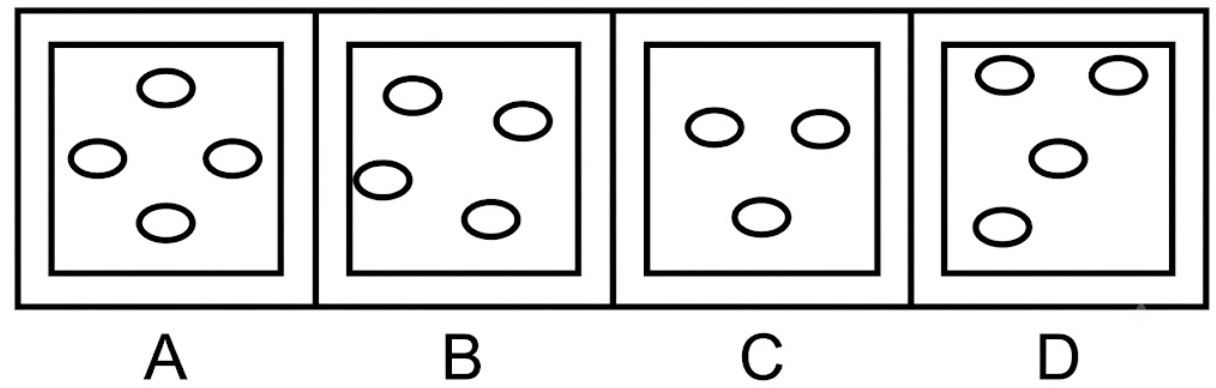
To identify the odd one out, we need to analyze the arrangement and number of elements within each figure. The goal is to find the figure that does not conform to the pattern established by the others.
Correct Option: C) Option C is correct because it contains a different number of circles compared to the other options.
This is a blood relations question. We need to establish the relationships between the individuals mentioned and then determine the relationship between Y and Z based on the given information.
Correct Option: B) Sister-in-law
Y is the sister of X, and X is the wife of Z. Therefore, Y is the sister of Z's wife, which makes Y Z's sister-in-law.
The question asks to identify a city that was part of the 9 new cities selected for the Smart Cities Mission in January 2018. This requires knowledge of the specific cities chosen in that particular batch of the mission.
B) Itanagar — Itanagar was indeed one of the 9 cities selected in January 2018 under the Smart Cities Mission.