
The question describes a scenario where an aeroplane performs more work (covers a greater distance) in less time compared to a car, implying a difference in their capabilities. We need to identify the physical quantity that quantifies the rate at which work is done.
Correct Option: B) Power is the physical quantity that measures the rate at which work is done or energy is transferred. The statement "a more powerful engine can do more work in less time" is a direct definition and example of power.
We will set up a system of two linear equations based on the given information about Ankur's and Hanit's ages at two different points in time (present and 10 years from now). We will then solve these equations simultaneously to find their present ages.
Define variables:
Let Ankur's present age be \(A\) years.
Let Hanit's present age be \(H\) years.
Formulate the first equation (present age):
"Ankur's present age is 5 years less than twice that of his cousin Hanit."
This translates to:
Determine ages 10 years from now:
Ankur's age 10 years from now will be \(A + 10\).
Hanit's age 10 years from now will be \(H + 10\).
Formulate the second equation (10 years from now):
"Ten years from now, Ankur's age will be 150% of Hanit's age."
150% can be written as \(\frac{150}{100} = 1.5\).
So, the equation is:
Solve the system of equations:
Now we have two equations:
1) \(A = 2H - 5\)
2) \(A = 1.5H + 5\)
Since both equations are equal to \(A\), we can set them equal to each other:
Solve for \(H\):
\[ 2H - 1.5H = 5 + 5 \]\[ 0.5H = 10 \]\[ H = \frac{10}{0.5} \]\[ H = 20 \]Solve for \(A\):
Substitute the value of \(H\) into either Equation 1 or Equation 2. Using Equation 1:
Verify the answer:
Present ages: Ankur = 35, Hanit = 20.
Check condition 1: \(35 = 2(20) - 5 \Rightarrow 35 = 40 - 5 \Rightarrow 35 = 35\) (True).
Ages 10 years from now: Ankur = 45, Hanit = 30.
Check condition 2: \(45 = 1.5(30) \Rightarrow 45 = 45\) (True).
Both conditions are satisfied.
C) 35 — Ankur's present age is 35 years.
Solve the equation given below
2 - 5 + 7 × 8 + (9 + 11) ÷ 2 =?
To solve this equation, we must follow the order of operations, commonly known as BODMAS/PEMDAS. This acronym stands for Brackets (Parentheses), Orders (Exponents), Division and Multiplication (from left to right), and Addition and Subtraction (from left to right).
Brackets: First, solve the expression inside the parentheses.
\[ (9 + 11) = 20 \]Substitute: Replace the bracketed expression in the original equation.
\[ 2 - 5 + 7 \times 8 + 20 \div 2 \]Division: Perform the division operation.
\[ 20 \div 2 = 10 \]Substitute: Replace the division result in the equation.
\[ 2 - 5 + 7 \times 8 + 10 \]Multiplication: Perform the multiplication operation.
\[ 7 \times 8 = 56 \]Substitute: Replace the multiplication result in the equation.
\[ 2 - 5 + 56 + 10 \]Addition and Subtraction (from left to right): Now, perform addition and subtraction from left to right.
C) The final result after following the order of operations is 63.
This problem can be solved using the principle of inclusion-exclusion, specifically by breaking down the number of people who bought different combinations of vegetables. We are given the total number of people who bought each vegetable, the number who bought all three, and the number who bought at least two. We need to find the number of people who bought exactly one vegetable.
Let O, N, B be the sets of women who bought okra, onions, and bitter gourd, respectively.
We are given that 2 women bought all three vegetables:
\[ |O \cap N \cap B| = 2 \]We are given that 5 women bought at least two of these vegetables. This means the sum of those who bought exactly two and those who bought exactly three:
\[ \text{Exactly two} + \text{Exactly three} = 5 \]From this, we can find the number of women who bought exactly two vegetables:
\[ \text{Exactly two} = 5 - \text{Exactly three} \]\[ \text{Exactly two} = 5 - 2 = 3 \]The total number of women who bought any vegetable is given by the inclusion-exclusion principle:
\[ |O \cup N \cup B| = |O| + |N| + |B| - (|O \cap N| + |O \cap B| + |N \cap B|) + |O \cap N \cap B| \]We know that the sum of people who bought exactly two vegetables is:
\[ \text{Exactly two} = (|O \cap N| + |O \cap B| + |N \cap B|) - 3 \times |O \cap N \cap B| \]This is because each person who bought all three vegetables is counted three times in \((|O \cap N| + |O \cap B| + |N \cap B|)\). So, to get the count of those who bought *only* two, we subtract \(3 \times |O \cap N \cap B|\).\[ 3 = (|O \cap N| + |O \cap B| + |N \cap B|) - 3 \times 2 \]\[ 3 = (|O \cap N| + |O \cap B| + |N \cap B|) - 6 \]\[ (|O \cap N| + |O \cap B| + |N \cap B|) = 3 + 6 = 9 \]Now, substitute the values into the inclusion-exclusion principle to find the total number of women who bought at least one vegetable:
\[ |O \cup N \cup B| = 10 + 20 + 15 - 9 + 2 \]\[ |O \cup N \cup B| = 45 - 9 + 2 \]\[ |O \cup N \cup B| = 36 + 2 = 38 \]The number of women who bought exactly one vegetable is the total number of women who bought any vegetable minus those who bought exactly two and those who bought exactly three:
\[ \text{Exactly one} = |O \cup N \cup B| - \text{Exactly two} - \text{Exactly three} \]\[ \text{Exactly one} = 38 - 3 - 2 \]\[ \text{Exactly one} = 33 \]A) 33. The calculation shows that 33 women bought exactly one vegetable.
This is a blood relation problem. We need to establish the relationships between the given individuals step-by-step and then deduce the final relationship requested in the question.
C) Aunt — Z's sister is the sister of X's mother. A mother's sister is always an aunt.
This problem can be solved by setting up a system of linear equations based on the given information. We are given the total amount of money for three pairs of individuals. By adding these equations, we can find the total money for all three individuals combined, and then use that to find the amount for each person.
Let R be the amount of money Raveena has, S be the amount Suniti has, and A be the amount Avinash has.
Formulate the equations based on the given information:
Add all three equations together:
\[ (\text{R} + \text{S}) + (\text{S} + \text{A}) + (\text{A} + \text{R}) = 127 + 153 + 160 \]\[ 2\text{R} + 2\text{S} + 2\text{A} = 440 \]Divide the sum by 2 to find the total money Raveena, Suniti, and Avinash have together:
\[ 2(\text{R} + \text{S} + \text{A}) = 440 \]\[ \text{R} + \text{S} + \text{A} = \frac{440}{2} \]\[ \text{R} + \text{S} + \text{A} = 220 \quad \text{(Equation 4)}\]To find Raveena's money (R), subtract Equation 2 (S + A = 153) from Equation 4 (R + S + A = 220):
\[ (\text{R} + \text{S} + \text{A}) - (\text{S} + \text{A}) = 220 - 153 \]\[ \text{R} = 67 \]Therefore, Raveena has Rs. 67.
C) Rs. 67 — By setting up a system of equations and solving them, we find that Raveena has Rs. 67.
The question asks about the types of venation found in the leaves of angiosperm plants. Venation refers to the pattern of veins in a leaf. We need to recall the primary classifications of venation in angiosperms.
C) Two — Angiosperm leaves primarily display two types of venation: reticulate venation (common in dicots) and parallel venation (common in monocots).
If the mirror is placed to the right of the following figure, select the correct mirror image of the given figure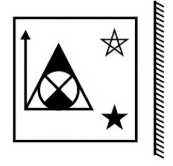
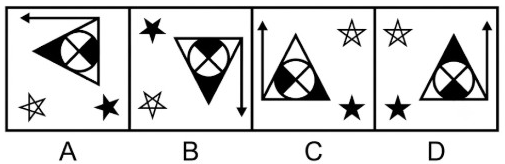
To determine the correct mirror image of the given figure, we need to understand how the elements of the figure will appear when a mirror is placed to the right of the image. The mirror image will reverse the horizontal orientation of the elements while maintaining their vertical positions.
Correct Option: D) …
Which of the following statements about the speed of sound in different mediums at 25°C is/are true?
A. In helium gas, the speed of sound is 965 m/s.
B. In hydrogen gas, the speed of sound is 1284 m/s.
Both A and B are true
Only A is true
Neither A nor B is true
Only B is true
This question tests knowledge about the speed of sound in different gaseous mediums at a specific temperature. The speed of sound varies significantly depending on the properties of the medium, such as its density and elasticity. For gases, lighter gases generally allow sound to travel faster.
Correct Option: A) Both A and B are true
Both statements accurately reflect the approximate speed of sound in helium and hydrogen gases at 25°C. The speed of sound in helium is indeed around 965 m/s, and in hydrogen, it is around 1284 m/s. These values are significantly higher than the speed of sound in air (approximately 343 m/s at 20°C).
The question asks for the year in which the Reserve Bank of India (RBI) was nationalized. This is a factual question related to the history of India's central banking institution. We need to recall the specific year of RBI's nationalization.
Correct Option: A) 1949 is the correct year when the Reserve Bank of India was nationalized.