
The question asks to identify the award given to coaches for producing medal winners in international sports events. This requires knowledge of major sports awards in India and their specific criteria.
Correct Option: B) Dronacharya Award is given to outstanding coaches in India who have successfully trained sportspersons or teams to achieve excellence in international competitions.
The difference between the CI compounded annually and SI on a certain sum for 2 years at 15% per annum is Rs. 180. Find the sum.
This problem involves finding the principal sum given the difference between Compound Interest (CI) and Simple Interest (SI) for a specific period and rate. We will use the standard formulas for CI and SI, or a direct formula for the difference between CI and SI for 2 years, to solve for the principal.
Identify the given values:
Recall the formulas for Simple Interest (SI) and Compound Interest (CI):
Calculate SI for 2 years:
\[ SI = \frac{P \times 15 \times 2}{100} = \frac{30P}{100} = \frac{3P}{10} \]Calculate CI for 2 years:
\[ CI = P \left[ \left(1 + \frac{15}{100}\right)^2 - 1 \right] \] \[ CI = P \left[ \left(1 + \frac{3}{20}\right)^2 - 1 \right] \] \[ CI = P \left[ \left(\frac{23}{20}\right)^2 - 1 \right] \] \[ CI = P \left[ \frac{529}{400} - 1 \right] \] \[ CI = P \left[ \frac{529 - 400}{400} \right] \] \[ CI = P \left[ \frac{129}{400} \right] = \frac{129P}{400} \]Use the given difference between CI and SI:
We are given \(CI - SI = 180\).
\[ \frac{129P}{400} - \frac{3P}{10} = 180 \]To subtract, find a common denominator, which is 400:
\[ \frac{129P}{400} - \frac{3P \times 40}{10 \times 40} = 180 \] \[ \frac{129P}{400} - \frac{120P}{400} = 180 \] \[ \frac{129P - 120P}{400} = 180 \] \[ \frac{9P}{400} = 180 \]Solve for P:
\[ 9P = 180 \times 400 \] \[ P = \frac{180 \times 400}{9} \] \[ P = 20 \times 400 \] \[ P = 8000 \]Alternatively, for 2 years, the difference between CI and SI can be directly calculated using the formula:
\[ CI - SI = P \left( \frac{R}{100} \right)^2 \]Substitute the given values:
\[ 180 = P \left( \frac{15}{100} \right)^2 \] \[ 180 = P \left( \frac{3}{20} \right)^2 \] \[ 180 = P \left( \frac{9}{400} \right) \] \[ P = \frac{180 \times 400}{9} \] \[ P = 20 \times 400 \] \[ P = 8000 \]The sum is Rs. 8,000.
B) Rs. 8,000 is the correct sum.
The question describes a specific assisted reproductive technology where fertilization occurs outside the female body. We need to identify the correct term for this process from the given options.
Correct Option: C) In vitro fertilisation
In vitro fertilisation (IVF) is an assisted reproductive technology where fertilization takes place outside the body, in a laboratory setting ("in vitro" means "in glass"). The description perfectly matches the definition and procedure of IVF, where eggs are retrieved, fertilized with sperm in a dish, and then the resulting embryo is transferred back into the uterus.
The question asks about the factors that cause the value of 'g' (acceleration due to gravity) to decrease. We need to recall the formula for 'g' and understand how different physical quantities affect it.
The acceleration due to gravity, \(g\), on the surface of a planet (or at a certain distance from its center) is given by Newton's Law of Universal Gravitation.
The formula for 'g' at a distance \(r\) from the center of a planet with mass \(M\) is:
\[ g = \frac{GM}{r^2} \]where \(G\) is the universal gravitational constant.
This formula shows that \(g\) is directly proportional to the mass of the planet (\(M\)) and inversely proportional to the square of the distance from the center of the planet (\(r\)).
When we talk about 'altitude', it refers to the height above the Earth's surface. If an object is at an altitude \(h\), its distance from the center of the Earth becomes \(r = R + h\), where \(R\) is the radius of the Earth.
Substituting this into the formula for \(g\):
\[ g_h = \frac{GM}{(R+h)^2} \]From this equation, it is clear that as the altitude \(h\) increases, the denominator \((R+h)^2\) increases. Since \(g_h\) is inversely proportional to \((R+h)^2\), an increase in altitude \(h\) will lead to a decrease in the value of \(g\).
Correct Option: D) altitude — As altitude increases, the distance from the center of the Earth increases, leading to a decrease in the acceleration due to gravity.
We are given two conditions about two numbers: their difference and the difference of their squares. We need to find their sum. We can set up a system of two equations with two variables and solve for the required sum using algebraic identities.
Let the two numbers be \(x\) and \(y\).
From the first condition, "Two numbers differ by 2", we can write the equation:
\[ x - y = 2 \quad \text{(Equation 1)} \]From the second condition, "The difference of squares of both is 100", we can write the equation:
\[ x^2 - y^2 = 100 \quad \text{(Equation 2)} \]Recall the algebraic identity for the difference of squares: \(a^2 - b^2 = (a - b)(a + b)\). Apply this to Equation 2:
\[ (x - y)(x + y) = 100 \]Substitute the value of \((x - y)\) from Equation 1 into the modified Equation 2:
\[ (2)(x + y) = 100 \]Now, solve for \((x + y)\), which represents the sum of the numbers:
\[ x + y = \frac{100}{2} \]\[ x + y = 50 \]Thus, the sum of the numbers is 50.
C) 50 is the correct answer. The sum of the two numbers is 50, as derived from the given conditions.
Global CO2 Concentration (ppm)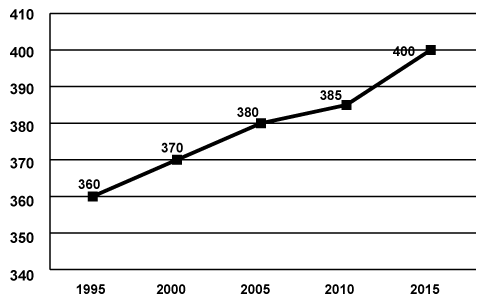
Based on the given graph, which statement correctly describes the pattern?
There is increase in CO2 concentration over the years.
There is decrease in CO2 concentration over the years.
There is no change in CO2 concentration over the years.
The CO2 concentration fluctuates over these years.
To determine the correct statement about the pattern of CO2 concentration over the years, we need to analyze the given graph.
Correct Option: A) There is increase in CO2 concentration over the years.
We are given the initial ratio of two numbers and the ratio after a constant value is added to each number. We can set up algebraic equations based on these ratios and solve for the original numbers.
Let the two original numbers be \(3x\) and \(4x\), as their ratio is given as \(3:4\).
According to the problem, if 3 is added to each number, the new numbers become \((3x + 3)\) and \((4x + 3)\).
The ratio of these new numbers is given as \(10:13\). So, we can write the equation:
\[ \frac{3x + 3}{4x + 3} = \frac{10}{13} \]Now, we cross-multiply to solve for \(x\):
\[ 13(3x + 3) = 10(4x + 3) \]\[ 39x + 39 = 40x + 30 \]Rearrange the terms to find \(x\):
\[ 39 - 30 = 40x - 39x \]\[ 9 = x \]Substitute the value of \(x\) back into our expressions for the original numbers:
First number \( = 3x = 3 \times 9 = 27 \)
Second number \( = 4x = 4 \times 9 = 36 \)
Thus, the original numbers are 27 and 36.
D) 27, 36. This matches our calculated original numbers.
A tank has two inlets which can fill it in 6 hours and 8 hours, respectively. An outlet can empty the full tank in 10 hours. If all three pipes are opened together in an empty tank how much time will they take to fill the tank completely?
5\( \frac{5}{46} \) Hours
6\( \frac{5}{23} \) Hours
6\( \frac{5}{46} \) Hours
5\( \frac{5}{23} \) Hours
To solve this problem, we need to calculate the effective filling rate of the tank when both inlet pipes and the outlet pipe are working simultaneously. We will find the individual work rates (fraction of tank filled/emptied per hour) for each pipe and then combine them to find the net work rate. Finally, the total time taken will be the reciprocal of the net work rate.
Calculate the filling rate of the first inlet pipe:
The first inlet pipe fills the tank in 6 hours. So, its rate of filling per hour is:
Calculate the filling rate of the second inlet pipe:
The second inlet pipe fills the tank in 8 hours. So, its rate of filling per hour is:
Calculate the emptying rate of the outlet pipe:
The outlet pipe empties the tank in 10 hours. So, its rate of emptying per hour is:
Calculate the net filling rate when all three pipes are opened together:
Since the inlet pipes fill and the outlet pipe empties, the net rate will be the sum of the filling rates minus the emptying rate:
Find a common denominator for the fractions:
The least common multiple (LCM) of 6, 8, and 10 is 120.
Perform the addition and subtraction:
\[ \text{Net Rate} = \frac{20 + 15 - 12}{120} \]\[ \text{Net Rate} = \frac{35 - 12}{120} \]\[ \text{Net Rate} = \frac{23}{120} \text{ tank/hour} \]Calculate the total time taken to fill the tank:
The time taken is the reciprocal of the net filling rate:
Convert the improper fraction to a mixed number:
\[ \frac{120}{23} = 5 \text{ with a remainder of } 5 \]\[ \text{Time} = 5 \frac{5}{23} \text{ hours} \]Correct Option: D) 5\( \frac{5}{23} \) Hours
The question asks to identify the instrument used for measuring potential difference. This requires knowledge of basic electrical measuring instruments and their specific functions.
Correct Option: D) Voltmeter. A voltmeter is an instrument used for measuring the electric potential difference between two points in an electric circuit. It is connected in parallel across the component or points where the potential difference is to be measured.
The question asks to identify which of the given options is NOT a compound. To answer this, we need to understand the definitions of an element and a compound.
Based on this analysis, Lead is the substance that is NOT a compound.
D) Lead is an element, not a compound. It is a pure substance consisting only of lead atoms.