Find the odd one out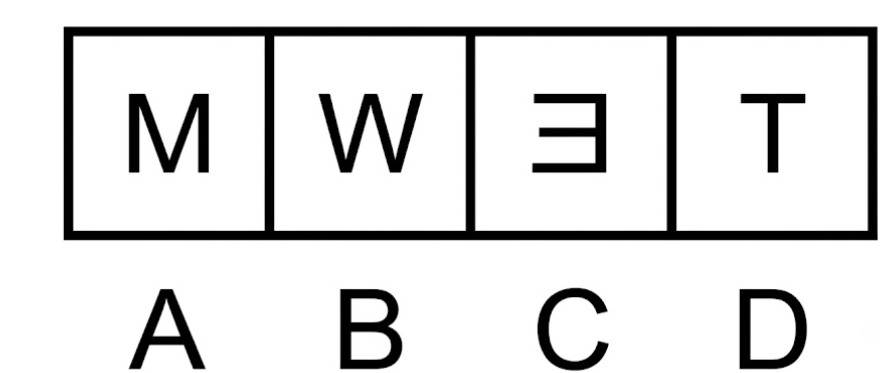
The task is to identify the odd one out among the given options based on the visual patterns of letters.
Correct Option: C) ?
A car accelerates uniformly from 18 kmh-1 to 72 kmh-1 in 10 s. Calculate the acceleration of the car.
To calculate the acceleration, we first need to convert the initial and final velocities from kilometers per hour (kmh-1) to meters per second (ms-1), as acceleration is typically expressed in ms-2. Then, we will use the formula for uniform acceleration: \(a = \frac{v - u}{t}\), where \(a\) is acceleration, \(v\) is final velocity, \(u\) is initial velocity, and \(t\) is time.
Initial velocity, \(u = 18 \text{ kmh}^{-1}\)
To convert kmh-1 to ms-1, we multiply by \(\frac{5}{18}\) (since \(1 \text{ km} = 1000 \text{ m}\) and \(1 \text{ h} = 3600 \text{ s}\), so \[1 \text{ kmh}^{-1} = \frac{1000}{3600} \text{ ms}^{-1} = \frac{5}{18} \text{ ms}^{-1}\]).
\[ u = 18 \times \frac{5}{18} \text{ ms}^{-1} = 5 \text{ ms}^{-1} \]Final velocity, \(v = 72 \text{ kmh}^{-1}\)
\[ v = 72 \times \frac{5}{18} \text{ ms}^{-1} = 4 \times 5 \text{ ms}^{-1} = 20 \text{ ms}^{-1} \]Time, \(t = 10 \text{ s}\)
The formula for acceleration is:
\[ a = \frac{v - u}{t} \]\[ a = \frac{20 \text{ ms}^{-1} - 5 \text{ ms}^{-1}}{10 \text{ s}} \]\[ a = \frac{15 \text{ ms}^{-1}}{10 \text{ s}} \]\[ a = 1.5 \text{ ms}^{-2} \]D) 1.5 ms-2 is the correct acceleration calculated after converting velocities to ms-1 and applying the acceleration formula.
In the center of a square room with sides 10 m, there is a square of turkey carpet and the rest of the floor is covered with oil cloth. The carpet and the oil cloth cost Rs. 15 and Rs. 6.50 respectively per square meter and the total cost of the carpet and the oil cloth is Rs. 1,338.50. What is the width of the oil cloth border?
The problem involves calculating the dimensions of a square carpet and the surrounding oil cloth border within a larger square room. We are given the dimensions of the room, the cost per square meter for both the carpet and the oil cloth, and the total cost. We need to find the width of the oil cloth border. We can set up equations based on the areas and costs to solve for the unknown dimension.
Calculate the total area of the room:
The room is a square with sides 10 m.
Define variables for the carpet:
Let the side of the square turkey carpet be \(x\) meters.
Calculate the area of the oil cloth:
The area covered by the oil cloth is the total area of the room minus the area of the carpet.
Set up the total cost equation:
The cost of the carpet is Rs. 15 per square meter, and the cost of the oil cloth is Rs. 6.50 per square meter. The total cost is Rs. 1,338.50.
Solve the equation for \(x\):
\[ 15x^2 + 650 - 6.5x^2 = 1338.50 \]\[ 8.5x^2 = 1338.50 - 650 \]\[ 8.5x^2 = 688.50 \]\[ x^2 = \frac{688.50}{8.5} \]\[ x^2 = 81 \]\[ x = \sqrt{81} \]\[ x = 9 \text{ m} \]Calculate the width of the oil cloth border:
The side of the room is 10 m, and the side of the carpet is 9 m. The oil cloth forms a uniform border around the carpet. Let the width of the border be \(w\).
The side of the room can be expressed as the side of the carpet plus twice the width of the border (since the border is on both sides).
\[ \text{Side of room} = \text{Side of carpet} + 2 \times \text{Width of border} \]\[ 10 = 9 + 2w \]\[ 2w = 10 - 9 \]\[ 2w = 1 \]\[ w = \frac{1}{2} \text{ m} \]C) \( \frac{1}{2} \) meter — The calculations show that the width of the oil cloth border is \( \frac{1}{2} \) meter.
Find the similar pair: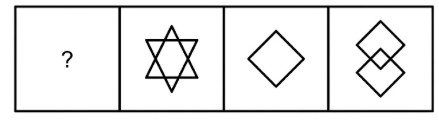
To solve this problem, we need to identify the pattern or relationship among the given shapes in the question diagram and find the option that completes the sequence or matches the pattern.
Correct Option: D) Triangle
The question asks to identify the word that does not belong to the given group: Blanket, Sheet, Pillow, Cot. This is a classification-based question where we need to find the common characteristic among most items and identify the outlier.
Correct Option: C) Cot is the word that does not belong to the group because a cot is a piece of furniture (a bed), whereas a blanket, sheet, and pillow are bedding accessories used on a bed.
This problem involves the concept of work and time. We will calculate the total work required, the work completed, and then the remaining work. Finally, we will determine the time taken by the reduced number of workers to complete the remaining work.
The total work can be expressed in terms of "man-days" (number of people \(\times\) number of days).
\[ \text{Total Work} = \text{Number of people} \times \text{Number of days} \] \[ \text{Total Work} = 18 \text{ people} \times 12 \text{ days} = 216 \text{ man-days} \]For the first 4 days, 18 people worked.
\[ \text{Work done in 4 days} = 18 \text{ people} \times 4 \text{ days} = 72 \text{ man-days} \]Subtract the work done from the total work.
\[ \text{Remaining Work} = \text{Total Work} - \text{Work done in 4 days} \] \[ \text{Remaining Work} = 216 \text{ man-days} - 72 \text{ man-days} = 144 \text{ man-days} \]After 4 days, 2 workers left.
\[ \text{Remaining workers} = 18 - 2 = 16 \text{ people} \]Now, 16 people need to complete 144 man-days of work.
\[ \text{Days needed} = \frac{\text{Remaining Work}}{\text{Remaining workers}} \] \[ \text{Days needed} = \frac{144 \text{ man-days}}{16 \text{ people}} = 9 \text{ days} \]Correct Option: B) 9
To identify a physical change, we need to understand its definition: a physical change alters the form or appearance of a substance but does not change its chemical composition. No new substances are formed during a physical change. Chemical changes, on the other hand, result in the formation of new substances with different chemical properties.
Correct Option: A) Melting of ice. This is a physical change because water changes its state from solid (ice) to liquid (water), but its chemical composition (\(\text{H}_2\text{O}\)) remains the same. No new substance is formed.
The question asks to identify a recessive character in garden pea plants. This refers to Mendel's experiments on inheritance, where he studied several contrasting traits. Understanding which traits are dominant and which are recessive is key to answering this question.
C) wrinkled seed — According to Mendel's findings, the wrinkled seed shape is a recessive character in garden pea plants, while the round seed shape is dominant.
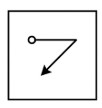
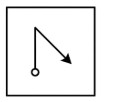
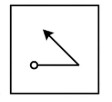
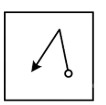
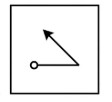
Choose the mirror image for the following figure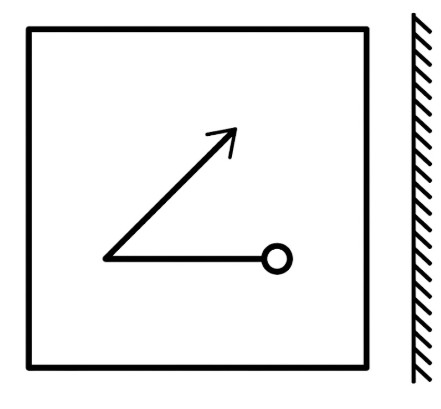
To find the mirror image of a figure, you need to visualize how the figure would look if reflected across a vertical mirror placed on its right side. The key is to reverse the orientation of elements horizontally.
Correct Option: C) The arrow is correctly pointing diagonally upwards to the left, and the circle is on the right side of the arrow, matching the mirror image of the original figure.
The question asks to identify the non-metal element that is placed with alkali metals in the periodic table. This requires knowledge of the periodic table's structure, specifically the first group (Group 1) and the classification of elements as metals or non-metals.
B) Hydrogen — Hydrogen is a non-metal element. Despite being a non-metal, it is placed in Group 1 of the periodic table along with the alkali metals because it has one valence electron and can lose it to form a positive ion, similar to alkali metals. However, its other properties are distinctly non-metallic.