
To solve this problem, we need to follow the order of operations, often remembered by the acronym PEMDAS/BODMAS (Parentheses/Brackets, Exponents/Orders, Multiplication and Division (from left to right), Addition and Subtraction (from left to right)).
Thus, the value of the expression is \(-5\).
B) -5 is the correct answer, as calculated by following the order of operations.
To determine which material has the highest resistivity, we need to understand the concept of resistivity and classify the given materials as conductors, semiconductors, or insulators. Resistivity is a measure of how strongly a material opposes the flow of electric current. Insulators have very high resistivity, while conductors have very low resistivity.
Correct Option: A) Ebonite
To find the square root of a large number like 519841, we can use the long division method or estimation combined with checking the last digit. Since the options are given, we can also use the properties of square numbers and check the last digit of the given number and the options.
A) 721 is the correct answer because \(721^2 = 519841\).
This question asks about the energy source that a cell (like a battery) uses to maintain current in an electrical circuit. Understanding the fundamental principle of how batteries work is key to answering this.
Correct Option: C) A cell converts chemical energy stored within its components into electrical energy. This electrical energy then drives the current in the circuit.
To solve this problem, we first need to determine the cost price (CP) of the article. We are given the selling price (SP) and the profit percentage for the first transaction. Once the cost price is known, we can calculate the profit or loss percentage for the second selling price.
Calculate the Cost Price (CP):
Given:
The formula relating SP, CP, and Profit% is:
\[ \text{SP} = \text{CP} \times \left(1 + \frac{\text{P}\%}{100}\right) \]\[ 420 = \text{CP} \times \left(1 + \frac{5}{100}\right) \]\[ 420 = \text{CP} \times \left(1 + 0.05\right) \]\[ 420 = \text{CP} \times 1.05 \]\[ \text{CP} = \frac{420}{1.05} \]\[ \text{CP} = 400 \]Calculate Profit or Loss for the New Selling Price:
Now, the article is sold for a new Selling Price (\(\text{SP}_2\)) = Rs. 380.
Since the Cost Price (\(\text{CP}\)) is Rs. 400 and the new Selling Price (\(\text{SP}_2\)) is Rs. 380, we can see that \(\text{SP}_2 < \text{CP}\), which means there is a loss.
Loss = \(\text{CP} - \text{SP}_2\)
\[ \text{Loss} = 400 - 380 \]\[ \text{Loss} = \text{Rs. } 20 \]Calculate the Loss Percentage:
The loss percentage is calculated as:
\[ \text{Loss}\% = \frac{\text{Loss}}{\text{CP}} \times 100 \]\[ \text{Loss}\% = \frac{20}{400} \times 100 \]\[ \text{Loss}\% = \frac{1}{20} \times 100 \]\[ \text{Loss}\% = 5\% \]Therefore, by selling the article for Rs. 380, the seller incurs a loss of 5%.
D) L = 5% is the correct answer. The calculation shows a loss of 5% when the article is sold for Rs. 380.
We need to analyze the given statement and determine which of the conclusions logically follows from it. The statement describes a municipality inviting tenders for the construction of a bridge. We must infer what can be directly concluded from this action.
Correct Option: A) Only conclusion I follows.
The question asks to identify the inventor of alternating current (AC). This is a factual recall question related to the history of science and technology, specifically in the field of electricity.
C) Nikola Tesla is credited with the invention and development of the alternating current (AC) electrical system, which is the standard for power transmission today. His work on AC motors, generators, and the polyphase system revolutionized electrical engineering.
Select the option that is related to third word in the same way as second word is related to first word.
Eat : Ate :: Buy :?
The question asks us to find the word that completes the analogy. We need to identify the relationship between the first pair of words (Eat : Ate) and then apply the same relationship to the third word (Buy) to find the fourth word.
Correct Option: A) Bought
This problem involves understanding the standard orientation of a clock face and then reorienting it based on the given information about the minute hand's direction. We need to determine the direction of the hour hand at a specific time (9:00 am) after this reorientation.
Therefore, the hour hand points towards West.
Correct Option: D) West
Find the odd one out.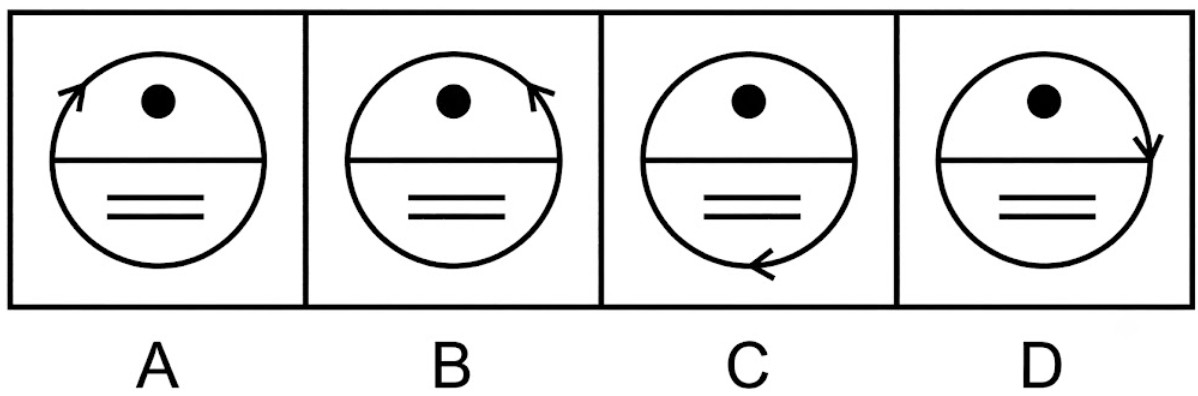
The goal is to identify the pattern in the given figures and determine which option does not conform to this pattern. The figures consist of a circle with a dot and an arrow, along with lines below the circle.
Correct Option: D) Option D is the odd one out because it does not follow the alternating pattern of arrow directions.