
The question asks to identify whose portrait/statue was unveiled by Maharashtra Chief Minister Devendra Fadnavis at the headquarters of the Greater Mumbai Municipal Corporation. This is a factual question related to a specific event in Maharashtra's political and social history.
D) Prabodhankar Thackeray — Devendra Fadnavis, the then Chief Minister of Maharashtra, unveiled a portrait of Keshav Sitaram Thackeray, popularly known as Prabodhankar Thackeray, at the Brihanmumbai Municipal Corporation (BMC) headquarters on September 17, 2017, to mark his 132nd birth anniversary. Prabodhankar Thackeray was a prominent social reformer, journalist, and author, and the father of Shiv Sena founder Bal Thackeray.
This problem involves calculating a past population given a current population and a constant annual growth rate. We will use the compound interest formula, adapted for population growth, to find the population 2 years ago.
Correct Option: B) 48980
Which answer figure is formed from the shapes given in the question figure?
Question figure:
Answer figure: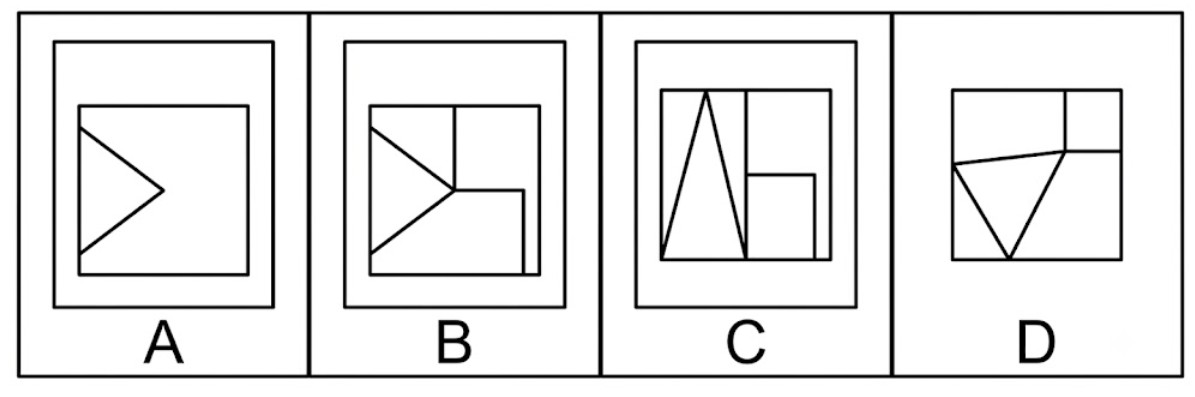
The task is to determine which answer figure can be formed using the shapes provided in the question figure. This requires analyzing the shapes and their arrangement in both the question and answer figures.
Correct Option: D) Option D correctly uses all the shapes from the question figure.
To calculate the work done by a force, we use the formula that relates force, displacement, and the angle between them. Since the object moves in the direction of the force, the angle is 0 degrees, simplifying the calculation.
Work done (\(W\)) by a constant force is given by:
\[ W = F \cdot d \cdot \cos(\theta) \]Since \(\theta = 0^\circ\), \(\cos(0^\circ) = 1\).
\[ W = 125 \, \text{N} \cdot 5 \, \text{m} \cdot \cos(0^\circ) \]\[ W = 125 \, \text{N} \cdot 5 \, \text{m} \cdot 1 \]\[ W = 625 \, \text{N}\cdot\text{m} \]The unit of work is Joules (J), where \(1 \, \text{J} = 1 \, \text{N}\cdot\text{m}\).
Therefore, the work done is 625 J.
Correct Option: D) 625 J
The question describes a specific bonding arrangement of carbon atoms: each carbon atom bonded to three other carbon atoms in the same plane, forming a hexagonal array. This description points to a particular allotrope of carbon. We need to identify which of the given options matches this structural characteristic.
B) Graphite is an allotrope of carbon where each carbon atom is \(sp^2\) hybridized and bonded to three other carbon atoms in the same plane, forming a hexagonal lattice. These planar layers stack on top of each other.
A car falls from the edge of the road to the ground in 0.5 s. Let g = 10 ms–2. How high is the edge of the road above the ground?
The problem describes a car falling under gravity, which is a case of free fall. We need to find the height from which the car falls, given the time of fall and the acceleration due to gravity. We can use the equations of motion for uniformly accelerated motion, specifically the one relating displacement, initial velocity, time, and acceleration.
For an object falling under gravity, the vertical displacement (height, \(h\)) can be calculated using the second equation of motion:
\[ h = ut + \frac{1}{2}gt^2 \]Since the initial velocity \(u = 0\), the term \(ut\) becomes 0.
\[ h = (0)(0.5) + \frac{1}{2}(10)(0.5)^2 \]Simplify the equation:
\[ h = 0 + \frac{1}{2}(10)(0.25) \]\[ h = 5 \times 0.25 \]\[ h = 1.25 \text{ m} \]The height of the edge of the road above the ground is \(1.25\) m.
C) 1.25 m — This is the correct height calculated using the equation of motion for free fall.
We will set up a system of linear equations based on the given information about Sudha's and Radha's ages. First, we'll define variables for their current ages. Then, we'll form equations from the two conditions provided in the problem. Solving these equations will give us their current ages, and finally, we will calculate their ages 2 years ago.
Define variables for current ages:
Let Sudha's current age be \(S\) years.
Let Radha's current age be \(R\) years.
Formulate the first equation:
The problem states, "Sudha is twice as old as Radha."
So, we can write this as:
\[ S = 2R \quad \text{(Equation 1)} \]
Formulate the second equation:
The problem states, "If 6 years is subtracted from Radha's age and Sudha's age is increased by 4 years, then Sudha's age will be four times that of Radha."
Radha's age after subtraction: \(R - 6\)
Sudha's age after increase: \(S + 4\)
According to the condition:
\[ S + 4 = 4(R - 6) \quad \text{(Equation 2)} \]
Solve the system of equations:
Substitute Equation 1 into Equation 2:
\[ (2R) + 4 = 4(R - 6) \]
Now, solve for \(R\):
\[ 2R + 4 = 4R - 24 \]
Rearrange the terms to group \(R\) terms on one side and constants on the other:
\[ 4 + 24 = 4R - 2R \]
\[ 28 = 2R \]
\[ R = \frac{28}{2} \]
\[ R = 14 \text{ years} \]
Now, find Sudha's current age \(S\) using Equation 1:
\[ S = 2R \]
\[ S = 2 \times 14 \]
\[ S = 28 \text{ years} \]
So, Sudha's current age is 28 years and Radha's current age is 14 years.
Calculate ages 2 years ago:
Sudha's age 2 years ago: \(28 - 2 = 26\) years
Radha's age 2 years ago: \(14 - 2 = 12\) years
Correct Option: B) 26 years and 12 years
In 4\( \frac{1}{2} \) hours, Jack can cover a distance of 6 km more than the distance covered by Jill in 3 hours. In 6 hours, Jack can cover 5 km less than the distance covered by Jill in 5 hours. What is the average speed of Jack in km/hr?
This problem involves setting up a system of two linear equations based on the given information about distances and times for Jack and Jill. We will use the formula \(\text{Distance} = \text{Speed} \times \text{Time}\) to form these equations. Then, we will solve the system of equations to find the speeds of Jack and Jill, and finally, determine Jack's average speed.
Let \(S_J\) be the average speed of Jack in km/hr.
Let \(S_{Ji}\) be the average speed of Jill in km/hr.
"In \(4\frac{1}{2}\) hours, Jack can cover a distance of 6 km more than the distance covered by Jill in 3 hours."
Time for Jack \[= 4\frac{1}{2} = \frac{9}{2}\] hours.
Distance covered by Jack \(= S_J \times \frac{9}{2}\).
Time for Jill \(= 3\) hours.
Distance covered by Jill \(= S_{Ji} \times 3\).
According to the problem statement:
\[ \frac{9}{2} S_J = 3 S_{Ji} + 6 \]\[ 9 S_J = 6 S_{Ji} + 12 \]\[ 3 S_J = 2 S_{Ji} + 4 \quad \text{(Equation 1)} \]"In 6 hours, Jack can cover 5 km less than the distance covered by Jill in 5 hours."
Time for Jack \(= 6\) hours.
Distance covered by Jack \(= S_J \times 6\).
Time for Jill \(= 5\) hours.
Distance covered by Jill \(= S_{Ji} \times 5\).
According to the problem statement:
\[ 6 S_J = 5 S_{Ji} - 5 \quad \text{(Equation 2)} \]We have two equations:
1) \(3 S_J = 2 S_{Ji} + 4\)
2) \(6 S_J = 5 S_{Ji} - 5\)
From Equation 1, express \(S_{Ji}\) in terms of \(S_J\):
\[ 2 S_{Ji} = 3 S_J - 4 \]\[ S_{Ji} = \frac{3 S_J - 4}{2} \]The average speed of Jack is 10 km/hr.
Correct Option: A) 10
The calculations show that Jack's average speed \(S_J\) is 10 km/hr, which matches option A.
Lime Ca(OH)2 reacts slowly with _________ in air to form a thin layer of CaCO3 on the walls.
The question asks about the chemical reaction that occurs when lime (calcium hydroxide) is applied to walls and how it forms a thin layer of calcium carbonate. This is a common chemical process observed in whitewashing.
Correct Option: C) \(\text{CO}_2\) is the gas in the air that reacts with calcium hydroxide to form calcium carbonate.
The problem presents a series of letters and asks us to identify the missing letter. To solve this, we need to find the pattern or rule governing the sequence of letters. This typically involves looking at the alphabetical positions of the letters and the differences between them.
D) J is the correct answer because it follows the established pattern of decreasing by 3 alphabetical positions.