
This is a question based on syllogism. We need to evaluate the given conclusions based on the provided statements. The best way to solve such problems is by using Venn diagrams to visually represent the relationships between the categories.
Let's represent the sets as circles.
Consider the possible scenarios for the 'Donkeys' circle:
Since this conclusion is not necessarily true in all possible diagrams (specifically, Scenario 1), it does not follow.
Therefore, this conclusion does not follow.
C) Neither 1 nor 2 follows.
Based on our analysis, neither conclusion can be definitively drawn from the given statements. Conclusion 1 is a possibility but not a certainty, and Conclusion 2 is a stronger statement than what is given and cannot be inferred.
Select mirror image of following figure.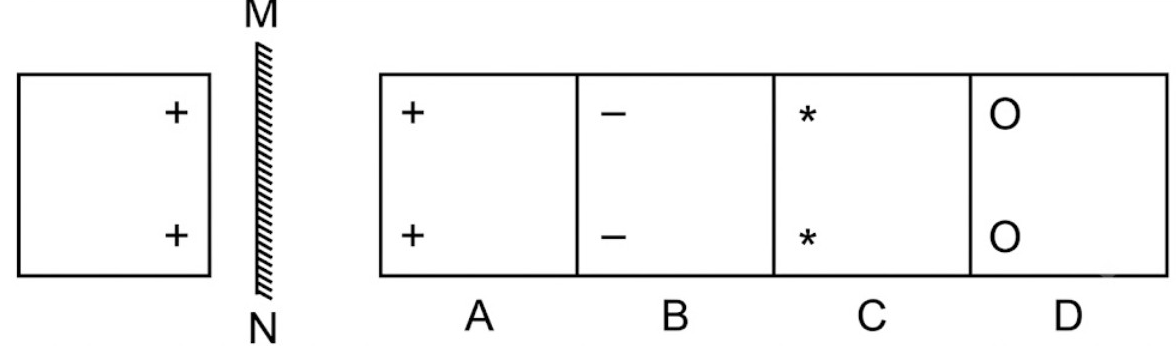
To find the mirror image of a figure, we need to reflect the elements across the given mirror line. This involves flipping the positions horizontally while maintaining the vertical orientation.
Correct Option: B) The minus signs (-) in Option B correctly mirror the plus signs (+) from the original figure.
Find mode of the following data:
25, 45, 58, 87, 45, 54, 65, 12, 25, 59, 42, 60
To find the mode of a given set of data, we need to identify the value or values that appear most frequently in the dataset. The mode is the number that occurs with the highest frequency.
Therefore, the modes of the given data are 25 and 45.
D) 45,25 — This option correctly identifies both 25 and 45 as the modes, as they both appear twice, which is the highest frequency in the dataset.
In which of the following processes, the cell is involved in the generation of an exact copy of another living part or a complete organism?
Cloning
In vitro fertilization (IVF)
Fructification
Regeneration
The question asks to identify the process where a cell is used to generate an exact genetic copy of another living part or a complete organism. We need to evaluate each option based on its biological definition.
Correct Option: A) Cloning is the process of producing genetically identical individuals from a single cell or organism. This directly aligns with the definition of generating an exact copy of another living part or a complete organism.
Sum of three fractions is 6. If one of them is 1\( \frac{1}{4} \), while the ratio of the other two is 9 : 10, then the largest fraction among the three fractions is:
2\( \frac{1}{4} \)
2\( \frac{3}{4} \)
2\( \frac{1}{8} \)
2\( \frac{1}{2} \)
The problem asks us to find the largest of three fractions given their sum, one of the fractions, and the ratio of the other two. We will first convert the given mixed fraction to an improper fraction. Then, we will subtract this known fraction from the total sum to find the sum of the remaining two fractions. Using the given ratio, we can set up an equation to find the values of these two fractions and identify the largest among all three.
Let the three fractions be \(F_1\), \(F_2\), and \(F_3\). The sum of these three fractions is 6.
\[ F_1 + F_2 + F_3 = 6 \]One of the fractions is given as \(1\frac{1}{4}\). Let's say \(F_1 = 1\frac{1}{4}\). Convert this mixed fraction to an improper fraction:
\[ F_1 = 1 + \frac{1}{4} = \frac{4 \times 1 + 1}{4} = \frac{5}{4} \]Substitute \(F_1\) into the sum equation:
\[ \frac{5}{4} + F_2 + F_3 = 6 \]Find the sum of the other two fractions, \(F_2 + F_3\):
\[ F_2 + F_3 = 6 - \frac{5}{4} \] \[ F_2 + F_3 = \frac{6 \times 4 - 5}{4} = \frac{24 - 5}{4} = \frac{19}{4} \]The ratio of the other two fractions (\(F_2\) and \(F_3\)) is 9 : 10. Let \(F_2 = 9x\) and \(F_3 = 10x\) for some common multiplier \(x\).
Substitute these expressions into the sum \(F_2 + F_3 = \frac{19}{4}\):
\[ 9x + 10x = \frac{19}{4} \] \[ 19x = \frac{19}{4} \]Solve for \(x\):
\[ x = \frac{19}{4 \times 19} = \frac{1}{4} \]Now, find the values of \(F_2\) and \(F_3\):
\[ F_2 = 9x = 9 \times \frac{1}{4} = \frac{9}{4} \] \[ F_3 = 10x = 10 \times \frac{1}{4} = \frac{10}{4} = \frac{5}{2} \]The three fractions are \(F_1 = \frac{5}{4}\), \(F_2 = \frac{9}{4}\), and \(F_3 = \frac{10}{4}\) (or \( \frac{5}{2} \)).
To compare them, it's easiest to have a common denominator or convert to mixed numbers/decimals:
Comparing these values, the largest fraction is \(F_3 = 2\frac{1}{2}\).
D) \(2\frac{1}{2}\) is the largest fraction among the three, as calculated.
The question asks us to identify the relationship between the first pair of words and then apply the same relationship to the third word to find the fourth word. This is an analogy question testing logical reasoning and vocabulary.
C) Experience — Just as a rose is known for its smell, wisdom is often acquired and characterized by experience. Experience is a primary source and a key component of wisdom.
Select the option that comes next in the following series.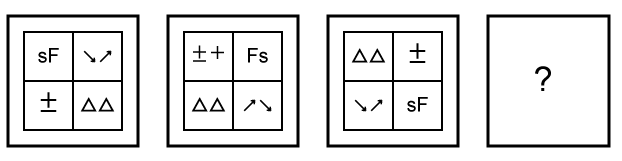
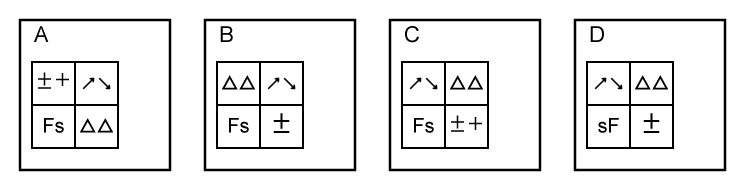
The problem requires identifying the pattern in a series of diagrams and selecting the option that logically follows this pattern.
Correct Option: A) The symbols are arranged as expected based on the pattern.
The question asks to identify the largest group of creatures among the given options. This requires knowledge of animal classification and the relative diversity of different phyla.
The phylum Arthropoda includes insects, arachnids, crustaceans, and myriapods. It is by far the largest phylum in the animal kingdom, accounting for over 80% of all known animal species. Their success is attributed to their exoskeleton, segmented bodies, and jointed appendages, allowing them to adapt to diverse environments.
Correct Option: A) Arthropoda is indeed the largest phylum in the animal kingdom, both in terms of the number of species and the number of individuals. It includes insects, spiders, crabs, and many other familiar creatures, making up over 80% of all known animal species.
The following pie chart shows the production of different types of garments in Company XYZ in 2014.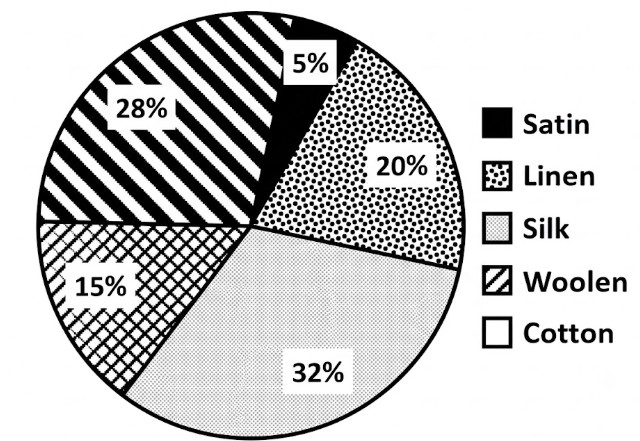
If a total of 150,000 tonnes of textiles were produced in 2014, then what was the production of woolen garments (in tonnes) in 2014?
To find the production of woolen garments, we need to calculate the percentage of woolen garments from the total production and then apply it to the total production quantity.
Therefore, the production of woolen garments is 42,000 tonnes.
Correct Option: A) 42,000
To find the Least Common Multiple (LCM) of a set of numbers, we can use the prime factorization method. This involves expressing each number as a product of its prime factors, and then taking the highest power of each prime factor that appears in any of the factorizations.
B) 336 is the least common multiple of 112, 24, and 48, as calculated by finding the product of the highest powers of all prime factors involved.