The data shows the number of children vaccinated in the year 2016 in different cities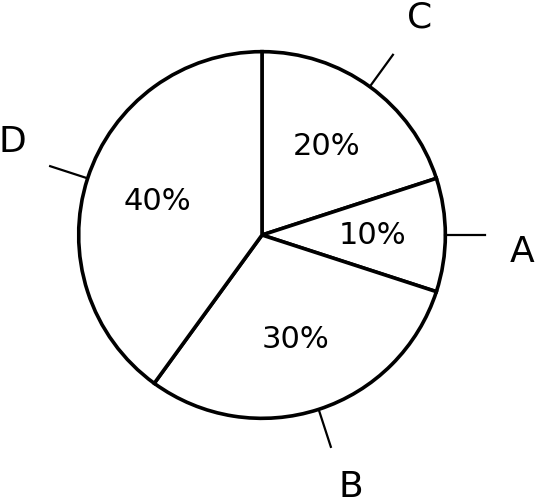
If the total number of children vaccinated in 2016 is 1,20,000, then how many children from city B were vaccinated?
The pie chart provided in the diagram illustrates the percentage distribution of vaccinated children across different cities. We need to calculate the number of children vaccinated in city B using the given percentage.
Number of children in city B = Total vaccinated children × Percentage for city B
Given:
Calculation:
Number of children in city B = \(1,20,000 \times \frac{30}{100} = 36,000\)
Thus, the number of children vaccinated in city B is 36,000.
Correct Option: D) 36,000
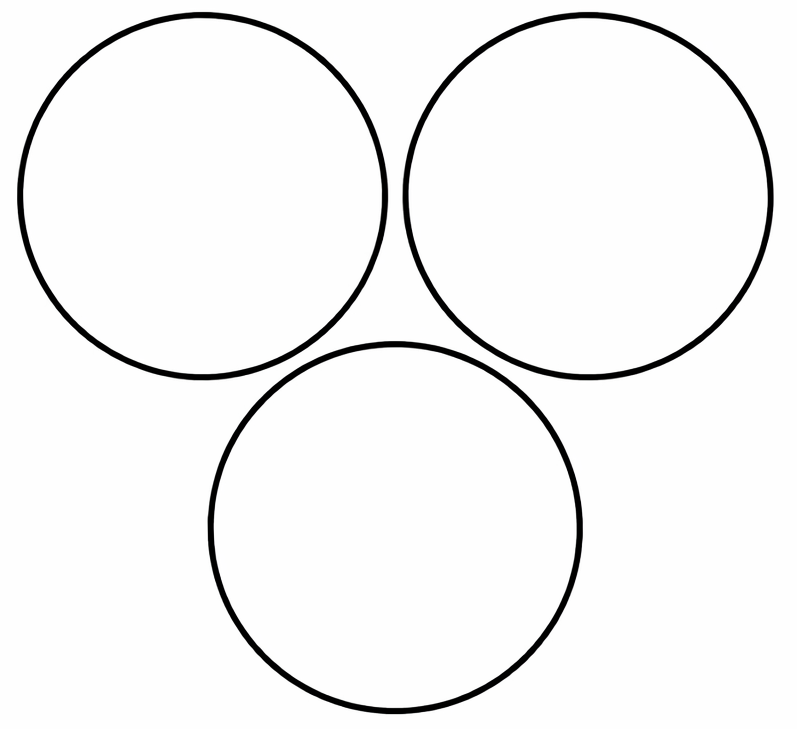
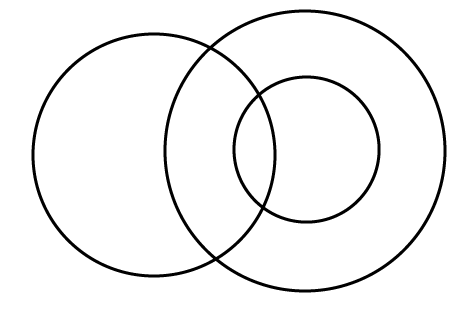
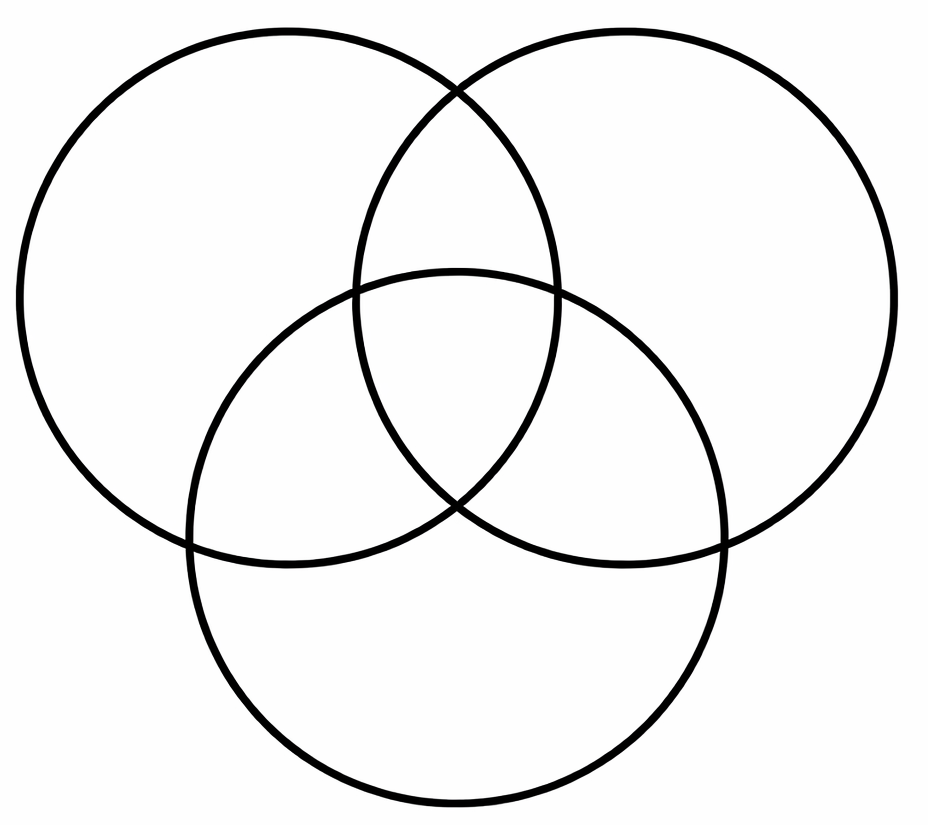
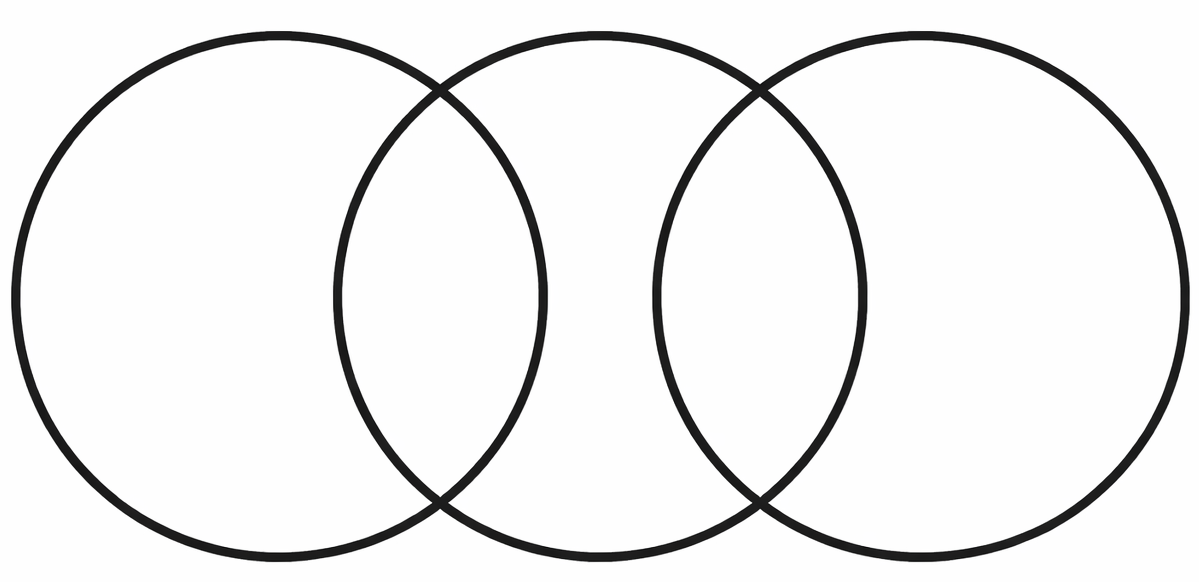
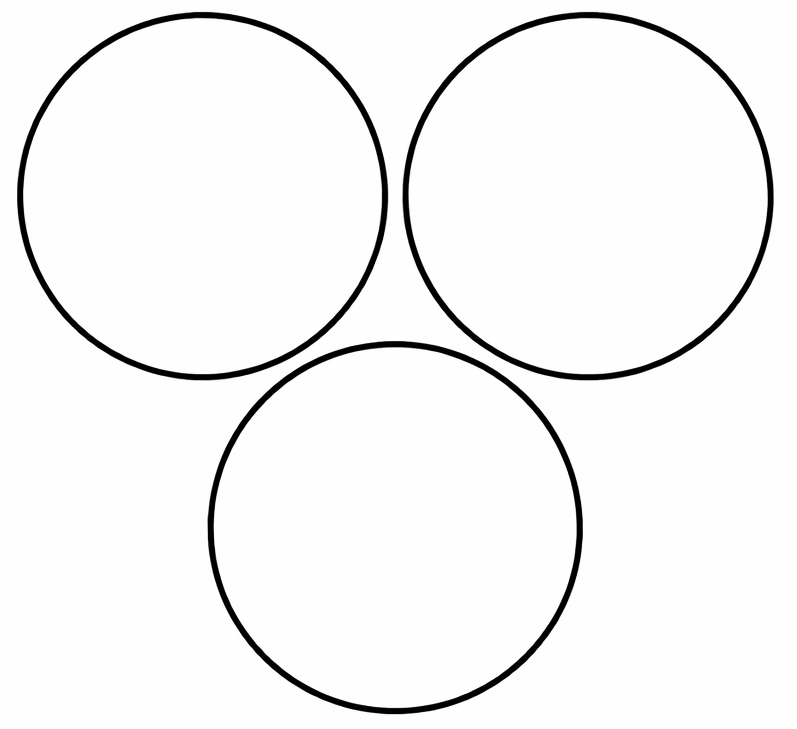
Choose the correct Venn diagram which represents the given words
"Utensils, Furniture, Clothes"
To solve this question, we need to determine the relationship between the categories: "Utensils," "Furniture," and "Clothes." These categories are distinct and do not overlap, as they represent different types of items.
Correct Option: A) The diagram shows three distinct circles, which accurately represents the separate nature of "Utensils," "Furniture," and "Clothes."
Sindhu can cover a distance of 20\( \frac{2}{3} \) km in 7\( \frac{3}{4} \) hours on foot. How many km per hour does she walk?
4 km
\( \frac{2}{3} \) km
2\( \frac{2}{3} \) km
3\( \frac{2}{3} \) km
To find the speed (km per hour), we need to divide the total distance covered by the total time taken. Both the distance and time are given in mixed fractions, so the first step is to convert them into improper fractions. Then, we will perform the division.
The given distance is \(20\frac{2}{3}\) km.
\[ 20\frac{2}{3} = \frac{(20 \times 3) + 2}{3} = \frac{60 + 2}{3} = \frac{62}{3} \text{ km} \]The given time is \(7\frac{3}{4}\) hours.
\[ 7\frac{3}{4} = \frac{(7 \times 4) + 3}{4} = \frac{28 + 3}{4} = \frac{31}{4} \text{ hours} \]Speed is calculated as Distance divided by Time.
\[ \text{Speed} = \frac{\text{Distance}}{\text{Time}} \]\[ \text{Speed} = \frac{\frac{62}{3}}{\frac{31}{4}} \]To divide by a fraction, multiply by its reciprocal.
\[ \text{Speed} = \frac{62}{3} \times \frac{4}{31} \]Notice that 62 is \(2 \times 31\). So, we can cancel out 31.
\[ \text{Speed} = \frac{2 \times 31}{3} \times \frac{4}{31} = \frac{2 \times 4}{3} = \frac{8}{3} \text{ km/hr} \]Divide 8 by 3.
\[ 8 \div 3 = 2 \text{ with a remainder of } 2 \]\[ \text{Speed} = 2\frac{2}{3} \text{ km/hr} \]Correct Option: C) \(2\frac{2}{3}\) km
The calculated speed is \(2\frac{2}{3}\) km/hr, which matches option C.
The task is to evaluate the strength of the given arguments in relation to the statement. A strong argument should directly support or logically follow from the statement, providing a reasonable course of action or a valid counter-point. The statement warns about the negative impact of pain killers on the liver.
A) Only argument I is strong. Argument I provides a logical and responsible course of action based on the health warning presented in the statement. It suggests avoiding pain killers for minor issues to protect the liver, which directly follows from the statement's premise.
First, we will use the given simple interest information to find the principal sum. Then, we will calculate the compound interest for the new time period (double the original) using the same principal and rate of interest.
The formula for Simple Interest (SI) is:
\[ \text{SI} = \frac{\text{P} \times \text{R} \times \text{T}}{100} \]Given:
Substitute the values into the formula:
\[ 360 = \frac{\text{P} \times 8 \times 1.5}{100} \]Now, solve for P:
\[ \text{P} = \frac{360 \times 100}{8 \times 1.5} = \frac{36000}{12} = 3000 \]So, the principal sum is Rs 3000.
The new time period (T') is double the original time:
\[ \text{T'} = 2 \times 1.5 \text{ years} = 3 \text{ years} \]The formula for Amount (A) under compound interest is:
\[ \text{A} = \text{P} \left(1 + \frac{\text{R}}{100}\right)^{\text{T'}} \]Substitute the values:
Simplify the expression:
\[ \text{A} = 3000 \left(1 + 0.08\right)^3 \]\[ \text{A} = 3000 \left(1.08\right)^3 \]\[ \text{A} = 3000 \times 1.259712 \]\[ \text{A} = 3779.136 \]Now, calculate the Compound Interest (CI):
\[ \text{CI} = \text{A} - \text{P} \]\[ \text{CI} = 3779.136 - 3000 \]\[ \text{CI} = 779.136 \]Rounding to two decimal places, the compound interest is Rs 779.13.
Correct Option: D) Rs 779.13
The question asks for the capital city of the Indian state of Jharkhand. This is a direct factual recall question related to Indian geography and political divisions. One needs to know the administrative capitals of Indian states.
Jharkhand is a state in eastern India. It was carved out of the southern part of Bihar on 15 November 2000. Its capital city is Ranchi.
C) Ranchi is the capital city of Jharkhand. It is a major industrial and educational hub of the region.
We will use the concept of work rate. If a person can complete a work in 'n' days, their one-day work rate is \(1/n\). We will set up equations based on the given information about the combined work of Rathin and Bratin, and the scenario where Rathin leaves early, to find Bratin's individual work rate and then the time he would take alone.
Let R's one day work be \(1/R\) and B's one day work be \(1/B\).
Given that Rathin and Bratin together can complete the work in 12 days. So, their combined one-day work rate is:
\[ \frac{1}{R} + \frac{1}{B} = \frac{1}{12} \quad \text{(Equation 1)} \]The work took a total of 15 days to complete. Rathin left 5 days before the work got over. This means Rathin worked for \(15 - 5 = 10\) days.
Bratin worked for all 15 days.
The total work done can be expressed as the sum of work done by Rathin and Bratin:
\[ 10 \times \frac{1}{R} + 15 \times \frac{1}{B} = 1 \quad \text{(Equation 2)} \]From Equation 1, we can express \(1/R\) in terms of \(1/B\):
\[ \frac{1}{R} = \frac{1}{12} - \frac{1}{B} \]Substitute this expression for \(1/R\) into Equation 2:
\[ 10 \left( \frac{1}{12} - \frac{1}{B} \right) + 15 \times \frac{1}{B} = 1 \]Simplify the equation:
\[ \frac{10}{12} - \frac{10}{B} + \frac{15}{B} = 1 \]\[ \frac{5}{6} + \frac{5}{B} = 1 \]Isolate the term with \(1/B\):
\[ \frac{5}{B} = 1 - \frac{5}{6} \]\[ \frac{5}{B} = \frac{6 - 5}{6} \]\[ \frac{5}{B} = \frac{1}{6} \]Solve for B:
\[ B = 5 \times 6 \]\[ B = 30 \]So, Bratin would take 30 days to complete the work by himself.
Correct Option: C) 30
The substances whose odour changes in acidic or basic media are called
Natural Indicators
Synthetic Indicators
Acid-base Indicators
Olfactory Indicators
The question asks to identify the term for substances whose odor changes in acidic or basic media. This concept relates to indicators used in chemistry, specifically those that rely on smell rather than color change.
D) Olfactory Indicators — These are substances whose smell or odor changes depending on whether they are in an acidic or basic solution. For example, onion has a characteristic smell that diminishes in a basic solution but remains detectable in an acidic solution.
This question tests knowledge of the typical speed of sound in common media at a specified temperature. The speed of sound varies depending on the medium's properties (elasticity and density) and temperature. We need to recall or verify the standard values for the speed of sound in oxygen gas and distilled water at 25°C.
C) Both A and B are true. Statement A correctly states the speed of sound in oxygen gas at 25°C as approximately 316 m/s. Statement B correctly states the speed of sound in distilled water at 25°C as approximately 1498 m/s. Both values are standard and widely accepted.
To find the square root of the perfect square obtained by multiplying 4050 with the least positive integer, we first need to find the prime factorization of 4050. Then, we identify which prime factors are not in pairs. The least positive integer required to make it a perfect square will be the product of these unpaired prime factors. Finally, we multiply 4050 by this integer and find the square root of the resulting perfect square.
First, we find the prime factors of 4050.
\[ 4050 = 10 \times 405 \]\[ 4050 = (2 \times 5) \times (5 \times 81) \]\[ 4050 = 2 \times 5 \times 5 \times 9 \times 9 \]\[ 4050 = 2 \times 5^2 \times 3^2 \times 3^2 \]\[ 4050 = 2 \times 3^4 \times 5^2 \]For a number to be a perfect square, all its prime factors must have an even exponent (i.e., appear in pairs). In the prime factorization of 4050, we have:
The factor 2 is unpaired.
To make 4050 a perfect square, we need to multiply it by the least positive integer that will make all prime factors have even exponents. In this case, we need one more factor of 2. So, the least positive integer is 2.
Multiply 4050 by the least positive integer (2):
\[ \text{Perfect Square} = 4050 \times 2 = 8100 \]Now, find the square root of 8100.
\[ \sqrt{8100} = \sqrt{81 \times 100} \]\[ \sqrt{8100} = \sqrt{81} \times \sqrt{100} \]\[ \sqrt{8100} = 9 \times 10 \]\[ \sqrt{8100} = 90 \]B) 90 is the square root of the perfect square obtained by multiplying 4050 with the least positive integer.