
To determine the work done by the wind on the car, we need to understand the definition of work in physics and the relative directions of the force applied by the wind and the displacement of the car.
Definition of Work: In physics, work done (\(W\)) by a force (\(F\)) is defined as the product of the magnitude of the force, the magnitude of the displacement (\(d\)), and the cosine of the angle (\(\theta\)) between the force and the displacement vectors. Mathematically, this is expressed as:
\[ W = F \cdot d \cdot \cos(\theta) \]Identify Forces and Displacement: The car is moving in one direction, and the wind is blowing from the opposite direction. This means the force exerted by the wind on the car is in the direction opposite to the car's displacement.
Determine the Angle (\(\theta\)): Since the force exerted by the wind is opposite to the direction of the car's displacement, the angle between the force vector and the displacement vector is \(180^\circ\).
Calculate \(\cos(\theta)\): The cosine of \(180^\circ\) is \(-1\).
\[ \cos(180^\circ) = -1 \]Calculate Work Done: Substitute the value of \(\cos(\theta)\) into the work formula:
\[ W = F \cdot d \cdot (-1) \]\[ W = -F \cdot d \]Conclusion: Since the force (\(F\)) and displacement (\(d\)) are both positive magnitudes, the work done (\(W\)) will be a negative value.
Correct Option: C) Negative
The work done by the wind on the car is negative because the force exerted by the wind is in the opposite direction to the car's motion. This means the wind is opposing the car's movement, and thus doing negative work.
The question asks for the SI unit of power. To answer this, we need to recall the definition of power and its standard unit in the International System of Units (SI).
D) Watt — The Watt (W) is the SI unit of power, defined as one Joule per second (1 J/s).
This problem involves work and time, where we need to find the time taken by an individual (B) to complete a task, given the combined work rates of different pairs and groups of people. We will use the concept that if a person can complete a task in \(D\) days, their one-day work rate is \(1/D\).
Let the one-day work rate of A, B, and C be \(W_A\), \(W_B\), and \(W_C\) respectively.
From the first statement, A, B, and C can complete a task together in 81 days. So, their combined one-day work rate is:
\[ W_A + W_B + W_C = \frac{1}{81} \quad \text{(Equation 1)} \]From the second statement, A and B can complete the same task together in 97.2 days. So, their combined one-day work rate is:
\[ W_A + W_B = \frac{1}{97.2} \quad \text{(Equation 2)} \]From the third statement, B and C can complete the same task together in 162 days. So, their combined one-day work rate is:
\[ W_B + W_C = \frac{1}{162} \quad \text{(Equation 3)} \]To find the work rate of B alone (\(W_B\)), we can use these equations. Subtract Equation 2 from Equation 1 to find \(W_C\):
\[ (W_A + W_B + W_C) - (W_A + W_B) = \frac{1}{81} - \frac{1}{97.2} \]\[ W_C = \frac{1}{81} - \frac{1}{97.2} \]\[ W_C = \frac{1}{81} - \frac{10}{972} \]To subtract these fractions, find a common denominator. \(972 = 12 \times 81\). So, \(972\) is a common multiple.
\[ W_C = \frac{12}{972} - \frac{10}{972} \]\[ W_C = \frac{2}{972} \]\[ W_C = \frac{1}{486} \]Now that we have \(W_C\), substitute this value into Equation 3 to find \(W_B\):
\[ W_B + W_C = \frac{1}{162} \]\[ W_B + \frac{1}{486} = \frac{1}{162} \]\[ W_B = \frac{1}{162} - \frac{1}{486} \]\[ W_B = \frac{3}{486} - \frac{1}{486} \]\[ W_B = \frac{2}{486} \]\[ W_B = \frac{1}{243} \]Since B's one-day work rate is \(1/243\), B alone can complete the task in 243 days.
A) 243 is the correct answer. The calculations show that B's one-day work rate is \(1/243\), meaning B takes 243 days to complete the task alone.
The mass number of an element is defined as the total number of protons and neutrons present in its nucleus. We are given the number of protons and neutrons, so we simply need to sum them up.
Correct Option: A) 27 is the correct answer because the mass number is the sum of protons and neutrons.
The question asks us to find the word that completes the analogy. We need to identify the relationship between the first pair of words (Sound : Ear) and then apply the same relationship to the third word (Scent) to find the fourth word.
Correct Option: D) Nose — The nose is the sensory organ through which we perceive scent, just as the ear is the organ through which we perceive sound.
If the vulgar fraction of 0.\( \overline{41} \) is given by \(\frac{41}{\underbrace{999\ldots9}_{n\text{ times}}}\), then find the value of n?
The problem asks us to find the value of 'n' when a repeating decimal (vulgar fraction) is given in a specific form. We need to convert the given repeating decimal into its vulgar fraction form and then compare it with the provided format to determine 'n'.
Let the given repeating decimal be \(x\).
\[ x = 0.\overline{41} \]This means the digits '41' repeat indefinitely.
\[ x = 0.414141\ldots \]To convert this repeating decimal to a vulgar fraction, we multiply \(x\) by a power of 10 such that the repeating part aligns. Since two digits are repeating, we multiply by \(10^2 = 100\).
\[ 100x = 41.414141\ldots \]Now, subtract the original equation (\(x = 0.414141\ldots\)) from this new equation:
\[ 100x - x = 41.414141\ldots - 0.414141\ldots \]\[ 99x = 41 \]Solve for \(x\):
\[ x = \frac{41}{99} \]The problem states that the vulgar fraction of \(0.\overline{41}\) is given by \[\frac{41}{\underbrace{999\ldots9}_{n\text{ times}}}\].
Comparing our derived fraction \(\frac{41}{99}\) with the given form \[\frac{41}{\underbrace{999\ldots9}_{n\text{ times}}}\], we can see that the denominator is 99.
The denominator 99 consists of two '9's. Therefore, the number of times '9' appears in the denominator is 2.
Thus, \(n = 2\).
Correct Option: C) The value of n is 2, as the denominator 99 has two '9's, which corresponds to the two repeating digits in the decimal \(0.\overline{41}\).
This problem involves setting up an algebraic equation based on the given age relationship. We need to find the number of years after which Bratin's age will be 1.5 times his cousin's age. We will represent the number of years with a variable and form an equation to solve for it.
Let \(x\) be the number of years after which Bratin's age will be 1.5 times his cousin's age.
According to the problem, after \(x\) years, Bratin's age will be 1.5 times his cousin's age. So, we can write the equation:
\[ 18 + x = 1.5 \times (7 + x) \]First, distribute 1.5 on the right side:
\[ 18 + x = 1.5 \times 7 + 1.5 \times x \] \[ 18 + x = 10.5 + 1.5x \]Now, gather terms with \(x\) on one side and constant terms on the other:
\[ 18 - 10.5 = 1.5x - x \] \[ 7.5 = 0.5x \]To find \(x\), divide both sides by 0.5:
\[ x = \frac{7.5}{0.5} \] \[ x = 15 \]After 15 years:
Check the ratio: \(33 / 22 = 1.5\). This confirms our answer.
Correct Option: A) 15
Choose the odd one out from the given figures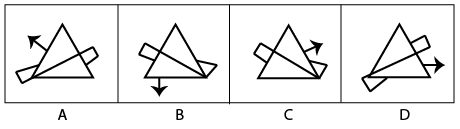
To identify the odd one out, examine the orientation and direction of the arrows in each figure. The goal is to find the figure with a different pattern or orientation compared to the others.
Figures A and C have arrows pointing in a similar clockwise direction, while Figure B has a vertical arrow. Figure D is distinct because its arrow points in an anti-clockwise direction, making it the odd one out.
Correct Option: D) Figure D is the odd one out due to its anti-clockwise arrow direction.
The question asks about the specific year when English was officially adopted as the medium of instruction in India by the British. This requires knowledge of key educational reforms and policies during British rule.
Correct Option: A) 1835
In 1835, Lord William Bentinck, the then Governor-General of India, passed the English Education Act. This act was based on Thomas Babington Macaulay's famous "Minute on Indian Education" of February 1835. Macaulay strongly advocated for the promotion of Western education through the medium of English, arguing that a class of Indians educated in English would act as interpreters between the British rulers and the millions they governed. This decision marked a significant shift in educational policy, making English the official language of government and the medium of instruction in higher education.
This is a blood relation question. To solve such problems, we break down the relationship step-by-step, starting from the last known person and moving towards the first, or vice-versa, to identify the direct relationship.
Therefore, Srilekha’s brother’s only sister’s father’s sister is Srilekha’s Paternal Aunt.
Correct Option: A) Paternal Aunt — As derived, the sister of Srilekha's father is her paternal aunt.