The question asks about the primary site where transpiration occurs in plants. Transpiration is the process of water movement through a plant and its evaporation from aerial parts, such as leaves, stems, and flowers. We need to identify the specific plant structure responsible for the majority of this water loss.
C) Stomata — Stomata are small pores, mainly on the leaf surface, that regulate gas exchange, including the release of water vapor during transpiration. Guard cells surrounding stomata control their opening and closing, thereby regulating the rate of transpiration.
This problem involves substituting given symbols with mathematical operators and then evaluating the expression according to the order of operations (BODMAS/PEMDAS).
Thus, the value of the expression is 90.
Correct Option: B) 90
This problem involves Ohm's Law, which states that the current flowing through a conductor between two points is directly proportional to the potential difference across the two points, and inversely proportional to the resistance between them. For an electric heater, its resistance is generally considered constant. We will first calculate the resistance of the heater using the initial given values of potential difference and current. Then, we will use this constant resistance to find the new current when the potential difference is increased.
According to Ohm's Law, \(V = IR\), where \(V\) is the potential difference, \(I\) is the current, and \(R\) is the resistance. We can rearrange this to find the resistance:
\[ R = \frac{V_1}{I_1} \]\[ R = \frac{60 \text{ V}}{4 \text{ A}} \]\[ R = 15 \text{ } \Omega \]Since the resistance of the heater remains constant, we can use Ohm's Law again with the new potential difference and the calculated resistance:
\[ I_2 = \frac{V_2}{R} \]\[ I_2 = \frac{172.5 \text{ V}}{15 \text{ } \Omega} \]\[ I_2 = 11.5 \text{ A} \]Correct Option: D) The new current drawn by the heater will be 11.5 A.
The question asks to identify the shuttler who represented the Olympic Committee in the Badminton World Federation (BWF) as of 2018. This requires knowledge of specific appointments and roles within international sports federations.
Correct Option: A) Saina Nehwal was appointed to the Badminton World Federation's (BWF) Athletes' Commission as a representative of the International Olympic Committee (IOC) in 2018. This role involved her representing the Olympic Committee's interests and athlete perspectives within the BWF.
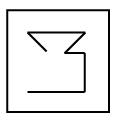
The above figure is embedded in any of these four figures; the correct answer containing the above picture is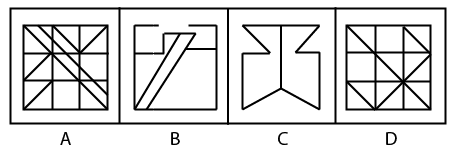
To solve this question, we need to identify which option contains the figure from the first image. Carefully observe the shapes, orientations, and intersections in the diagrams.
Correct Option: D) Option D contains the exact figure from the first image.
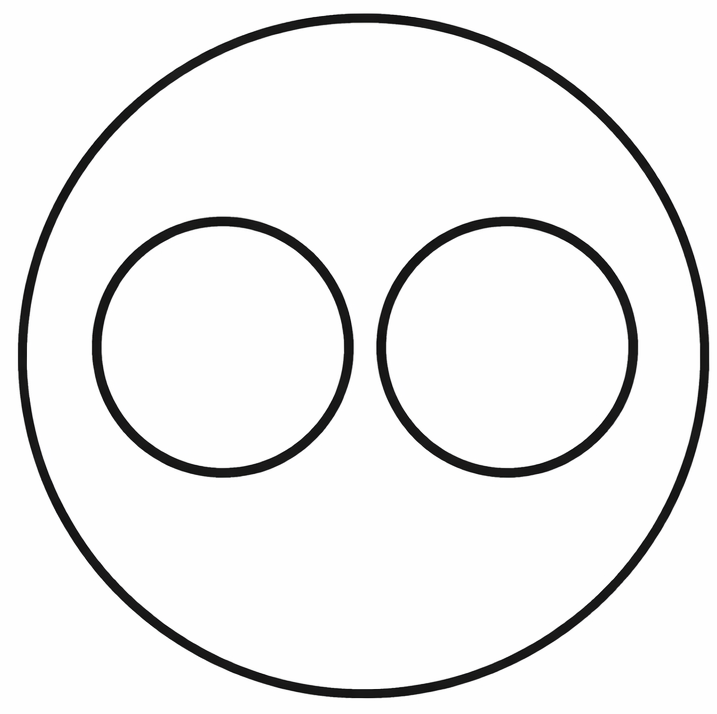
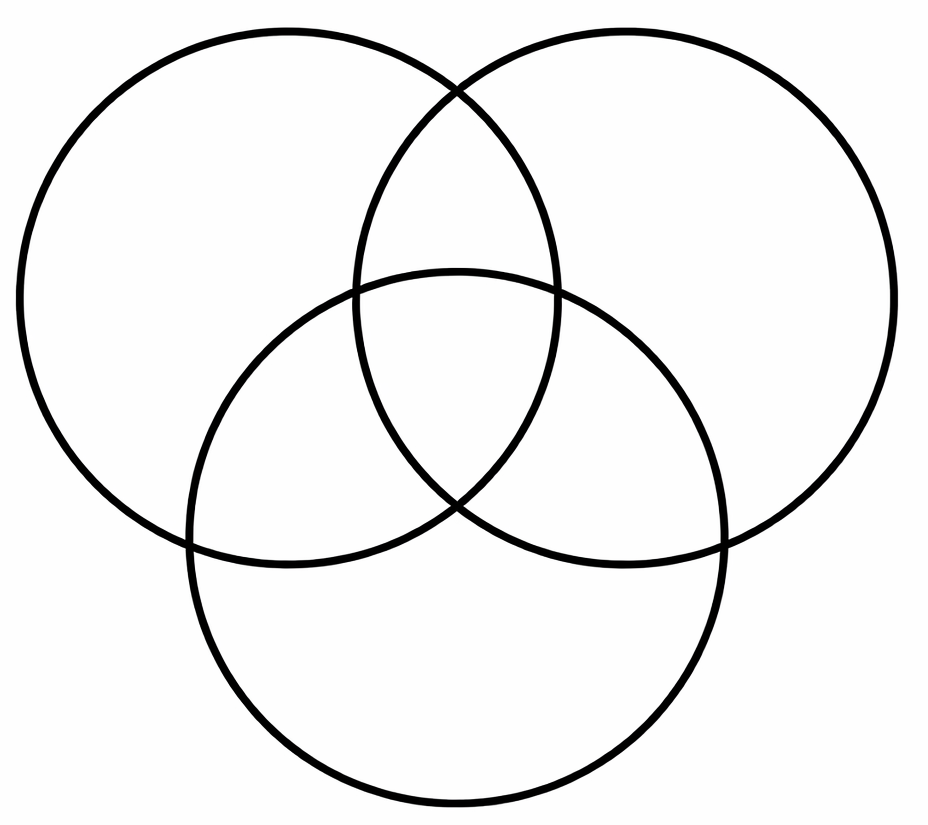
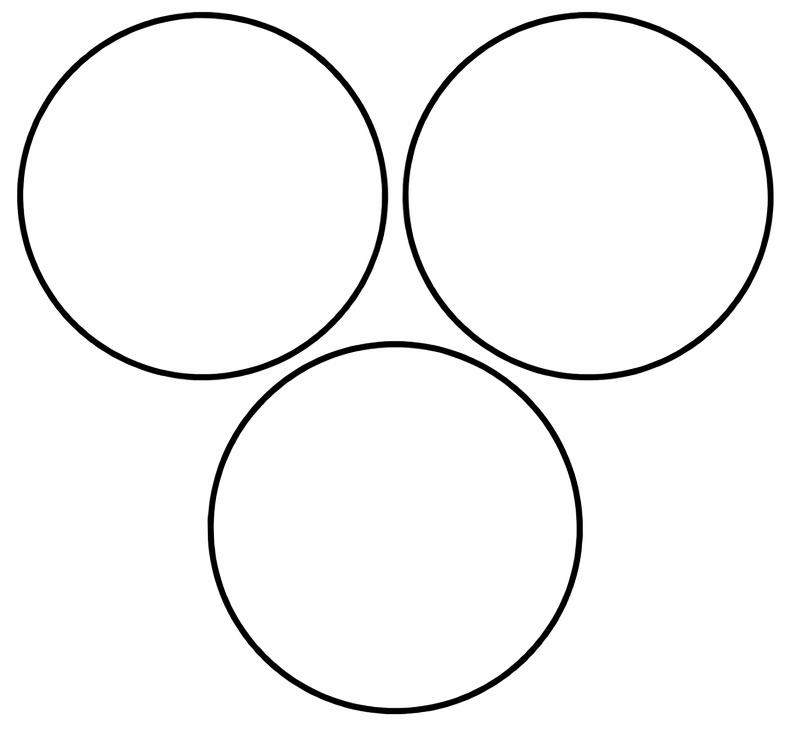
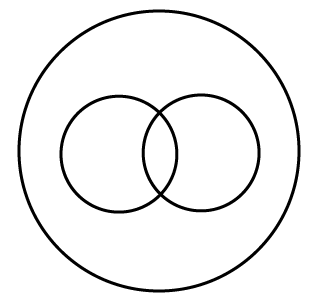
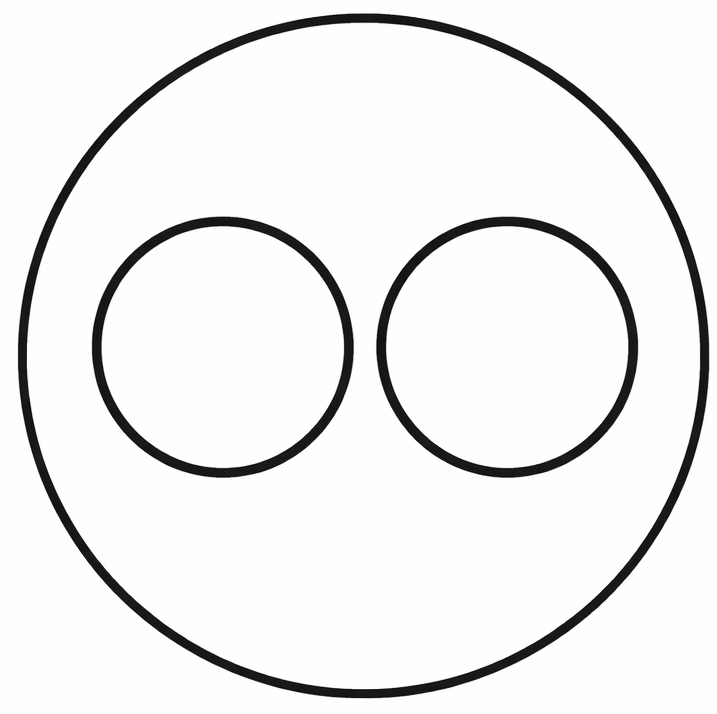
Choose the correct Venn diagram which represents the given words
"Metal, Gold, Platinum"
To solve this problem, we need to identify the correct Venn diagram that represents the relationship between the categories "Metal," "Gold," and "Platinum." Both gold and platinum are types of metals, so they should be represented as subsets of the larger set "Metal."
Correct Option: A) The diagram shows two non-overlapping circles ("Gold" and "Platinum") inside a larger circle ("Metal"), accurately representing the relationship.
A person borrowed Rs 32,000 at a yearly 9% simple interest and deposited the same amount in a bank at a yearly compound interest of 10%. What is the gain in rupees at the end of 3 years?
To find the gain, we need to calculate the simple interest paid on the borrowed amount and the compound interest earned on the deposited amount over 3 years. The gain will be the difference between the compound interest earned and the simple interest paid.
Principal \(P = \text{Rs } 32,000\)
Rate \(R = 9\%\) per annum
Time \(T = 3\) years
\[ \text{SI} = \frac{P \times R \times T}{100} \] \[ \text{SI} = \frac{32000 \times 9 \times 3}{100} \] \[ \text{SI} = 320 \times 27 \] \[ \text{SI} = \text{Rs } 8,640 \]Principal \(P = \text{Rs } 32,000\)
Rate \(R = 10\%\) per annum
Time \(T = 3\) years
First, calculate the Amount (A) using the compound interest formula:
\[ A = P \left(1 + \frac{R}{100}\right)^T \] \[ A = 32000 \left(1 + \frac{10}{100}\right)^3 \] \[ A = 32000 \left(1 + 0.1\right)^3 \] \[ A = 32000 \left(1.1\right)^3 \] \[ A = 32000 \times 1.331 \] \[ A = \text{Rs } 42,592 \]Now, calculate the Compound Interest (CI):
\[ \text{CI} = A - P \] \[ \text{CI} = 42592 - 32000 \] \[ \text{CI} = \text{Rs } 10,592 \]Gain = Compound Interest earned - Simple Interest paid
\[ \text{Gain} = 10592 - 8640 \] \[ \text{Gain} = \text{Rs } 1,952 \]D) Rs 1,952 is the correct gain after 3 years.
The question asks to identify the law that states the properties of elements are a periodic function of their atomic number. This requires knowledge of the historical development of the periodic table and the fundamental principles behind different periodic laws.
Correct Option: B) The Modern Periodic Law, proposed by Henry Moseley, states that the physical and chemical properties of elements are a periodic function of their atomic number. This law corrected the anomalies of Mendeleev's periodic table by arranging elements based on their atomic number, which is a more fundamental property than atomic mass.
The question asks to identify the scientist who discovered the relationship between potential difference (voltage) and current. This is a fundamental concept in electricity, known as Ohm's Law.
D) Ohm — Georg Simon Ohm was a German physicist who, in 1827, published his complete theory of electricity, which included the relationship between voltage, current, and resistance, now famously known as Ohm's Law.
Out of the four option figures, three are similar in a certain manner. However, one figure is NOT like the other three. Select the figure which is different from the rest.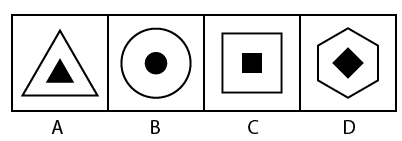
The task is to identify the figure that is different from the others based on a certain pattern or characteristic. Observing the shapes and their arrangements will help in determining the odd one out.
Correct Option: C) The inner square is not centered, unlike the other options.