
The question asks us to identify the truthfulness of two statements (A and B) related to the definitions and examples of strong and weak acids. We need to recall the definitions of strong and weak acids based on their ionization in water and the concentration of H⁺ ions produced.
Correct Option: A) Both A and B are true
A fraction when added to \( \frac{17}{3} \) gives 4. What is the said fraction?
\( \frac{-1}{1} \)
–1 \( \frac{2}{3} \)
\( \frac{9}{2} \)
\( \frac{2}{3} \)
To find the unknown fraction, we can set up an algebraic equation based on the given information. Let the unknown fraction be \(x\). The problem states that when this fraction is added to \( \frac{17}{3} \), the result is 4. We will solve this equation for \(x\).
Let the unknown fraction be \(x\). According to the problem statement:
\[ x + \frac{17}{3} = 4 \]To find \(x\), subtract \( \frac{17}{3} \) from both sides of the equation:
\[ x = 4 - \frac{17}{3} \]To subtract the fractions, we need a common denominator, which is 3. Convert 4 into a fraction with a denominator of 3:
\[ 4 = \frac{4 \times 3}{3} = \frac{12}{3} \]Now substitute this back into the equation for \(x\):
\[ x = \frac{12}{3} - \frac{17}{3} \]\[ x = \frac{12 - 17}{3} \]\[ x = \frac{-5}{3} \]The fraction \( \frac{-5}{3} \) can be written as a mixed number. Divide 5 by 3:
\[ 5 \div 3 = 1 \text{ with a remainder of } 2 \]So, \[\frac{5}{3} = 1 \frac{2}{3}\]. Therefore, \[\frac{-5}{3} = -1 \frac{2}{3}\].Correct Option: B) \( -1 \frac{2}{3} \)
The calculated fraction is \( \frac{-5}{3} \), which is equivalent to \( -1 \frac{2}{3} \).
The question asks to identify the recipient of the Florence Nightingale Award from former President Pranab Mukherjee in 2017. This is a factual question requiring knowledge of specific awards and their recipients.
A) Krishna Kumari — Ms. Krishna Kumari, a nursing officer from AIIMS, New Delhi, was indeed one of the recipients of the National Florence Nightingale Award in 2017, presented by former President Pranab Mukherjee.
The question asks for the SI unit of pressure. To answer this, we need to recall the definition of pressure and its standard unit in the International System of Units (SI).
Correct Option: C) Pascal. The Pascal (Pa) is the SI unit of pressure, defined as one Newton per square meter (\(1 \text{ Pa} = 1 \text{ N/m}^2\)).
Let α, β be the roots of ax² + bx + c = 0; γ, δ be the roots of px² + qx + r = 0; D₁, D₂ the respective discriminants of these equations. If α, β, γ, δ are in A.P., then find the value of D₁ : D₂.
\(\frac{a^2}{p^2}\)
\(\frac{a^2}{b^2}\)
\(\frac{b^2}{q^2}\)
\(\frac{c^2}{r^2}\)
We are given two quadratic equations with their roots and discriminants. The roots of both equations are in an arithmetic progression (A.P.). We need to find the ratio of their discriminants, \(D_1 : D_2\).
Let the four roots \(\alpha, \beta, \gamma, \delta\) be in A.P. We can represent them as \(a - 3d, a - d, a + d, a + 3d\) for some common difference \(2d\).
For the first equation \(ax^2 + bx + c = 0\), the roots are \(\alpha\) and \(\beta\). So, we have:
From Vieta's formulas:
The discriminant \(D_1\) is given by:
\[ D_1 = b^2 - 4ac \]We also know that \(D_1 = a^2 (\alpha - \beta)^2\). Substituting the values of \(\alpha\) and \(\beta\):
\[ D_1 = a^2 ((a - 3d) - (a - d))^2 = a^2 (-2d)^2 = a^2 (4d^2) = 4a^2 d^2 \]For the second equation \(px^2 + qx + r = 0\), the roots are \(\gamma\) and \(\delta\). So, we have:
From Vieta's formulas:
The discriminant \(D_2\) is given by:
\[ D_2 = q^2 - 4pr \]Similarly, \(D_2 = p^2 (\gamma - \delta)^2\). Substituting the values of \(\gamma\) and \(\delta\):
\[ D_2 = p^2 ((a + d) - (a + 3d))^2 = p^2 (-2d)^2 = p^2 (4d^2) = 4p^2 d^2 \]Now, we need to find the ratio \(D_1 : D_2\):
\[ \frac{D_1}{D_2} = \frac{4a^2 d^2}{4p^2 d^2} \]Assuming \(d \neq 0\) (otherwise all roots are equal, which is a trivial case where discriminants would be zero), we can cancel \(4d^2\):
\[ \frac{D_1}{D_2} = \frac{a^2}{p^2} \]Correct Option: A) \(\frac{a^2}{p^2}\)
In triangle ABC, AD ⊥ BC and AO is the bisector of ∠BAC. If ∠ABC = 65° and ∠ACB = 23\(\frac{1^\circ}{2}\), then ∠DAO is ______ (in degrees)
20\(\frac{1^\circ}{4}\)
20\(\frac{1^\circ}{5}\)
20\(\frac{1^\circ}{2}\)
20\(\frac{3^\circ}{4}\)
We need to find the measure of angle DAO. We are given a triangle ABC with AD perpendicular to BC and AO bisecting angle BAC. We are also given the measures of angle ABC and angle ACB. We will use the properties of triangles, specifically the sum of angles in a triangle and the definition of an angle bisector and altitude, to find the required angle.
In \(\triangle ABC\), the sum of angles is \(180^\circ\).
\[ \angle BAC + \angle ABC + \angle ACB = 180^\circ \]\[ \angle BAC + 65^\circ + 23\frac{1}{2}^\circ = 180^\circ \]\[ \angle BAC + 65^\circ + 23.5^\circ = 180^\circ \]\[ \angle BAC + 88.5^\circ = 180^\circ \]\[ \angle BAC = 180^\circ - 88.5^\circ \]\[ \angle BAC = 91.5^\circ \]AO is the bisector of \(\angle BAC\). Therefore,
\[ \angle OAC = \frac{1}{2} \angle BAC \]\[ \angle OAC = \frac{1}{2} \times 91.5^\circ \]\[ \angle OAC = 45.75^\circ \]AD \(\perp\) BC, so \(\triangle ADC\) is a right-angled triangle with \(\angle ADC = 90^\circ\).
In \(\triangle ADC\), the sum of angles is \(180^\circ\).
\[ \angle DAC + \angle ADC + \angle ACB = 180^\circ \]\[ \angle DAC + 90^\circ + 23.5^\circ = 180^\circ \]\[ \angle DAC + 113.5^\circ = 180^\circ \]\[ \angle DAC = 180^\circ - 113.5^\circ \]\[ \angle DAC = 66.5^\circ \]From the diagram, we can see that \(\angle DAC = \angle DAO + \angle OAC\).
Alternatively, \(\angle DAO = \angle DAC - \angle OAC\).
\[ \angle DAO = 66.5^\circ - 45.75^\circ \]\[ \angle DAO = 20.75^\circ \]\(0.75^\circ = \frac{3}{4}^\circ\).
So, \(\angle DAO = 20\frac{3}{4}^\circ\).
D) \(20\frac{3^\circ}{4}\) is the correct answer, as calculated in the step-by-step solution.
Find the mirror image of the given figure if the mirror is placed at line MN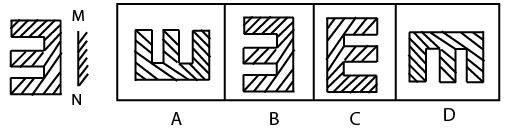
To find the mirror image of a figure, we need to visualize how the figure would appear if reflected across the given mirror line. In this case, the mirror is placed at line MN. The mirror image will have the same shape and size but flipped horizontally.
Correct Option: D) The figure is correctly mirrored across line MN.
_______ was the founder of the Lodhi dynasty?
Sultan Ibrahim
Ala-ud-din Lodhi
Ibrahim Lodhi
Bahlul Lodhi
The question asks to identify the founder of the Lodhi dynasty. This requires knowledge of the history of the Delhi Sultanate, specifically the succession and establishment of its various dynasties.
Correct Option: D) Bahlul Lodhi was the founder of the Lodhi dynasty. He established the dynasty in 1451, ending the Sayyid rule and initiating the last phase of the Delhi Sultanate before the advent of the Mughals.
The question asks about a specific historical sports event: the winner and runner-up of the Women's Asia Cup Hockey in 2017. To answer this, one needs to recall or know the results of that particular tournament.
Correct Option: C) The Indian Women's hockey team won the Asia Cup 2017 by defeating China in the final match. India beat China 5-4 in a penalty shootout after the game ended 1-1 in regulation time.
This problem involves calculating the total number of students in a class given the number of boys, the mean scores for boys and girls, and the overall mean score. We will use the formula for the overall mean, which is the sum of all scores divided by the total number of students.
Let the number of boys be \(N_B\) and the number of girls be \(N_G\).
Given: \(N_B = 18\)
Let the mean score of boys be \(M_B\) and the mean score of girls be \(M_G\).
Given: \(M_B = 12\)
Given: \(M_G = 14\)
Let the overall average score be \(M_{overall}\).
Given: \(M_{overall} = 13.1\)
The sum of scores for boys (\(S_B\)) can be calculated as:
\[ S_B = N_B \times M_B = 18 \times 12 = 216 \]The sum of scores for girls (\(S_G\)) can be calculated as:
\[ S_G = N_G \times M_G = N_G \times 14 = 14 N_G \]The total sum of scores for the class (\(S_{total}\)) is the sum of scores for boys and girls:
\[ S_{total} = S_B + S_G = 216 + 14 N_G \]The total number of students in the class (\(N_{total}\)) is the sum of the number of boys and girls:
\[ N_{total} = N_B + N_G = 18 + N_G \]The overall average score is given by the formula:
\[ M_{overall} = \frac{S_{total}}{N_{total}} \]Substitute the known values into the overall average formula:
\[ 13.1 = \frac{216 + 14 N_G}{18 + N_G} \]Now, solve for \(N_G\):
\[ 13.1 (18 + N_G) = 216 + 14 N_G \]\[ 13.1 \times 18 + 13.1 N_G = 216 + 14 N_G \]\[ 235.8 + 13.1 N_G = 216 + 14 N_G \]\[ 235.8 - 216 = 14 N_G - 13.1 N_G \]\[ 19.8 = 0.9 N_G \]\[ N_G = \frac{19.8}{0.9} \]\[ N_G = \frac{198}{9} \]\[ N_G = 22 \]The number of girls is 22.
The total number of students in the class is \(N_{total} = N_B + N_G\):
\[ N_{total} = 18 + 22 = 40 \]D) 40