
The question asks for the absolute refractive index of diamond. This is a standard value that is typically memorized in physics and optics for competitive exams. The refractive index is a measure of how much the speed of light is reduced when passing through a medium compared to its speed in a vacuum.
C) 2.42 is the correct absolute refractive index of diamond. This high value is responsible for diamond's characteristic brilliance and dispersion (splitting of white light into its constituent colors).
The question asks to identify the author of "Harshacharitra", a significant historical work providing information about Emperor Harsha and his administration. This requires knowledge of ancient Indian literature and history.
Correct Option: D) Banabhatta
Banabhatta was a 7th-century Sanskrit prose writer and poet in the court of King Harsha Vardhana, who ruled from Kannauj. His most important work, the "Harshacharitra" (Deeds of Harsha), is a biography of Harsha and a significant historical source providing detailed insights into Harsha's life, reign, and the administration of his empire. It is considered one of the earliest historical biographies in Sanskrit.
The problem asks us to identify the wrong term in a given series of numbers. We need to analyze the pattern or relationship between the numbers in the series to find the term that does not fit.
Correct Option: C) 342
This question tests general knowledge about the Union Cabinet ministers in India during a specific period. To answer correctly, one needs to recall who held the portfolio of Union Minister of Agriculture and Farmers Welfare as of August 2018.
Correct Option: B) Radha Mohan Singh was the Union Minister of Agriculture and Farmers Welfare as of August 2018.
The question asks for the location where India conducted its first nuclear device test. This is a factual question related to India's nuclear program history. We need to identify the correct test site among the given options.
Correct Option: C) Pokhran
India's first nuclear device was tested at the Pokhran Test Range in Rajasthan on May 18, 1974. This operation was officially described as a "peaceful nuclear explosion" and was codenamed "Smiling Buddha."
Which figure follows next?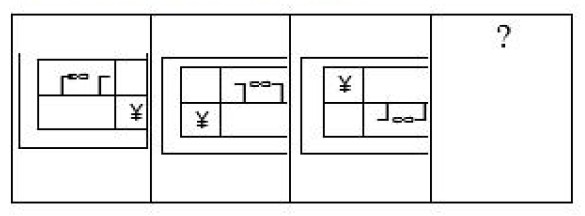
Option Figures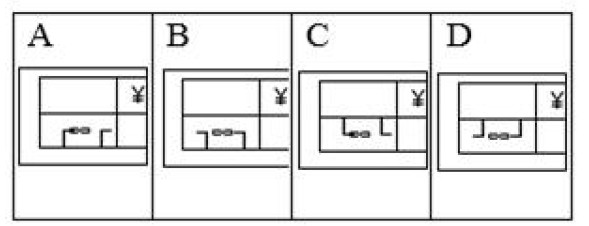
To solve this problem, we need to identify the pattern in the sequence of figures and determine which option continues the pattern correctly.
Correct Option: B) The pattern of movement in the sequence is correctly continued in this option.
Find the value of \(\sqrt{4.2436}\)
To find the square root of a decimal number, we can use the long division method or convert the decimal to a fraction, find the square root of the numerator and denominator, and then convert it back to a decimal. A quicker way for competitive exams is to examine the last digit of the number and the options, or to square the options to see which one matches the given number.
Examine the last digit: The given number is \(4.2436\). The last digit is \(6\). When a number is squared, its last digit is determined by the last digit of the original number. For example:
Looking at the options:
This method helps eliminate options if their last digit doesn't match, but here, all options result in a last digit of \(6\) when squared.
Estimate the value: We know that \(2^2 = 4\) and \(3^2 = 9\). Since \(4.2436\) is slightly greater than \(4\), its square root must be slightly greater than \(2\). All options (\(2.04, 2.14, 2.06, 2.16\)) fit this criterion.
Square the options: This is a reliable method for multiple-choice questions.
A) \((2.04)^2\):
\[\begin{aligned} (2.04)^2 &= (2 + 0.04)^2 \ &= 2^2 + 2(2)(0.04) + (0.04)^2 \ &= 4 + 0.16 + 0.0016 \ &= 4.1616 \end{aligned}\]This is not \(4.2436\).
B) \((2.14)^2\):
\[\begin{aligned} (2.14)^2 &= (2.1 + 0.04)^2 \ &= (2.1)^2 + 2(2.1)(0.04) + (0.04)^2 \ &= 4.41 + 0.168 + 0.0016 \ &= 4.5796 \end{aligned}\]This is not \(4.2436\).
C) \((2.06)^2\):
\[\begin{aligned} (2.06)^2 &= (2 + 0.06)^2 \ &= 2^2 + 2(2)(0.06) + (0.06)^2 \ &= 4 + 0.24 + 0.0036 \ &= 4.2436 \end{aligned}\]This matches the given number.
D) \((2.16)^2\):
\[\begin{aligned} (2.16)^2 &= (2.1 + 0.06)^2 \ &= (2.1)^2 + 2(2.1)(0.06) + (0.06)^2 \ &= 4.41 + 0.252 + 0.0036 \ &= 4.6656 \end{aligned}\]This is not \(4.2436\).
Therefore, \(\sqrt{4.2436} = 2.06\).
C) \(2.06\) is correct because \((2.06)^2 = 4.2436\).
To calculate the concentration of a solution in terms of mass by mass percentage, we need to determine the mass of the solute and the total mass of the solution. The formula for mass by mass percentage is the mass of the solute divided by the mass of the solution, multiplied by 100.
C) 15 % is the correct concentration of the solution in terms of mass by mass percentage.
______ double bond(s) is/are present in one molecule of Benzene.
The question asks about the number of double bonds in a single molecule of Benzene. To answer this, we need to recall the chemical structure of Benzene.
Therefore, a molecule of Benzene contains 3 double bonds.
Correct Option: A) 3 double bonds are present in one molecule of Benzene, as depicted in its Kekulé structure.
The question asks to identify the founder of the Sun TV Network. This is a factual question related to prominent Indian media personalities and their ventures. Recalling the founders of major media houses is key.
Correct Option: A) Kalanithi Maran is the founder and chairman of the Sun Group, which established the Sun TV Network in 1993. He is a prominent media baron and the son of former Union Minister Murasoli Maran.