
The problem asks for the age of S three years from now. To find this, we first need to determine S's current age. We will evaluate each statement individually and then together to see if they provide enough information to calculate S's current age, and subsequently, S's age in three years.
Analyze the Question: We need to find S's age 3 years from now. Let S's current age be \(S_{\text{current}}\). Then, S's age 3 years from now will be \(S_{\text{current}} + 3\).
Evaluate Statement 1: "M is 25 years old today."
Evaluate Statement 2: "S is younger than M by 10 years."
Evaluate Statements 1 and 2 together:
Correct Option: D) Statements 1 and 2 together are necessary
To determine which number has an irrational square root, we need to find the square root of each given number. If the square root is an integer, the number is a perfect square, and its square root is rational. If the square root is not an integer, it is irrational. A common method to find square roots of large numbers ending in 25 is to observe the pattern: if a number ends in 25, its square root will end in 5. We can then find the number whose product with the next consecutive integer equals the number formed by removing '25' from the original number.
Only 18025 does not yield an integer square root, meaning its square root is irrational.
Correct Option: B) 18025
You are given a question and three statements. Identify which of the statements is/are necessary/sufficient to answer the question. Question:
K, F, M and T are standing in a queue. Based on the following information, can we tell who is standing in the second place if we arrange shortest to tallest?
Statements:
1. F is the tallest.
2. K is taller than T.
3. T is the shortest.
Statements 1 and 2 together are sufficient
Statements 1 and 3 are sufficient to solve.
The statements are insufficient.
Statements 1, 2, 3 alone are enough to solve
We need to determine if we can uniquely identify the person standing in the second place when arranged from shortest to tallest, using the given statements. We will analyze each statement and their combinations to see if a definitive order can be established.
Analyze Statement 1: F is the tallest.
Analyze Statement 2: K is taller than T.
Analyze Statement 3: T is the shortest.
Combine Statements 1 and 2: F is the tallest, K is taller than T.
Combine Statements 1 and 3: F is the tallest, T is the shortest.
Combine Statements 2 and 3: K is taller than T, T is the shortest.
Combine Statements 1, 2, and 3: F is the tallest, K is taller than T, T is the shortest.
Correct Option: C) The statements are insufficient.
This problem involves ratios and algebraic equations. We are given an initial ratio of red balls to green balls. Then, a change occurs (more green balls are added), leading to a new ratio. We need to find the original number of red balls. We will set up variables for the number of red and green balls, form equations based on the given ratios, and solve for the unknown.
Define variables based on the initial ratio:
Let the number of red balls be \(R\) and the number of green balls be \(G\). The initial ratio of red balls to green balls is 15 : 26.
So, we can write:
\[ \frac{R}{G} = \frac{15}{26} \]Express \(R\) and \(G\) in terms of a common multiplier:
From the ratio, we can assume that for some constant \(x\):
Formulate the equation after adding green balls:
If 12 more green balls are added, the new number of green balls will be \(G' = G + 12 = 26x + 12\). The number of red balls remains unchanged, \(R = 15x\).
The new ratio of red balls to green balls is 1 : 2.
So, we can write:
\[ \frac{R}{G'} = \frac{1}{2} \]\[ \frac{15x}{26x + 12} = \frac{1}{2} \]Solve the equation for \(x\):
Cross-multiply the equation:
\[ 2 \times (15x) = 1 \times (26x + 12) \]\[ 30x = 26x + 12 \]Isolate \(x\):
Subtract \(26x\) from both sides:
\[ 30x - 26x = 12 \]\[ 4x = 12 \]Calculate \(x\):
Divide by 4:
\[ x = \frac{12}{4} \]\[ x = 3 \]Find the number of red balls:
The number of red balls is \(R = 15x\).
Substitute the value of \(x\):
\[ R = 15 \times 3 \]\[ R = 45 \]Thus, there are 45 red balls in the bag.
Correct Option: B) 45
This question tests knowledge of Mendel's experimental procedures in genetics. Specifically, it asks about the method Mendel used to obtain the F2 generation from the F1 generation plants.
Correct Option: D) Self-pollination
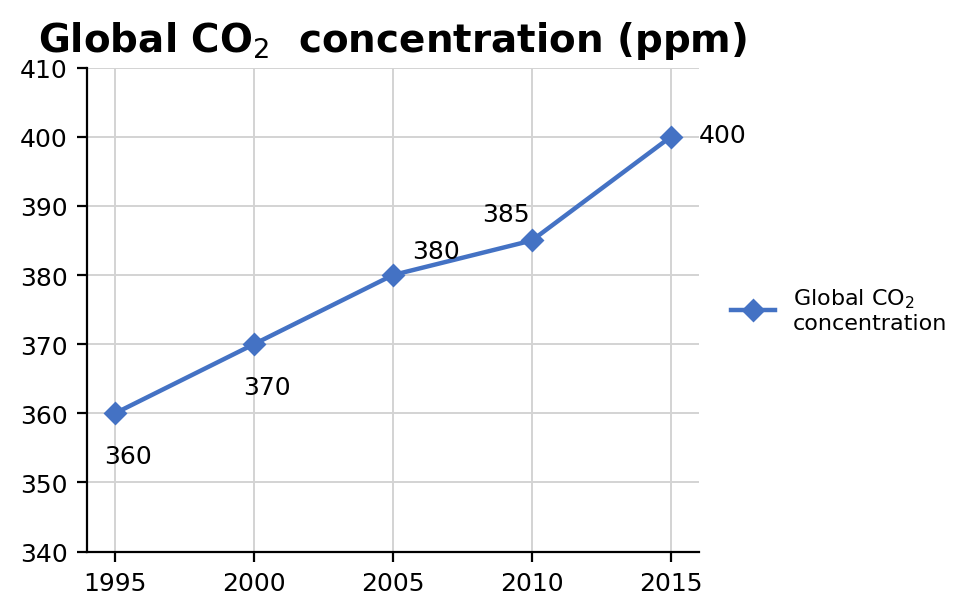
Based on the given graph, what is the percentage change in CO₂ concentration from year 1995 to 2015?
To find the percentage change in CO₂ concentration from 1995 to 2015, we need to use the formula for percentage change based on the initial and final values observed from the graph.
Correct Option: D) 11.11 %
This question tests the understanding of the reactivity series of metals and displacement reactions. A more reactive metal can displace a less reactive metal from its salt solution.
Correct Option: A) more reactive than copper
The question asks to identify the Indian woman cricketer who achieved the milestone of 200 ODI wickets in 2018. This requires knowledge of prominent Indian women cricketers and their career milestones.
Correct Option: D) Jhulan Goswami — Jhulan Goswami is an Indian cricketer who, in February 2018, became the first woman in the world to claim 200 wickets in One Day International (ODI) cricket. This achievement solidified her status as one of the greatest bowlers in women's cricket history.
The question asks to identify the supersonic missile successfully test-fired by the Indian Navy in 2017. This requires knowledge of India's missile programs and significant test events.
Correct Option: C) BrahMos is the supersonic cruise missile that was successfully test-fired by the Indian Navy in 2017. It is a joint venture between India's DRDO and Russia's NPO Mashinostroyeniya.
The question asks to identify the Indian state where local thunderstorms are known as "mango showers" and are beneficial for ripening mango crops. This is a geography-based question related to local weather phenomena and their regional names.
D) Kerala — In Kerala and coastal Karnataka, these pre-monsoon showers are locally known as "mango showers" because they help in the ripening of mangoes.