
The question asks about the primary components that form the hard matrix of bone tissue. Bone is a specialized connective tissue that provides structural support and protection. Its hardness and rigidity are due to the extracellular matrix, which is extensively mineralized.
D) Ca and P — Calcium (Ca) and Phosphorus (P) are the primary mineral components of the hard matrix of bone, forming calcium phosphate crystals (hydroxyapatite) which provide rigidity and strength.
This problem involves substituting given symbol transformations into a mathematical expression and then evaluating the expression using the standard order of operations (BODMAS/PEMDAS).
The original expression is \((25 < 15) × 4 < 1\).
Substituting the new operations, we get:
\[ (25 + 15) \div 4 + 1 \]First, solve the operation inside the parentheses:
\[ (25 + 15) = 40 \]Now, the expression becomes:
\[ 40 \div 4 + 1 \]Next, perform the division operation:
\[ 40 \div 4 = 10 \]Finally, perform the addition operation:
\[ 10 + 1 = 11 \]Correct Option: A) 11
Last year, Mayank’s capital investment in a small business venture was Rs 20,000. This year, to cater to a new customer base, he is planning to increase the capital funding by 30% over what he had invested last year. How much money is he planning to invest this year?
The problem asks us to calculate the new capital investment after a percentage increase. We need to find 30% of the original investment and then add it to the original investment to find the total new investment.
Last year's investment = Rs 20,000
Percentage increase = 30%
The increase in investment is 30% of Rs 20,000.
\[ \text{Increase amount} = 30\% \times 20,000 \]\[ \text{Increase amount} = \frac{30}{100} \times 20,000 \]\[ \text{Increase amount} = 30 \times 200 \]\[ \text{Increase amount} = 6,000 \]The new investment will be the initial investment plus the increase amount.
\[ \text{New investment} = \text{Initial investment} + \text{Increase amount} \]\[ \text{New investment} = 20,000 + 6,000 \]\[ \text{New investment} = 26,000 \]So, Mayank is planning to invest Rs 26,000 this year.
Correct Option: D) 26,000
This question requires converting a power value from Watts (W) to kilowatts (kW). The key is to understand the relationship between these two units, specifically that "kilo" represents a factor of 1000.
D) 2.5 is the correct answer because 2500 Watts divided by 1000 equals 2.5 kilowatts.
The question asks to identify the material commonly used in electrical heating devices. This requires knowledge of the properties of different materials, specifically their electrical resistance and melting points, which are crucial for heating applications.
B) Nichrome — Nichrome is an alloy of nickel and chromium known for its high electrical resistivity, high melting point, and resistance to oxidation at high temperatures. These characteristics make it an excellent choice for heating elements in devices like toasters, electric kettles, and heaters.
A boy is observing a hot air balloon flying at 692 m above ground. The angle of elevation of the balloon from the eyes of the boy was 60°. After some time, the balloon moves away horizontally from the boy and the angle reduces to 30°. What is the approximate distance travelled by the balloon? (Take \(\sqrt{3}\)=1.73)
This problem involves trigonometry, specifically the tangent function, to calculate distances based on angles of elevation. We'll use two right-angled triangles formed by the boy's position, the balloon's initial position, and the balloon's final position, along with the given height and angles of elevation.
Define variables and initial setup:
Let \(H\) be the height of the balloon from the ground, which is 692 m.
Let the boy's eye level be at point A. Let the initial position of the balloon be B and the final position be C. Let D be the point directly below B on the ground, and E be the point directly below C on the ground. The height of the balloon from the boy's eye level will be \(H\). (Assuming the boy's height is negligible or the given height is already from his eye level, which is standard in such problems unless specified otherwise).
In the first scenario, the angle of elevation from the boy's eye (A) to the balloon (B) is 60°.
In the second scenario, the balloon moves horizontally to C, and the angle of elevation from A to C is 30°.
We need to find the horizontal distance travelled by the balloon, which is the distance between the initial horizontal position and the final horizontal position, i.e., \(DE\) or \(BC'\) if we project B and C horizontally from the boy's eye level.
Let \(AD\) be the initial horizontal distance from the boy to the point directly below the balloon, and \(AE\) be the final horizontal distance.
The height of the balloon from the boy's eye level is \(BD = CE = 692 \text{ m}\).
Calculate the initial horizontal distance (\(AD\)):
In the right-angled triangle \(\triangle ABD\):
\[ \tan(60^\circ) = \frac{BD}{AD} \]\[ \sqrt{3} = \frac{692}{AD} \]\[ AD = \frac{692}{\sqrt{3}} \]Calculate the final horizontal distance (\(AE\)):
In the right-angled triangle \(\triangle ACE\):
\[ \tan(30^\circ) = \frac{CE}{AE} \]\[ \frac{1}{\sqrt{3}} = \frac{692}{AE} \]\[ AE = 692 \sqrt{3} \]Calculate the distance travelled by the balloon:
The distance travelled horizontally by the balloon is \(DE = AE - AD\).
\[ DE = 692 \sqrt{3} - \frac{692}{\sqrt{3}} \]\[ DE = 692 \left( \sqrt{3} - \frac{1}{\sqrt{3}} \right) \]\[ DE = 692 \left( \frac{3 - 1}{\sqrt{3}} \right) \]\[ DE = 692 \left( \frac{2}{\sqrt{3}} \right) \]\[ DE = \frac{1384}{\sqrt{3}} \]Substitute the value of \(\sqrt{3}\) and calculate:
Given \(\sqrt{3} = 1.73\).
\[ DE = \frac{1384}{1.73} \]\[ DE \approx 800 \text{ m} \]Correct Option: B) 800 m
To find the square root of 4356, we can use either the prime factorization method or the long division method. Alternatively, we can estimate the square root by looking at the last digit and the range of squares, then verify with the given options.
B) 66 is the correct answer because \(66 \times 66 = 4356\).
Based on the given Venn diagram, answer the following question.
A - People who are efficient
B - People who are honest
C - People who are hard-working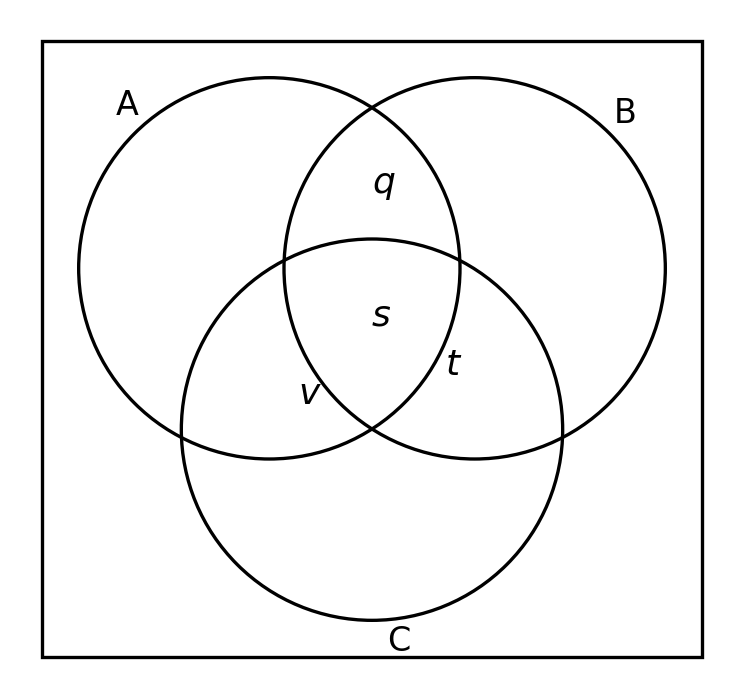
Which segment represents people who are only hardworking but not honest or efficient?
The question asks us to identify the segment in the Venn diagram that represents people who are only hardworking but not honest or efficient. We need to analyze the diagram and understand which segment corresponds to this description.
Correct Option: A) c – (v + s + t)
This is an analogy question. We need to identify the relationship between the first pair of words (Trees : Plants) and then apply the same relationship to the third word (Desert) to find the fourth word.
Correct Option: D) Land
The question asks to identify a key feature of the Insolvency and Bankruptcy Code (Amendment) Ordinance, 2018. This requires knowledge of the specific changes introduced by that ordinance to the Insolvency and Bankruptcy Code (IBC), 2016.
Correct Option: A) Relief to home buyers by recognising their status as financial creditors. This was a landmark provision introduced by the Insolvency and Bankruptcy Code (Amendment) Ordinance, 2018, to protect the interests of home buyers by elevating their status to that of financial creditors, thereby giving them representation in the Committee of Creditors.