
If 2x2 + ax + 2b, when divided by x − 1, leaves a remainder of 16 and x2 + bx + 2a, when divided by x + 1, leaves a remainder of –1, then a+b equals:
This problem involves the application of the Remainder Theorem. The Remainder Theorem states that if a polynomial \(P(x)\) is divided by \(x - c\), the remainder is \(P(c)\). We will use this theorem to form two linear equations in terms of 'a' and 'b' and then solve them simultaneously to find the values of 'a' and 'b', and subsequently \(a+b\).
Let \(P(x) = 2x^2 + ax + 2b\). When \(P(x)\) is divided by \(x - 1\), the remainder is 16.
According to the Remainder Theorem, \(P(1) = 16\).
\[ 2(1)^2 + a(1) + 2b = 16 \]\[ 2 + a + 2b = 16 \]\[ a + 2b = 14 \quad \text{(Equation 1)} \]Let \(Q(x) = x^2 + bx + 2a\). When \(Q(x)\) is divided by \(x + 1\), the remainder is -1.
According to the Remainder Theorem, \(Q(-1) = -1\).
\[ (-1)^2 + b(-1) + 2a = -1 \]\[ 1 - b + 2a = -1 \]\[ 2a - b = -2 \quad \text{(Equation 2)} \]We have two equations:
1) \(a + 2b = 14\)
2) \(2a - b = -2\)
Multiply Equation 2 by 2:
\[ 2 \times (2a - b) = 2 \times (-2) \]\[ 4a - 2b = -4 \quad \text{(Equation 3)} \]Adding the two equations will eliminate 'b'.
\[ (a + 2b) + (4a - 2b) = 14 + (-4) \]\[ 5a = 10 \]\[ a = \frac{10}{5} \]\[ a = 2 \]Using Equation 1: \(a + 2b = 14\)
Substitute \(a = 2\):
\[ 2 + 2b = 14 \]\[ 2b = 14 - 2 \]\[ 2b = 12 \]\[ b = \frac{12}{2} \]\[ b = 6 \]Now that we have \(a = 2\) and \(b = 6\), we can find \(a+b\).
\[ a + b = 2 + 6 \]\[ a + b = 8 \]Correct Option: D) 8
To solve this problem, we need to follow the order of operations, often remembered by the acronym BODMAS/PEMDAS (Brackets/Parentheses, Orders/Exponents, Division and Multiplication (from left to right), Addition and Subtraction (from left to right)). We will evaluate the innermost brackets first and work our way outwards.
First, evaluate the expression inside the innermost parentheses: \((45 - 56 \div 7 \times 4)\).
According to BODMAS, division comes before multiplication.
\[ 56 \div 7 = 8 \]Now, substitute this value back into the expression:
\[ 45 - 8 \times 4 \]Next, perform the multiplication:
\[ 8 \times 4 = 32 \]Substitute this back:
\[ 45 - 32 = 13 \]Now, substitute this result back into the curly braces: \(\{29 - (13)\}\).
\[ 29 - 13 = 16 \]Substitute this result back into the square brackets: \([68 - \{16\}]\).
\[ 68 - 16 = 52 \]Finally, perform the last division:
\[ 104 \div 52 \]Calculate the division:
\[ 104 \div 52 = 2 \]Correct Option: B) The final result of the calculation is 2.
The modern periodic table arranges elements based on their atomic number. The period number corresponds to the principal energy level (shell) that is being filled with electrons. To determine the period for a given range of atomic numbers, we need to understand the electron configuration and the filling order of shells.
Correct Option: A) Elements with atomic numbers 19 to 36 are placed in the 4th period. This is because the filling of the 4s, 3d, and 4p orbitals occurs in this period, and the highest principal energy level for these elements is 4.
If a + \( \frac{1}{a} \) = -6, find the value of a3 + \( \frac{1}{a^3} \)
The problem asks us to find the value of \(a^3 + \frac{1}{a^3}\) given the equation \(a + \frac{1}{a} = -6\). We can solve this by cubing both sides of the given equation and using the algebraic identity for the cube of a sum: \((x+y)^3 = x^3 + y^3 + 3xy(x+y)\).
We are given the equation:
\[ a + \frac{1}{a} = -6 \]Cube both sides of the equation:
\[ \left(a + \frac{1}{a}\right)^3 = (-6)^3 \]Apply the algebraic identity \((x+y)^3 = x^3 + y^3 + 3xy(x+y)\) to the left side. Here, \(x=a\) and \(y=\frac{1}{a}\):
\[ a^3 + \left(\frac{1}{a}\right)^3 + 3 \cdot a \cdot \frac{1}{a} \left(a + \frac{1}{a}\right) = (-6)^3 \]Simplify the expression:
\[ a^3 + \frac{1}{a^3} + 3 \cdot 1 \cdot \left(a + \frac{1}{a}\right) = -216 \]\[ a^3 + \frac{1}{a^3} + 3\left(a + \frac{1}{a}\right) = -216 \]Substitute the given value \(a + \frac{1}{a} = -6\) into the simplified equation:
\[ a^3 + \frac{1}{a^3} + 3(-6) = -216 \]\[ a^3 + \frac{1}{a^3} - 18 = -216 \]Isolate \(a^3 + \frac{1}{a^3}\) by adding 18 to both sides:
\[ a^3 + \frac{1}{a^3} = -216 + 18 \]\[ a^3 + \frac{1}{a^3} = -198 \]Correct Option: B) -198
Which of the options bears the closest resemblance to the following figure?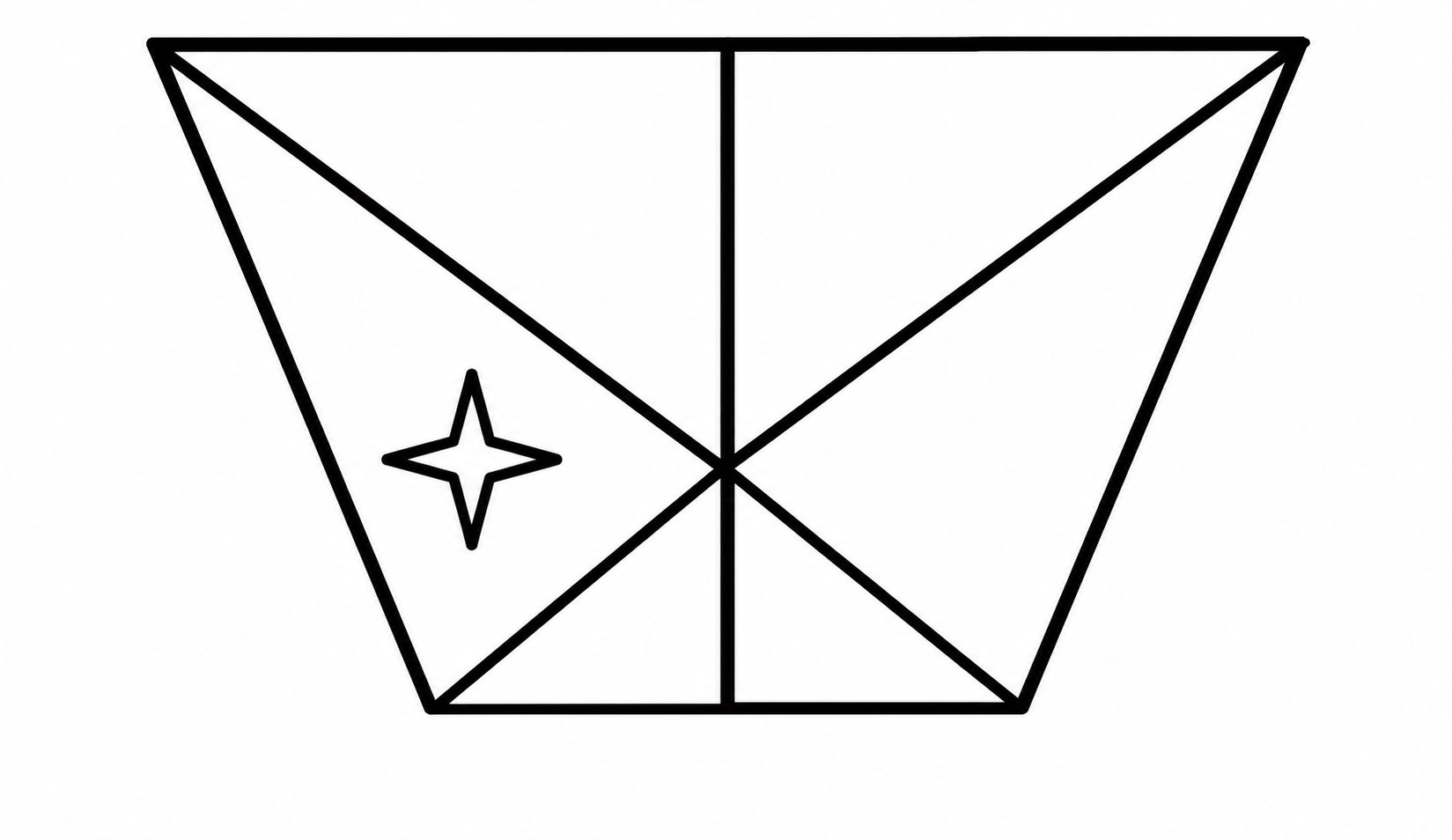
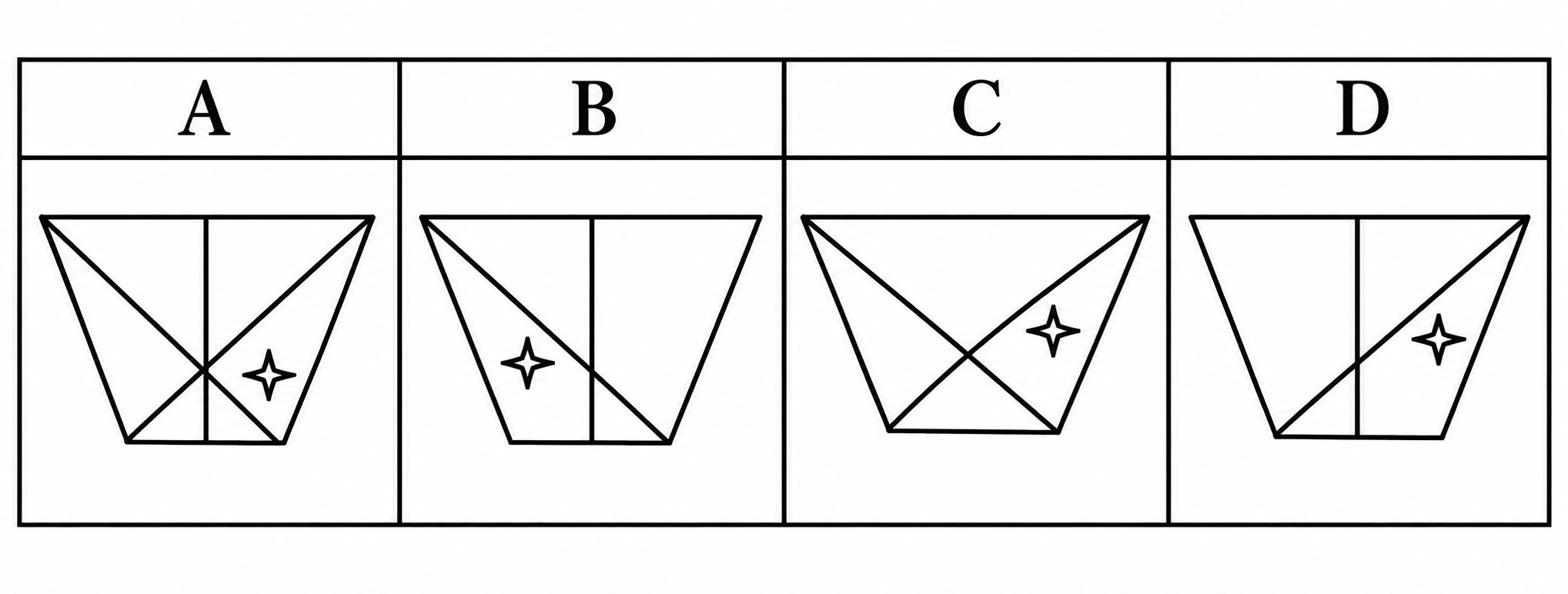
The task is to identify which option most closely resembles the given figure. The figure consists of a trapezoidal shape divided into triangular sections with a star pattern in one section.
Correct Option: A) The figure in option A exactly matches the original figure in terms of the division of sections and the position of the star pattern.
This problem involves work and time. We need to find the individual time taken by A, B, and C to complete a task. We are given the time taken by pairs (A+B, B+C, C+A) to complete the task. We can use the concept of work rates (reciprocal of time taken) to solve this problem.
Let the time taken by A, B, and C to complete the task individually be \(a\), \(b\), and \(c\) days respectively. Their one-day work rates will be \(\frac{1}{a}\), \(\frac{1}{b}\), and \(\frac{1}{c}\) respectively.
From the given information, we can form the following equations based on their combined one-day work rates:
A and B together complete the task in 50 days:
\[ \frac{1}{a} + \frac{1}{b} = \frac{1}{50} \quad \text{(Equation 1)} \]B and C together complete the task in 37.5 days (which is \(\frac{75}{2}\) days):
\[ \frac{1}{b} + \frac{1}{c} = \frac{1}{37.5} = \frac{2}{75} \quad \text{(Equation 2)} \]C and A together complete the task in 30 days:
\[ \frac{1}{c} + \frac{1}{a} = \frac{1}{30} \quad \text{(Equation 3)} \]Add Equation 1, Equation 2, and Equation 3:
\[ \left(\frac{1}{a} + \frac{1}{b}\right) + \left(\frac{1}{b} + \frac{1}{c}\right) + \left(\frac{1}{c} + \frac{1}{a}\right) = \frac{1}{50} + \frac{2}{75} + \frac{1}{30} \]\[ 2\left(\frac{1}{a} + \frac{1}{b} + \frac{1}{c}\right) = \frac{3}{150} + \frac{4}{150} + \frac{5}{150} \]\[ 2\left(\frac{1}{a} + \frac{1}{b} + \frac{1}{c}\right) = \frac{3+4+5}{150} = \frac{12}{150} = \frac{2}{25} \]Divide by 2 to find the combined one-day work rate of A, B, and C:
\[ \frac{1}{a} + \frac{1}{b} + \frac{1}{c} = \frac{1}{25} \quad \text{(Equation 4)} \]Now, subtract each of the original equations (1, 2, 3) from Equation 4 to find the individual work rates:
To find \(\frac{1}{c}\) (C's one-day work): Subtract Equation 1 from Equation 4:
\[ \left(\frac{1}{a} + \frac{1}{b} + \frac{1}{c}\right) - \left(\frac{1}{a} + \frac{1}{b}\right) = \frac{1}{25} - \frac{1}{50} \]\[ \frac{1}{c} = \frac{2}{50} - \frac{1}{50} = \frac{1}{50} \]So, C takes 50 days to complete the task individually.To find \(\frac{1}{a}\) (A's one-day work): Subtract Equation 2 from Equation 4:
\[ \left(\frac{1}{a} + \frac{1}{b} + \frac{1}{c}\right) - \left(\frac{1}{b} + \frac{1}{c}\right) = \frac{1}{25} - \frac{2}{75} \]\[ \frac{1}{a} = \frac{3}{75} - \frac{2}{75} = \frac{1}{75} \]So, A takes 75 days to complete the task individually.To find \(\frac{1}{b}\) (B's one-day work): Subtract Equation 3 from Equation 4:
\[ \left(\frac{1}{a} + \frac{1}{b} + \frac{1}{c}\right) - \left(\frac{1}{c} + \frac{1}{a}\right) = \frac{1}{25} - \frac{1}{30} \]\[ \frac{1}{b} = \frac{6}{150} - \frac{5}{150} = \frac{1}{150} \]So, B takes 150 days to complete the task individually.Thus, A, B, and C take 75, 150, and 50 days respectively to complete the task individually.
Correct Option: C) 75, 150 and 50
A shop consumed 250 units of energy in a month. How much energy was consumed in joules?
To convert energy consumed from units (kilowatt-hours) to joules, we need to know the conversion factor between kilowatt-hours and joules. One unit of energy in the context of electricity consumption typically refers to 1 kilowatt-hour (kWh).
C) 9×10 8 J is the correct answer, as calculated above.
The two roots of a quadratic equation are given as x = \( \frac{4}{3} \) and x = \( \frac{-3}{7} \). The equation can be written as:
(7x−3)(3x−4)=0
(7x+3)(3x−4)=0
(7x+3)(3x+4)=0
(7x−3)(3x+4)=0
The problem asks us to find the quadratic equation given its two roots. If \(x_1\) and \(x_2\) are the roots of a quadratic equation, then the equation can be written in factored form as \((x - x_1)(x - x_2) = 0\). We will substitute the given roots into this form and then simplify to match one of the options.
The two roots are given as \(x_1 = \frac{4}{3}\) and \(x_2 = \frac{-3}{7}\).
Using the general factored form \((x - x_1)(x - x_2) = 0\), substitute the given roots:
\[ \left(x - \frac{4}{3}\right) \left(x - \left(\frac{-3}{7}\right)\right) = 0 \]\[ \left(x - \frac{4}{3}\right) \left(x + \frac{3}{7}\right) = 0 \]To eliminate the fractions and obtain factors with integer coefficients, multiply each term inside the first parenthesis by 3 and each term inside the second parenthesis by 7. This is equivalent to multiplying the entire equation by \(3 \times 7 = 21\), which does not change the roots.
\[ 3 \left(x - \frac{4}{3}\right) \times 7 \left(x + \frac{3}{7}\right) = 0 \]\[ (3x - 3 \times \frac{4}{3}) (7x + 7 \times \frac{3}{7}) = 0 \]\[ (3x - 4) (7x + 3) = 0 \]The order of multiplication does not matter, so \((3x - 4)(7x + 3) = 0\) is the same as \((7x + 3)(3x - 4) = 0\).
Correct Option: B) (7x+3)(3x−4)=0
This option would imply roots \(x = \frac{3}{7}\) and \(x = \frac{4}{3}\). The second root matches, but the first root is incorrect (it should be \(-\frac{3}{7}\)).
This option would imply roots \(x = -\frac{3}{7}\) and \(x = -\frac{4}{3}\). The first root matches, but the second root is incorrect (it should be \(\frac{4}{3}\)).
This option would imply roots \(x = \frac{3}{7}\) and \(x = -\frac{4}{3}\). Neither of these roots matches the given roots.
The question asks about the field for which Usha Uthup received the Padma Shri award. This requires knowledge of prominent Indian personalities and their contributions, specifically in the context of national awards like the Padma Shri.
C) Arts — Usha Uthup is a renowned Indian singer, and her contributions to music are recognized under the category of Arts. She was awarded the Padma Shri in 2011 for her distinguished service in this field.
The question asks to identify the Indian state to which political leader Pyarimohan Mohapatra belonged. This requires knowledge of prominent political figures and their regional affiliations in India.
Correct Option: D) Odisha